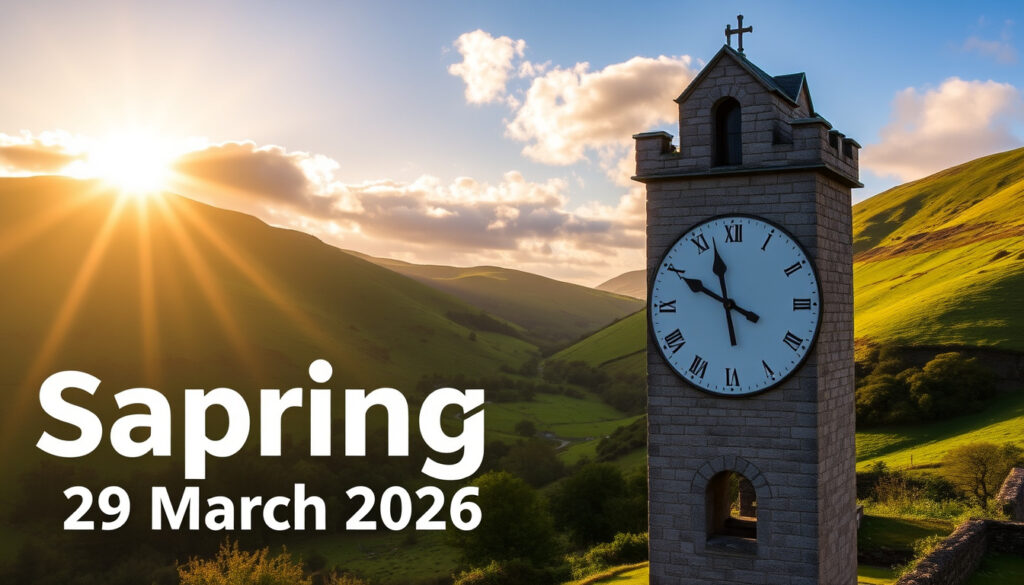
Day Light Saving 2026 in Ireland: Forward 29 March, Back 25 Oct
Every year, the same Sunday sneaks up on Irish households: the weekend you meant to sleep in, but your alarm went off an hour early. If you’re wondering whether the clocks shift in 2026—and when—you’re not alone. The good news is that Ireland’s change dates are locked in by EU directive, and they follow the same calendar each year.
Clocks go forward: 29 March 2026 ·
Clocks go back: 25 October 2026 ·
Forward time: 1am to 2am ·
Backward time: 2am to 1am ·
Sunrise shift back: 1 hour earlier on 25 Oct
Quick snapshot
The key dates, times, and official sources are summarized in the table below.
| Detail | Value | Source |
|---|---|---|
| Forward Date | 29 March 2026 | time.now |
| Back Date | 25 October 2026 | RTE |
| Forward Time | 1am to 2am | time.now |
| Back Time | 2am to 1am | time.now |
| Summer Timezone | IST UTC+01:00 | Wikipedia |
| Winter Timezone | GMT UTC+00:00 | Wikipedia |
When do clocks change in Ireland?
Ireland follows the EU-wide Daylight Saving Time schedule, switching clocks twice a year on the last Sunday of March and the last Sunday of October. This applies uniformly to all four provinces—Connacht, Leinster, Munster, and Ulster.
Spring forward date
In 2026, clocks spring forward on Sunday, 29 March. The change happens at 1am local time, when the hour jumps from 00:59 directly to 02:00. This marks the shift from Greenwich Mean Time (GMT, UTC+00:00) to Irish Standard Time (IST, UTC+01:00).
You lose one hour of sleep that Sunday morning, but gain an extra hour of evening daylight through the summer months.
Autumn back date
Clocks fall back on Sunday, 25 October 2026. At 2am, the hour rolls back to 1am, returning Ireland to GMT. The result is more light in the mornings as winter approaches.
What date do clocks forward in 2026?
The date is fixed: 29 March 2026. Under current EU law, all member states shift to summer time on the last Sunday in March and back to standard time on the last Sunday in October. Ireland has followed this pattern since 1916, with one break between 1968 and 1972.
Exact time of change
The spring forward happens at precisely 1am on 29 March 2026. After the change, sunrise and sunset occur roughly one hour later than the day before, extending daylight into the evenings.
Impact on daily life
The shift means brighter evenings but darker mornings. Phones and laptops typically auto-adjust, but stand-alone devices like alarm clocks, thermostats, and some older appliances may need a manual update.
Will clocks go forward in 2026 in Ireland?
Yes, clocks go forward in Ireland on 29 March 2026. This has been confirmed by multiple Irish sources, including RTE and time services that track clock changes across Europe.
Confirmation from sources
RTE, Ireland’s national broadcaster, explicitly states that clocks spring forward by one hour at 1am on the last Sunday of March. The time.now service, which aggregates international clock-change data, confirms the date as 29 March 2026.
Sunrise and sunset shifts
After the spring forward on 29 March 2026, sunrise and sunset both shift about one hour later. The practical effect: darker mornings but extended daylight in the evenings until October.
Do the clocks go back on 26 October?
No—the clocks go back on 25 October 2026, not 26 October. The correct date is the last Sunday in October, which falls on the 25th in 2026.
2026 back date
The autumn change happens at 2am on Sunday, 25 October 2026. The hour from 2:00 to 2:59 is repeated, effectively giving you an extra hour of sleep that morning.
Time adjustment
After the change, clocks revert to GMT (UTC+00:00). Sunrise comes roughly one hour earlier, giving morning commuters and schoolchildren more natural light.
Do I lose an hour of sleep on Sunday?
When clocks spring forward in March, you do lose an hour of sleep—that Sunday morning, your alarm goes off one hour earlier than usual. The flip side is that the following evenings have extra daylight.
Forward day effects
The March change briefly disrupts sleep schedules. Research from time services suggests most people adjust within a day or two. The autumn change does the opposite: you gain an hour of sleep when clocks fall back.
Preparation tips
A few days before the change, shift your bedtime 15 minutes earlier to ease the transition. Check that all non-smart devices—alarm clocks, car dashboards, thermostats—are set correctly before you go to bed on the Saturday night.
Key dates for Ireland in 2026
Two dates drive the year: 29 March when clocks move forward, and 25 October when they move back. Both follow the EU-wide directive that synchronizes the change across all member states. For those interested in the specific timings, you can find the Everton West Ham head to head dates for Ireland in 2026 here: Everton West Ham head to head.
The previous DST end date was 26 October 2025. The next spring forward after 29 March 2026 is scheduled for 28 March 2027.
Timeline of changes
Ireland first adopted Daylight Saving Time in 1916, briefly suspended the practice between 1968 and 1972, and has observed it continuously ever since. The EU attempted to end the practice in 2019 when the European Parliament voted to abolish clock changes, but no further legislative steps have been taken since that vote.
Confirmed facts vs. what remains unclear
Confirmed facts
- Ireland forward 29 Mar 2026 from RTE and time services
- Ireland back 25 Oct 2026 from RTE and time services
- All provinces switch on same dates
- Phones and laptops auto-adjust
What’s unclear
- Exact minute for Ireland back in some secondary sources
- Whether Irish government guidance has updated since 2024
What experts and sources say
The clocks then ‘fall back’ an hour at 2am on the last Sunday of October (25 October, 2026).
— RTE (Irish public broadcaster)
Clocks go forward tonight, marking the beginning of the spring-summer season, with an hour lost from the Sunday lie-in but brighter evenings ahead.
— The Irish Times (National newspaper)
For travellers and cross-border workers, Ireland shifts at the same time as the United Kingdom and Portugal, which share the same time zone. Most other EU countries also shift on the same Sundays but remain one hour ahead of Irish time year-round.
Related reading: Ireland First Home Buying Grant · HSE Level 4 Pay Rate 2026
These 2026 dates continue the familiar EU pattern seen in Irelands 2025 clock changes, with clocks springing forward 29 March and falling back 25 October.
Frequently asked questions
When to change clock in 2026?
Change clocks forward at 1am on Sunday, 29 March 2026, and back at 2am on Sunday, 25 October 2026. Non-smart devices may need manual adjustment.
When clocks forward in 2026?
Clocks go forward at 1am on Sunday, 29 March 2026, shifting Ireland from GMT to Irish Standard Time (IST).
What’s the darkest month in Ireland?
December typically has the shortest days in Ireland, with the winter solstice around 21–22 December bringing the least daylight.
Did the clock go back in 2026?
Clocks go back on 25 October 2026, not 26 October. The change happens at 2am when clocks shift to 1am.
Is daylight savings time on or off in 2026?
Daylight Saving Time is in effect for Ireland in 2026. The practice remains active after an EU Parliament vote in 2019 failed to produce follow-up legislation.
When does Daylight Savings end in Ireland?
Daylight Saving Time ends on 25 October 2026 when clocks fall back at 2am, returning Ireland to Greenwich Mean Time for the winter.
For anyone planning travel, scheduling broadcasts across time zones, or simply wanting to avoid that Monday-morning scramble, the two dates to note are 29 March and 25 October 2026. Travellers crossing the Irish border will find that Northern Ireland and the Republic maintain identical schedules, while those connecting with EU counterparts should remember that continental Europe stays one hour ahead year-round.
More related posts
 Auckland to Hawaii Flight Time: Direct 8h 35m Guide
 Cat in the Hat: Meaning, Movie Controversy, and 2026 Reboot
 Charles de Gaulle Airport Guide: Transport, Terminals & Tips
 How Long Is the New Avatar Movie – 3 Hours 15 Minutes Confirmed
 Ukraine War Latest News Today Live: Military & Casualty Updates
 Lena The Plug and Johnny Sins Collaboration: Key Facts
 Nunawading City vs Wellington Phoenix: Australia Cup Recap
 Wellington Airport Departures Today: Live Status & Map