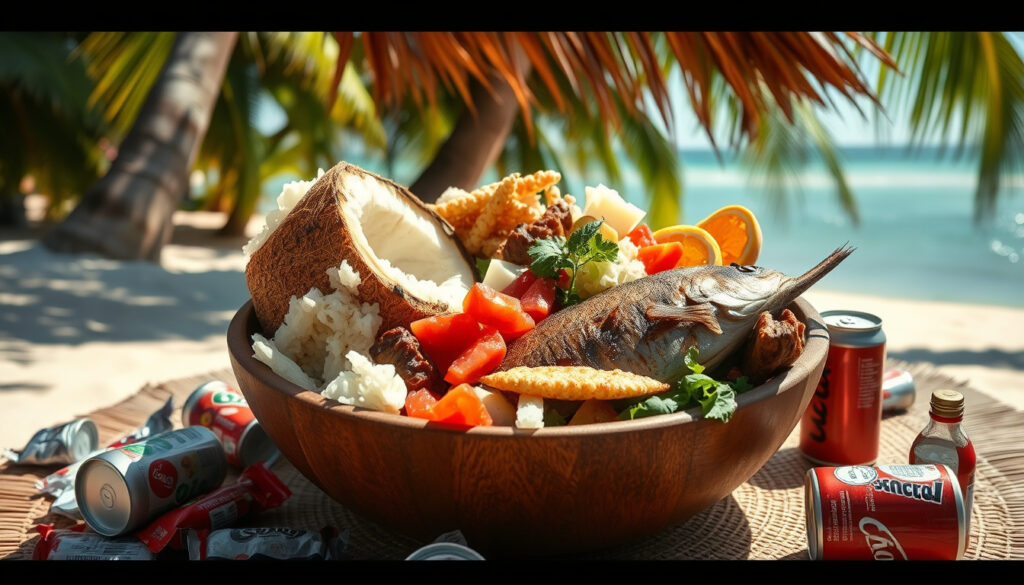
War Pacific Island Fusion: Fijian Cuisine & Pacific Obesity
There’s a moment when citrus “cooks” raw fish that turns a simple plate into something memorable. War Pacific Island Fusion, a Fijian restaurant at 5/237 Parnell Road in Auckland, builds its menu around that moment: the Parnell Business Association describes the snapper kokoda as a Fijian-style ceviche with smoked coconut cream, and Tripadvisor reviews rate the restaurant 4.9 out of 5. The menu tells one story; the Pacific’s health statistics tell another.
Obesity rate in Nauru: 61% (World Health Organization, 2016) · WAR’s rating: 4.9/5 from roughly 45–49 reviews on Tripadvisor · Chef’s Fiji background: 14+ years in five-star resorts · Fijian staples: taro, breadfruit, coconut, fresh fish
Quick snapshot
- WAR serves Fijian-Pacific fusion from 5/237 Parnell Road, Auckland (Tripadvisor)
- The reviewed menu includes snapper kokoda, spicy fish pakora, spring rolls and dumplings (First Table listing)
- Nauru’s adult obesity rate is 61%, the highest national rate recorded (World Health Organization, 2016) (First Table listing)
- Full menu pricing isn’t itemized in the First Table listing
- Whether the kitchen relies on traditional methods exclusively isn’t confirmed in the Parnell Business Association review
- Chef Krisneel Chand spent more than 14 years in five-star Fiji resorts before opening WAR (Parnell Business Association)
- With a 4.9/5 rating from roughly 45–49 reviews, WAR’s word-of-mouth runway is strong (Tripadvisor)
Six rows, one pattern: a single Auckland restaurant sits inside a public-health paradox most diners never see.
| Attribute | Detail |
|---|---|
| Restaurant name | War Pacific Island Fusion |
| Location | 5/237 Parnell Road, Auckland 1052 (Tripadvisor) |
| Cuisine type | Fijian and Pacific Island fusion (First Table listing) |
| Obesity rate in Nauru | 61% of adults (World Health Organization, 2016) |
| Most obese island nation | Nauru |
| Leading cause of death in Nauru | Diabetes-related complications |
What are some traditional foods from the Pacific Islands?
Taro, breadfruit, coconut and fresh fish form the base of Fijian cooking. From those four ingredients come dishes that range from raw kokoda to earth-oven feasts — and they are the same ingredients WAR Pacific Island Fusion is built around.
What are the staple ingredients in Fijian cuisine?
- Taro and cassava as the starchy base of everyday meals
- Coconut in every form — cream, milk, grated flesh
- Fresh reef fish and octopus
- Earth-oven (lovo) cooking for feasts
These staples explain most of WAR’s menu. The First Table listing shows the opening section leaning on Fijian and Indo-Fijian references: snapper kokoda, spicy fish pakora, spring rolls and dumplings.
How does WAR reinterpret traditional dishes?
- Kokoda: citrus-cured fish, finished with smoked coconut cream
- Lovo: translated as Fiji-style barbecue
- Curry tradition: masala goat curry with roti and dhal soup
The Parnell Business Association review adds the detail: Valolo Smoke layers pan-grilled fish over smoked lemongrass-coconut broth with poached vudi and greens, and the masala goat curry arrives with roti and dhal soup. Gulab jamun closes the meal with cardamom, rosewater and vanilla ice cream.
The smoking in the kokoda and the dhal beside the goat curry aren’t garnish. They are Fijian pantry logic translated for an Auckland dining room.
The pattern: WAR treats Fijian cooking as a living language, not a museum piece. Every reviewed dish keeps a recognizable Pacific root and changes the finish.
Why is obesity so high in the Pacific Islands?
The region that produced kokoda and lovo now carries some of the highest obesity rates on Earth. World Health Organization data from 2016 put adult obesity in Nauru at 61 percent, the highest national rate recorded, and diabetes-related complications are the leading cause of death there. Rates above 50 percent now appear in several Pacific nations, not just Nauru.
What are the main causes of obesity in the Pacific?
- A shift from traditional diets to imported processed foods
- Declining physical activity as island economies modernize
- Cheap, energy-dense imports displacing local staples
Public-health researchers describe this as a nutrition transition: as imported rice, flour, canned goods and sugary drinks became cheaper, meals built on taro, fish and coconut lost ground. Type 2 diabetes across the Pacific is the downstream consequence, not the starting problem.
How does Nauru’s diet contribute to its obesity rate?
- Adult obesity in Nauru: 61% (WHO, 2016)
- Global rank: most obese island nation
- Leading cause of death: diabetes-related complications
Nauru is the extreme end of the transition. The connection to a Parnell Road restaurant is the food itself: the traditional staples WAR serves are exactly the ones the nutrition transition pushed off Pacific tables.
The same globalization that filled Pacific pantries with processed imports makes WAR’s smoked-coconut kokoda quietly political: it sells the traditional diet back, one plate at a time.
Why this matters: A restaurant can’t fix a national health crisis on its own. But a menu built on taro, fish and coconut is a working example of the eating pattern the region lost — which is precisely why it belongs in the conversation.
What race is the heaviest?
The blunt question deserves a careful answer. By body-mass index, Pacific Islander populations record the highest average BMI and obesity prevalence of any ethnic group, a pattern confirmed by World Health Organization data and national health surveys.
How do obesity rates compare across ethnic groups globally?
- Pacific Islander populations: highest average BMI and obesity prevalence
- East Asian populations: lowest average BMI in global comparison data
- WHO and national health surveys confirm the disparity across countries
These gaps are population-level signals, not individual verdicts. Ethnicity shapes risk; it does not dictate any single person’s health outcome.
What factors explain higher body fat in Pacific Islanders?
- Genetic susceptibility shaped by food-scarce island environments
- Cultural norms that historically valued larger body size
- BMI thresholds that may not translate equally across ethnicities
Research points to both biology and culture: genetic factors influence how Pacific bodies store fat, and traditional island societies often associated size with status and strength. The BMI scale itself carries a caveat — cutoffs developed largely from Western populations may not fit all ethnicities equally.
The catch: Ranking who is heaviest obscures why. The honest reading of the data is that Pacific islanders carry the heaviest burden of a food transition that moved faster than communities could adapt.
Which country has the slimmest people?
At the other end of the global scale, the lowest obesity rates cluster in Asia and East Africa. Japan, South Korea and Ethiopia consistently rank among the slimmest countries in WHO data.
What countries report the lowest obesity rates?
- Japan
- South Korea
- Ethiopia
The common thread is not a shared cuisine — Japanese and Ethiopian plates barely overlap. What they share is a daily food environment that does not push processed, energy-dense calories at every turn.
How does Japan’s lifestyle contribute to low obesity?
- Dietary patterns: fish, vegetables and rice as everyday defaults
- Active lifestyles: walking and transit use built into daily routines
Japan’s low obesity numbers are the payoff of structure rather than willpower. The everyday diet and the everyday movement do the prevention work, so individual restraint is never the main line of defense.
The implication: The slimmest countries did not diet their way to the top of the charts. Their default food environments did the work — the same lesson Nauru learned in reverse.
What two foods never expire?
Two pantry staples last indefinitely when stored correctly: honey and salt. Both appear in preservation traditions across almost every culture that had access to them.
Are honey and salt truly non-perishable?
- Honey: low moisture and acidity block microbial growth
- Salt: pulls water out of anything that could spoil
Under airtight, moisture-free storage, honey stays edible for decades and salt never expires. That is the baseline fact, and it is why both became anchors of pre-refrigeration food systems.
How does this relate to traditional Pacific food preservation?
- Salt-cured fish was a standard Pacific preservation method
- Smoking and fermentation extended the life of fresh catches
Traditional Pacific kitchens used salt to keep fish, and smoke to stretch it further. The link to WAR’s menu is direct: kokoda uses citrus the way the old methods used salt — as a preserving agent, applied for flavor instead of shelf life.
The quiet contrast is with the imported packaged foods that now dominate so many Pacific pantries: they arrive with expiration dates, and the region is living with the health consequences. What this means: the two foods that never expire are exactly the preservation tools traditional Pacific kitchens already had.
Fijian classics vs. WAR’s fusion versions
Four dishes, one pattern: each WAR version keeps the Fijian root and changes the finish.
| Traditional Fijian dish | Classic form | WAR’s reviewed version |
|---|---|---|
| Kokoda | Raw fish cured in citrus, finished with coconut cream | Snapper kokoda with smoked coconut cream (First Table listing) |
| Lovo feast | Meat and root vegetables steamed in an earth oven | Fiji-style barbecue (First Table listing) |
| Indo-Fijian curry | Home-style curry served with roti | Grandma’s chicken curry (First Table listing) |
| Fish fritters | Fried fish snack from the Indo-Fijian community | Spicy fish pakora in a spinach-and-onion batter (Parnell Business Association review) |
What this means: The classic versions are harder to find in Auckland than the fusion ones. WAR’s menu is a practical bridge for diners who want the taste without a 12-hour flight.
Confirmed facts and what’s unclear
Public sources agree on the restaurant’s basics. Several details, however, rest on a single listing or one customer snapshot.
Confirmed facts
- Nauru has the world’s highest national obesity rate: 61% of adults (World Health Organization, 2016).
- Pacific Islander populations have higher average BMI than other ethnic groups, according to WHO and national health surveys.
- WAR operates from 5/237 Parnell Road, Auckland 1052 (Tripadvisor).
What’s unclear
- Full menu pricing is not published in the listings reviewed.
- Whether the kitchen uses traditional cooking methods exclusively is not established in the reviews surveyed.
- The restaurant’s precise ranking among Auckland’s 4,000+ restaurants comes from a single Tripadvisor snapshot and may shift.
- Vegetarian and vegan availability is mentioned in listings but not detailed across the menu reviews.
The gap between the two lists is the honest measure of what is publicly known about WAR today.
Voices on the food
The venue presents traditional Fijian cuisine through a modern fusion approach.
— First Table listing
Chand spent more than 14 years working in five-star resorts in Fiji before opening WAR.
— Parnell Business Association, In Review: War Pacific Island Fusion
A taste of home.
— Tripadvisor customer review, praising the freshness of the octopus and kokoda
What to watch: The strongest praise clusters around the seafood — the dishes that depend on freshness and technique.
WAR Pacific Island Fusion is a small restaurant translating Fijian food memories into an Auckland menu — not a public-health program, but a working example of the eating pattern the Pacific lost. The 4.9/5 Tripadvisor rating, and customer descriptions of the kokoda as a taste of home, say the kitchen delivers. For any Auckland diner curious about Fijian food, the decision is clear: try the snapper kokoda and the masala goat curry while this version of the menu is still taking shape, or let Parnell Road’s dining scene move on without them.
parnell.net.nz, tripadvisor.com, tripadvisor.com, iris.who.int
Frequently asked questions
What are the opening hours of War Pacific Island Fusion?
Restaurant listings describe lunch and dinner service, with the kitchen closed on Mondays.
Does War Pacific Island Fusion offer vegetarian options?
Tripadvisor listings report vegetarian-friendly and vegan options alongside the fish-forward Fijian menu.
Is there parking near the restaurant?
The reviewed listings don’t mention dedicated parking; street parking along Parnell Road is the most practical option for visitors.
How can I make a reservation at War Pacific Island Fusion?
First Table lists WAR for bookings, and the restaurant’s listed phone number is 09 302 5237.
Does War Pacific Island Fusion cater for events?
Event catering isn’t mentioned in the reviews and listings surveyed; the reviewed offering centers on sit-down lunch and dinner.
What is the price range for a meal at War Pacific Island Fusion?
Itemized prices aren’t published in the listings reviewed, a gap flagged as an open question in this assessment.
More related posts
 Improper Police Protocol NZ: Rights, Complaints & 2025 Scandal
 Arsenal vs Nottingham Forest Timeline: History & Results
 Clarke Gayford and Hollie Smith Relationship: Ex to Family
 Pak’nSave Rolleston: Location, Size, Hours & More
 NZ Cheap Cars Tauranga – Best Dealers, Auctions Under $10k
 Things to Do in Taupō: Best Attractions and Itineraries
 The Bads of Bollywood: Plot, Cast & Hit or Flop
 Air NZ Auckland to Wellington: Flights, Schedule & Prices