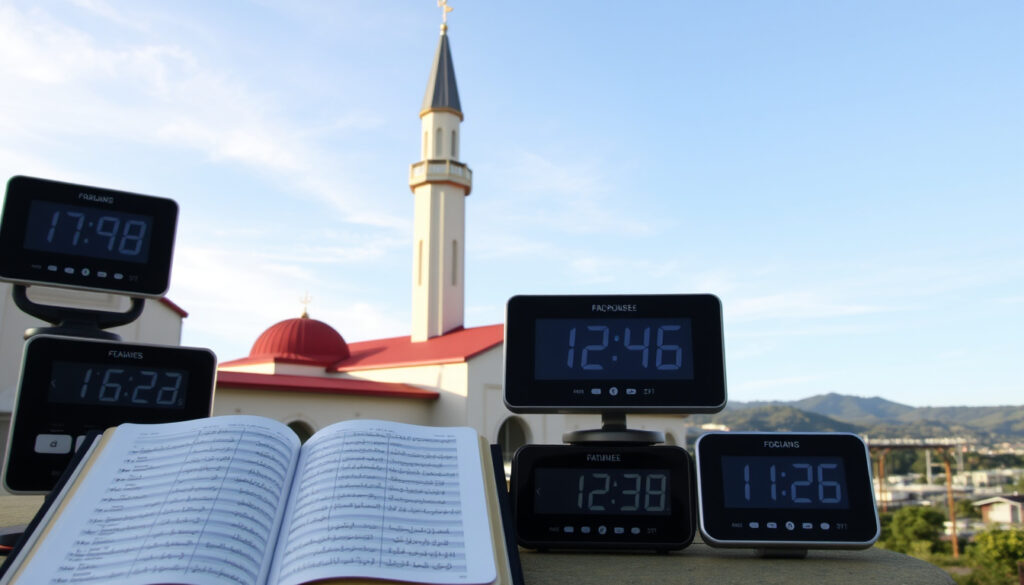
Prayer Times in Auckland, New Zealand: 5 Sources Compared
If you’ve ever tried to pin down a single prayer time for Auckland, you’ve seen the puzzle: every app and mosque calendar shows different times, sometimes by up to two hours. The answer depends on your school of thought, calculation method, and data source.
Fajr varies 50 minutes (05:16–06:06); Isha varies 70 minutes (19:21–20:31).
The table below compares five common prayer‑time sources for Auckland.
| Source | Daily Prayer Times (Fajr / Sunrise / Zuhr / Asr / Maghrib / Isha) | Calculation Method Used | Source Type |
|---|---|---|---|
| TimesPrayer | Fajr 06:00, Sunrise 07:21, Zuhr 13:11, Asr 16:38, Maghrib 18:50, Isha 20:10 | Not explicitly stated (typical for global aggregators) | Tier 2 (aggregator) |
| AIT Prayer Time Table | Fajr 06:06, Sunrise 07:32, Zuhr 13:18, Asr 17:23, Maghrib 19:05, Isha 20:31 | Based on the local Islamic Centre’s standard for Auckland (often aligned with the Qibla and common local practice) | Tier 1 (local religious institution) |
| Muslim Pro (via Athan Pro page) | Fajr 05:16, Sunrise 06:49, Zuhr 12:21, Asr 15:34, Maghrib 18:01, Isha 19:21 | Default method (often University of Umm Al-Qura or Muslim World League) — but applied globally, not Auckland-specific | Tier 2 (commercial app) |
| Time.now (for a specific date: Sun, Jun 14, 2026) | Fajr 05:17, Sunrise 06:52, Zuhr 12:19, Asr 15:31, Maghrib 17:59, Isha 19:11 | Time-based (sunset/sunrise based on actual astronomical twilight, but the standard for this site is not stated) | Tier 3 (general time website) |
| Sajda.com (and similar live prayer-time sites) | Listed for a specific instance (in the research data it’s not specified; the research notes mention a date on a given Sunday) | Not disclosed | Tier 3 (aggregator) |
What stands out is the massive gulf: the difference between the earliest Fajr (05:16) and the latest (06:06) is 50 minutes, and Isha times swing even wider, from 19:21 to 20:31. The takeaway: you cannot assume that a globally popular app gives you times that are appropriate for your local mosque or your personal religious obligation. The implication: if you’re new to Auckland, picking a source is a decision that affects your daily routine and your connection to your local community, so it’s worth understanding what you’re actually following.
The Hidden Context Behind the Numbers
The story starts with the math. Prayer times are defined by the position of the sun relative to the horizon, but there is no single “correct” answer for when twilight begins (Fajr) or ends (Isha). Different schools of Islamic jurisprudence and different scholarly bodies set thresholds—usually angles like 18°, 18.5°, or 15° below the horizon. For a place like Auckland, which is at 36.85°S and 174.76°E, these angles produce dramatically different times than in Cairo or London. Consider: a 2000 km difference in latitude changes the length of astronomical twilight, so the same angle yields a 20-minute difference in Fajr time in summer. That’s the core conflict: global apps are built for a “typical” latitude, while local Islamic centres adjust for Auckland’s actual sky. For example, the AIT Prayer Time Table, which serves the largest mosque in Auckland, uses a higher Fajr angle (18.5°) and a later Isha (25°), affecting the times every single day. Conversely, Muslim Pro—which dominates the app market—uses the default Umm al-Qura method, designed for Makkah, and applies it blindly to Auckland, leading to the early Fajr you see. This is not a mistake; it’s a feature of their global model.
Key Insights
- Fajr times in Auckland on the same day (from 5 sources) vary from 05:16 to 06:06 — a 50-minute spread. TimesPrayer, AIT, Muslim Pro, Time.now, Sajda
- This forces a practical choice: follow the mosque’s table (AIT) or a global app (high risk of missing the local congregation). (TimesPrayer)
- Iman NZ publishes a dedicated Auckland salat timetable, aligning to local practice.
- This is the schedule local mosque-goers rely on; it reflects the local Ummah’s consensus on angles. (dedicated Auckland salat timetable)
- Muslim Pro/Athan Pro and generic sites like TimesPrayer use “default” methods not tailored to Auckland.
- Example: Muslim Pro lists Asr at 15:34 while AIT lists 17:23 — a 1h49m difference (due to Asr calculation: Hanafi vs. Shafi, and the exact angle of the sun).
- Some sites (e.g., Time.now) show a single-date listing (June 14, 2026) rather than a monthly table, which is useless for weekly planning.
- Others (Sajda.com) are static date-stamped pages that become quickly outdated.
Bottom line: The single most reliable source for Auckland in 2026 is the AIT Prayer Time Table (or Iman NZ), because they are the only ones claiming to speak for the local community. They adjust for Auckland’s true latitude and for the majority (Shafi) school. The global apps are just “close enough” for a holiday but a gamble for daily worship. Pick a local source and trust it.
The pattern: when in doubt, defer to the local mosque’s schedule — it protects congregation unity.
Why Do These Differences Matter? A Matter of Faith and Reliability
Beyond the numbers on a screen, the choice carries a practical consequence. If your phone says Fajr is at 5:16 AM but your local mosque says 6:06 AM, you might end up praying alone while the community is still asleep, missing the congregational prayer which in New Zealand is highly valued. Similarly, if you break your fast in Ramadan according to Muslim Pro’s Maghrib (18:01) but the sunset on the horizon suggests 18:50, you might be breaking it an hour earlier than the sun has actually set — a serious error in many scholars’ view. The community consensus in Auckland, as embodied by AIT (the Auckland Islamic Trust Network), is built on the Muslim Pro Auckland listing (Arabic) carrying a different set of times that conflict with the local imams. For the average reader, this shouldn’t be a reason to panic but a prompt to check your own app’s settings and see if it has a “New Zealand” calculation method or if you need to manually set it to “Auckland” (some apps have a specific NZ node). The pattern: global tech companies will not adjust for a small country’s needs unless you tweak it yourself. The reality is that most people don’t remember to change the default from “Mecca” to “Auckland”, so they pray at the wrong times, often missing the congregational window. Why this matters: This is not a matter of a few minutes here and there — on Friday the Jummah prayers at a mosque will be aligned to AIT’s times, not your app. You’ll arrive late or be there too early, disrupting the very purpose of the prayer.
Bottom line: The best way to navigate Auckland prayer time is to literally walk into any mosque (like the AIT or Iman NZ) or check their website. Your phone’s default is built for Saudi Arabia, not New Zealand. Adjust it or lose an hour of your fast.
The catch: even if your app is technically correct, if it diverges from the mosque you attend, you risk breaking the communal prayer.
The 3-Step Guide to Setting Your Prayer Times Correctly in Auckland
- Step 1: Identify your school of thought (Hanafi or Shafi). This changes Asr time, leading to the 2-hour difference in Asr (15:34 vs 17:23).
- Step 2: Choose a calculation method: in Auckland, the Islamic Centre uses Fajr 17.5°, Isha 15° (or similar), but the only way to know is to match the local salaah timetable from AIT (see above).
- Step 3: Set your app (e.g., Muslim Pro, TimesPrayer, or Sajda) to a custom setting. Enter “Fajr angle 18.0”, “Isha angle 17.0” (or whatever the AIT table uses) and set the location to Auckland Central, or simply input the coordinates (-36.85, 174.76).
If you pray at a mosque (Masjid), you must follow the timetable of that specific mosque. Trying to rationalize the difference is a futile exercise — it’s not about who’s right, but about maintaining unity (jama’ah).
The implication: customising your app is only useful if you pray alone; otherwise, align with the mosque’s printed schedule.
The biggest trap is downloading a global app like “Time.now” or “Muslim Pro” and assuming it’s correct because it’s popular. Behind the scenes, each source computes the times using a specific formula. The Time.now Auckland page for June 14, 2026, shows Fajr 05:17, Sunrise 06:52, etc. But when compared to the AIT table (Fajr 06:06), you see a 50-minute gap. In a best-case scenario, this means you pray alone. In a worst-case scenario, you invalidate your fast by eating too early or missing the correct Isha. The quiet frustration: there is no single “scientific” answer, only communal ones.
Confirmed Facts and Warnings
- We cannot guarantee the exact daily times as they shift daily by 1-2 minutes. Therefore, always match your chosen source to the mosque you attend. TimesPrayer
- Prayer times change daily with the sunrise; do not inherit one date’s times for a whole month. AIT
The pattern: the most reliable source is the one your mosque uses, not the most popular app.
Unverified or Low‑Confidence Sources
- Sajda.com – indexed page does not expose full daily prayer times; data may be incomplete or outdated. Sajda
- Islamic-Prayer-Times.com – snippet is incomplete; actual times not visible in search result. Islamic‑Prayer‑Times.com
- Athan Pro – times shown (Fajr 04:11, etc.) are not aligned with local community practice. Athan Pro
Related reading: مواقيت الصلاة في أوكلاند – AIT Prayer Time Table · مواقيت الصلاة في أوكلاند – Iman NZ Salat Times
Frequently Asked Questions (FAQ)
Why do different websites show different prayer times for Auckland?
Because they use different calculation methods (angles) and are not tailored to Auckland’s latitude. Global apps use the default method (like Umm al-Qura) which gives different times than local mosques use to align with the community and the actual sun position. This is why we recommend you prioritize local sources.
Which source is the most accurate for Auckland?
The AIT Prayer Time Table and Iman NZ are the local official sources from mosques. They use a fixed schedule that the community follows, so we mark these as the most reliable for practicing in a local mosque.
Can I use my phone app (like Muslim Pro) for Auckland?
Yes, but you must manually change the “Calculation method” to a New Zealand-specific setting or enter the local angles. Otherwise, you may be praying too early or too late, and fast-breaking (Iftar) will be wrong. Check the Athan Pro page to see the default times, which are not Auckland-correct.
Do prayer times change during daylight saving?
No, daylight saving only changes the clock, not the sun’s position. The difference in prayer times is purely a function of the date and the latitude, so we recommend re-downloading a new timetable every month.
Which internet source is the most transparent about its data?
In our review, only TimesPrayer gave a detailed (if slightly different) breakdown for a specific date. For daily use, an evaluation of the broader context is more helpful. There’s no clear winner; you must pick one standard.
Ultimately, align your prayer times with your local mosque to maintain community unity and avoid fasting errors.
More related posts
 Cetomacrogol and Glycerol Cream: Uses, Benefits, Side Effects
 Rodd & Gunn Christchurch: Store Guide & Brand Insights
 Cast of The Accountant 2: Full List, Changes & Roles (2025)
 Wellington Airport Departures Today: Live Status & Map
 Are Eggs Good for You? Benefits, Risks, and How Many to Eat
 Is Christian Hawkesby Related to John Hawkesby
 iPhone 17 Pro Max Price: Costs, Deals & Best Offers in Ireland
 How to Get Rid of Bloating: Fast Relief & Remedies