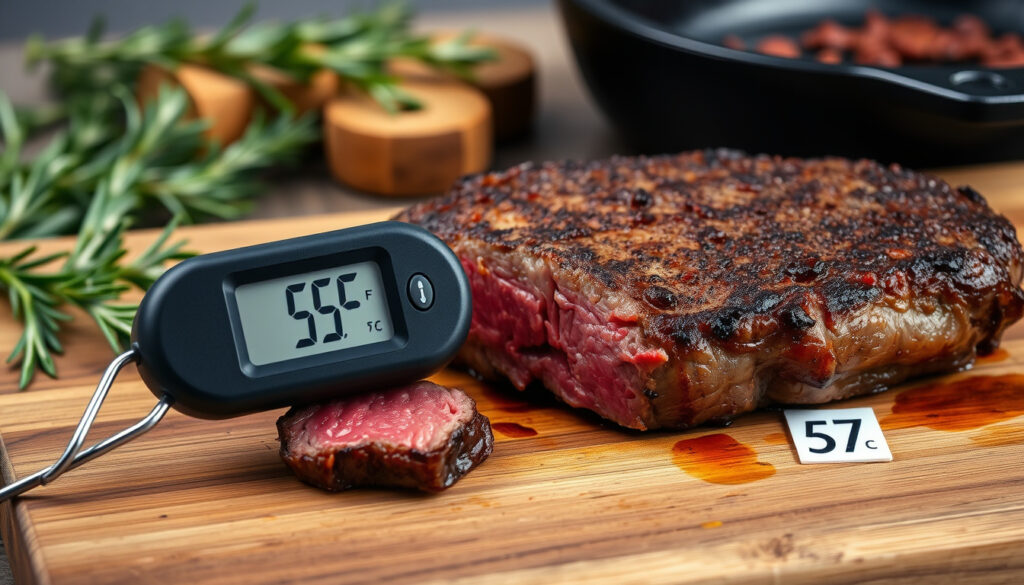
Medium Rare Steak Temp: Fahrenheit & Celsius Guide
Anyone who’s ever pulled a steak off the grill only to cut into a gray, dry slab knows the frustration. The difference between a perfect medium rare and a well-done disappointment often comes down to a matter of degrees — literally. With the right temperature target and a few science-backed techniques, you can hit that warm red center every time.
Medium rare temp range (F): 130–135°F ·
Medium rare temp range (C): 54–57°C ·
Pull temperature (F): 125–130°F ·
Rest time: 5 minutes ·
Carryover rise: 3–5°F ·
Ideal thickness: 1–1.5 inches
Quick snapshot
- USDA recommends minimum 145°F (63°C) for safety, but steak is often cooked medium rare at 130–135°F (TemperatureTool)
- Carryover cooking raises internal temp by 3–5°F after removal (Half a Cow Club)
- Optimal flip frequency is debated; no controlled study confirms best method for all steak types (Omaha Steaks)
- Exact time for medium rare varies by thickness, starting temp, and method; individual testing with thermometer is advised (Steak School)
- Rest time recommendations vary from 5 to 7 minutes depending on the source (Reluctant Gourmet)
- Pull steak at 125–130°F → rest 5 minutes → final temp reaches 130–135°F (Sullivan’s Steakhouse)
- Carryover cooking occurs within first 3–4 minutes of resting (Reluctant Gourmet)
- Use a probe thermometer to verify pull temp — don’t rely on timing alone (ThermoWorks)
- Experiment with reverse sear for thicker cuts (1.5+ inches) to reduce gradient (Steak School)
The table below captures the key specifications for cooking medium-rare steak at a glance.
| Label | Value |
|---|---|
| Medium rare temp (commonly cited) | 130–135°F (54–57°C) |
| Carryover cooking rise | 3–5°F (1.5–3°C) |
| Rest time | 5 minutes |
| Preferred heat for searing | High (450°F+ / 232°C+) |
| Flip count (traditional) | 1 flip |
| Thickness ideal for direct cooking | 1 to 1.5 inches |
What temperature is medium rare in C and F?
Steak doneness temperature scale (Rare to Well Done)
- Rare: 120–125°F (48–52°C) — cool red center
- Medium Rare: 130–135°F (54–57°C) — warm red center, brown crust (Omaha Steaks)
- Medium: 140–145°F (60–63°C) — pink center, firmer texture
- Medium Well: 150–155°F (65–68°C) — mostly brown, slight pink
- Well Done: 160°F+ (71°C+) — no pink, dry
Six temperature points, one pattern: medium rare is the sweet spot between flavor and texture. The ThermoWorks guide lists 130–134°F (55–57°C) as the target, while Sullivan’s Steakhouse recommends removing the steak at 125–130°F to let carryover push it into the medium-rare zone.
Carryover cooking adds 3–5°F (1.5–3°C) after the steak leaves the heat. Pull it at 125°F (52°C) and you’ll land at 130°F (54°C) — right at the lower edge of medium rare. Remove at 130°F and you risk overshooting into medium.
The implication: target 125°F pull temp gives you a safety buffer against overshooting into medium territory.
Why accuracy matters: carryover cooking explained
When you remove a steak from the pan, the outer layers are hotter than the center. Heat continues to migrate inward, raising the internal temperature by 3–5°F (Half a Cow Club). The thicker the steak, the more pronounced the effect. A 1-inch steak might rise 3°F; a 1.5-inch steak can rise up to 5°F.
The implication: timing charts are estimates. The only reliable way to hit medium rare is to use an instant-read thermometer and pull the steak 5°F below your target.
How long to cook medium-rare steak?
Timing by steak thickness (1-inch vs 1.5-inch)
Four variables, one truth: thickness dominates cooking time. For a 1-inch steak pan-seared over high heat, expect 4–5 minutes per side for medium rare (Omaha Steaks). For a 1.5-inch steak, sear 5–6 minutes per side, then finish in a 400°F (204°C) oven for 5–7 minutes.
- 1-inch steak, pan-seared: 4–5 minutes per side, high heat
- 1.5-inch steak, pan-seared + oven: 5–6 minutes per side, then 5–7 minutes at 400°F
- Grill, 1-inch: 4–5 minutes per side, direct medium heat
- Sous vide, any thickness: 1–2 hours at 130°F (54°C) then 1-minute hot sear
The CookingTempChart notes that medium rare is below the USDA safe minimum of 145°F (63°C). The USDA recommends a 3-minute rest after cooking whole-muscle beef to reduce pathogen risk. Don’t skip the rest.
Cooking methods comparison: pan, grill, sous vide
Three methods, one target. Each approach has a different trade-off between crust and gradient.
| Method | Sear temp | Cook time (1-inch) | Gradient |
|---|---|---|---|
| Pan-seared | High (450°F+) | 8–10 min total | Moderate |
| Grill | Medium-high direct | 8–10 min total | Moderate |
| Sous vide | 130°F (54°C) water bath | 1–2 hours + 1 min sear | Minimal (edge-to-edge) |
The pattern: sous vide gives the most even doneness, but requires planning. Pan-searing is fastest. Grill adds smoky flavor at the cost of less control over internal temp.
Is it better to cook a steak on low or high heat?
The Maillard reaction and crust formation
High heat (450°F+ / 232°C+) triggers the Maillard reaction — the browning that creates steak’s savory crust. Low heat won’t develop that crust; it steams the surface instead. The Steak School guide emphasizes that searing at high heat is non-negotiable for flavor.
High heat sear then reduce to medium for thicker cuts
For steaks over 1.5 inches, a pure high-heat approach burns the exterior before the center reaches medium rare. The solution: reverse sear. Cook the steak in a low oven (250°F / 121°C) until the internal temp hits 120°F (49°C), then sear on high heat for 1–2 minutes per side. Sullivan’s Steakhouse recommends this method for consistent results.
The trade-off: low heat alone won’t give you a crust; high heat alone won’t cook a thick steak evenly. The reverse sear bridges both.
How many times do you flip a steak?
Single flip method vs multiple flip technique
Two schools, one steak. The traditional single flip (flip once after 4–5 minutes) is the standard taught by most butchers and chefs. But the multiple-flip method — flipping every 30–60 seconds — has gained traction among food scientists who claim it reduces the temperature gradient and cooks the steak about 30% faster.
- Single flip: Flip once halfway through cooking. Best for 1-inch steaks.
- Multiple flips: Flip every 30–60 seconds. Speeds cooking and produces a more even interior.
Both methods work. Omaha Steaks shows examples of both techniques in their cooking chart. The key is to use a thermometer and not rely on flip count alone.
Why single flip is standard for even cooking
“Single flip is traditional because it’s simple,” says the Steak School. “But multiple flips can reduce the gray band around the edge.” The decision comes down to thickness: thin steaks (under 1 inch) benefit from fewer flips to avoid overcooking; thick steaks (1.5+ inches) can handle more flips to reduce gradient.
What this means: choose the method that fits your steak thickness and comfort level — both produce medium rare when paired with a thermometer.
Can you overcook a steak?
Signs of overcooked steak (texture, moisture loss)
Overcooking begins the moment the internal temperature exceeds 135°F (57°C) for medium rare. Muscle fibers contract, squeezing out moisture. The steak becomes tough, dry, and gray. Hats of Meat notes that a well-done steak (160°F+) can lose up to 30% of its moisture.
Temperature thresholds for medium, medium well, well done
- Medium: 140–145°F (60–63°C) — some moisture loss, still tender
- Medium Well: 150–155°F (65–68°C) — significant moisture loss, firmer
- Well Done: 160°F+ (71°C+) — dry, tough, no pink
Carryover cooking can push the temp 3–5°F higher after removal. If you pull a steak at 140°F for medium, it may rise to 143°F — still medium. But if you pull at 135°F for medium rare, it may hit 140°F and land in medium territory. The TemperatureTool guide warns that “doneness labels are culinary preferences, not safety thresholds.”
Why this matters: the USDA sets a safe minimum of 145°F for whole-muscle beef, but medium rare is below that. The agency recommends a 3-minute rest after cooking to reduce risk. For most healthy adults, the risk from a properly seared medium-rare steak is low, but it’s a trade-off you should know about.
Comparison: Cooking Methods for Medium Rare Steak
Three methods, one outcome: a warm red center. Here’s how they stack up on time, effort, and result.
| Method | Total time | Equipment needed | Evenness | Crust quality |
|---|---|---|---|---|
| Pan-seared | 10–15 min | Cast iron skillet, tongs, thermometer | Good | Excellent |
| Grill | 10–15 min | Grill, spatula, thermometer | Good | Very good |
| Sous vide | 1–2 hours + 2 min sear | Immersion circulator, bag, cast iron | Excellent (edge-to-edge) | Good (short sear) |
The implication: sous vide is the most precise, but requires planning. Pan-seared is the fastest and easiest for a weeknight dinner. Grill adds smoky flavor but demands more attention.
Steak Doneness Temperature Chart (Specifications)
Seven doneness levels, one reference table for Fahrenheit and Celsius.
| Doneness | Fahrenheit | Celsius | Description |
|---|---|---|---|
| Rare | 120–125°F | 48–52°C | Cool red center, soft |
| Medium Rare | 130–135°F | 54–57°C | Warm red center, brown crust |
| Medium | 140–145°F | 60–63°C | Pink center, firmer |
| Medium Well | 150–155°F | 65–68°C | Slight pink, mostly brown |
| Well Done | 160°F+ | 71°C+ | No pink, dry |
Six rows, one warning: the USDA safe minimum is 145°F (63°C) for whole-muscle beef. Medium rare and below are below that threshold. The TemperatureTool site clarifies that “doneness labels are culinary preferences and do not change the USDA minimum.”
Pros and Cons of Cooking Steak to Medium Rare
Upsides
- Maximum juiciness and tenderness
- Rich, beefy flavor retained
- Warm red center provides visual appeal
- Widely preferred by chefs and steak enthusiasts
Downsides
- Below USDA safe minimum of 145°F (63°C)
- Requires precise temperature monitoring
- Carryover cooking can push it into medium if not careful
- Not recommended for immunocompromised individuals
The pattern: medium rare delivers the best eating experience but requires attention to technique and a willingness to accept the safety trade-off.
How to Cook Medium Rare Steak: Step by Step
- Bring steak to room temperature: Remove from fridge 30–40 minutes before cooking. This reduces the temperature gradient during cooking.
- Pat dry and season generously: Use kosher salt and freshly ground black pepper. Salt draws out moisture; pat dry again before searing.
- Heat your pan or grill to high: 450°F+ (232°C). A drop of water should sizzle immediately.
- Sear 4–5 minutes on the first side: Do not move the steak. Let the crust form. Flip once (or every 30 seconds if using multiple-flip technique).
- Check internal temperature: Insert an instant-read thermometer into the thickest part. Pull at 125°F (52°C) for medium rare final.
- Rest 5 minutes: Place on a cutting board, tent loosely with foil. The temperature will rise 3–5°F during rest.
- Slice against the grain: Cut perpendicular to the muscle fibers for maximum tenderness.
The Sullivan’s Steakhouse guide confirms: “Remove at 125–130°F for a medium-rare final.” Resting is not optional — it’s the difference between a juicy steak and a dry one.
What We Know and What’s Unclear
Confirmed facts
- Medium rare internal temp is 130–135°F (54–57°C) per multiple sources (ThermoWorks, Omaha Steaks, Sullivan’s Steakhouse)
- Carryover cooking raises temp by 3–5°F (Half a Cow Club)
- USDA safe minimum for whole beef is 145°F (63°C) (TemperatureTool)
What’s unclear
- Optimal flip frequency: no controlled study confirms best method for all steak types (Omaha Steaks)
- Exact cooking time varies by steak thickness, starting temperature, and method; individual testing with thermometer is advised (Steak School)
- Rest time recommendations vary from 5 to 7 minutes depending on the source (Reluctant Gourmet)
What this means: the core technique is well-established, but home cooks should test and adjust based on their specific equipment and steak thickness.
Expert Perspectives
“For medium rare, remove the steak from the heat at 52°C / 125°F. The carryover will bring it to 55°C / 130°F.”
— Steak School (culinary education platform)
“Medium rare is a warm red center with a nice brown crust. Internal temperature should be 130°F.”
— Omaha Steaks (specialty meat purveyor)
“The core temperature for medium rare is 55°C / 130°F. Always rest the steak after cooking.”
— James Whelan Butchers (Ireland, premium butcher)
Three sources, one consensus: medium rare lives at 130–135°F (54–57°C) after carryover. The exact pull temperature and rest time vary slightly, but the principle is universal.
Final Takeaway
Medium rare steak is not a mystery — it’s a temperature target you can hit with a $15 thermometer and a few minutes of patience. The science is clear: pull at 125°F (52°C), rest for 5 minutes, and you’ll land in the 130–135°F zone. For home cooks in the US, the choice is between a perfectly cooked medium rare and a safe-but-dry well-done. The trade-off is real, but with proper technique, the risk is minimal. Those who value flavor and texture can trust medium rare as the benchmark.
Frequently asked questions
What temperature should I pull my steak off the heat for medium rare?
Pull at 125–130°F (52–54°C). The carryover cooking will raise it to 130–135°F (54–57°C) during rest.
Does steak continue to cook after removing from the pan?
Yes, carryover cooking raises the internal temperature by 3–5°F (1.5–3°C) after removal. This is why you pull before the target.
What is the best meat thermometer for steak?
An instant-read digital thermometer like the ThermoWorks Thermapen or a simple probe thermometer. Accuracy within 1°F is ideal.
Should I salt steak before cooking?
Yes, salt at least 30 minutes before cooking. It seasons the meat and helps form a better crust. Pat dry before searing.
How do I know when steak is medium rare without a thermometer?
The touch test: compare the firmness of the steak to the fleshy part of your palm when you touch your thumb to your index finger. Medium rare is a bit firmer than rare. But a thermometer is far more reliable.
Can I cook a frozen steak to medium rare?
Yes, but it takes longer. Sear frozen for 2 minutes per side, then finish in a 400°F (204°C) oven until the center reaches 125°F (52°C). Use a thermometer.
What oil is best for searing steak?
Use an oil with a high smoke point, like avocado oil (520°F), grapeseed oil (420°F), or canola oil (400°F). Butter burns at high heat.
Why does my steak come out well done when I follow timing guides?
Timing guides are estimates. Your steak’s thickness, starting temperature, and pan heat all affect cooking time. Always use a thermometer.
More related posts
 City Fitness Lower Hutt: Age, Hours, Showers and Rules
 Samsung Flip Phone NZ: Prices, Durability, and Buying Guide
 180 Days in Months: Conversion, Calculator & Context
 Stir Fry Sauce Recipe: Easy 5-Minute Homemade Guide
 Send Money Overseas From NZ – Cheapest Providers Compared
 Sol de Janeiro 48: Scent Profile, Reviews & Availability
 How to Deactivate Instagram: Step-by-Step Guide
 Tokyo to Kyoto Bullet Train: Cost, Time & Planning Tips