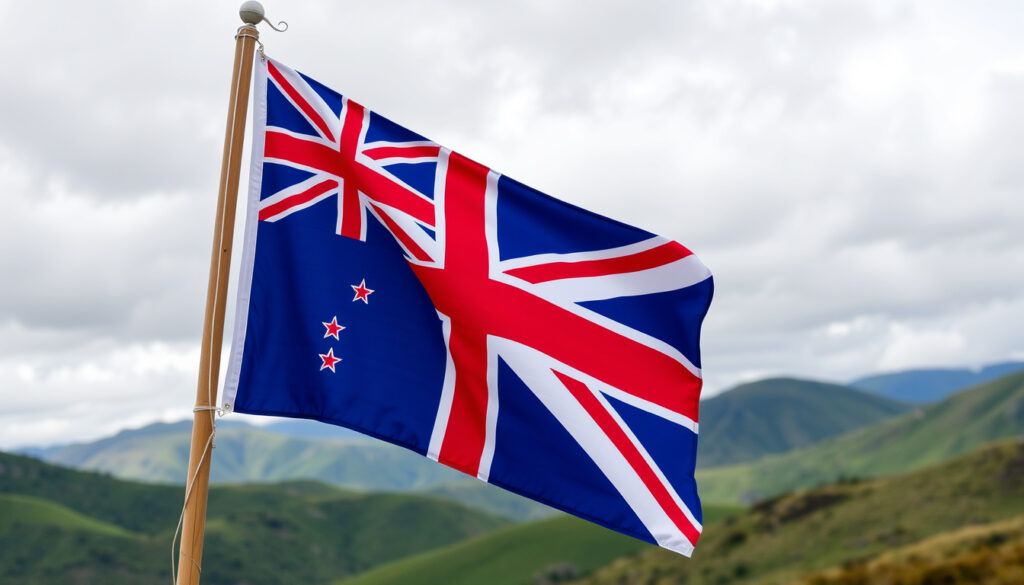
Flag of the United Tribes of New Zealand: History & Meaning
There aren’t many national flags that can trace their roots to a maritime customs dispute, but the flag of the United Tribes of New Zealand is one of them. Adopted on 20 March 1834 by 25 northern Māori chiefs meeting at Waitangi, it was the first official flag of New Zealand — a deliberate assertion of collective nationhood long before the Declaration of Independence. This article explores the flag’s history, design, and legacy, and why it still matters in debates about Māori sovereignty and New Zealand’s identity.
Adopted: 20 March 1834 ·
Recognised by: United Kingdom ·
Number of stars: 4 eight-pointed white stars ·
Alternative name: Te Kara ·
Associated document: He Whakaputanga (Declaration of Independence)
Quick snapshot
- Flag adopted on 20 March 1834 by 25 northern chiefs at Waitangi (NZ History (Ministry for Culture & Heritage))
- Design: St George’s cross on white, blue canton with white cross and four eight-pointed stars (NZ History (Ministry for Culture & Heritage))
- Recognised by British Crown in 1836 as symbol of independence (Wikipedia)
- Known as Te Kara, the first official flag of New Zealand (Te Ara Encyclopedia (New Zealand’s official encyclopedia))
- Exact symbolism of the four stars — Southern Cross, seasons, or directions? (NZ History (Ministry for Culture & Heritage))
- Whether the flag was actually hoisted on the adoption day; no definitive contemporary record (Te Papa Museum (New Zealand’s national museum))
- 1831: United Tribes confederation formed (The Spinoff (New Zealand current affairs))
- 20 March 1834: Flag adopted (NZ History (Ministry for Culture & Heritage))
- 28 October 1835: He Whakaputanga (Declaration of Independence) signed (Te Ara Encyclopedia)
- 1840: Treaty of Waitangi; Union Jack replaces flag (Te Papa Museum)
- Remains a historical flag with no current official status (Te Ara Encyclopedia)
- Growing calls for recognition alongside the Tino Rangatiratanga flag (The Spinoff)
- Flown at Waitangi Day ceremonies and preserved in museum collections (NZ History)
Five facts capture the flag’s core details: a date, a number, a name, a status, and a location.
| Category | Detail |
|---|---|
| Date of adoption | |
| Number of signatories | 25 chiefs |
| Alternate name | Te Kara (the colour) |
| Current status | Historical flag, no official status |
| Found in | Collections of Te Papa and local museums |
What is the meaning of the United Tribes flag?
Why was the United Tribes flag created?
- The flag was born from a practical crisis: Sydney customs officials had begun seizing New Zealand-built ships that lacked an official flag, citing British navigation laws (NZ History (Ministry for Culture & Heritage)).
- James Busby, the British Resident, proposed a flag in 1833 to solve the shipping problem and to encourage Māori to unite as a single political entity (NZ History).
- Henry Williams of the Church Missionary Society designed three flag options, produced in Sydney; the chosen flag received 12 out of 25 votes (NZ History).
What does Te Kara represent?
- The flag’s Māori name, Te Kara, simply means “the colour” or “the flag”, but its adoption was a profound act: for the first time, a collection of iwi and hapū spoke as one nation (Te Ara Encyclopedia (New Zealand’s official encyclopedia)).
- The four eight-pointed stars are thought to represent either the Southern Cross constellation, the four seasons, or the four cardinal directions — no single interpretation is officially recorded (NZ History).
The implication: a shipping dilemma became the catalyst for New Zealand’s first unified national symbol, long before the British Crown formally engaged.
The 1834 flag vote was the first time northern chiefs acted as a collective body, setting the stage for He Whakaputanga just 18 months later. The flag wasn’t just a piece of cloth — it was a legal argument for sovereignty.
What was the original Māori flag?
Does New Zealand have an indigenous flag?
- Before 1834, Māori used various banners and the Union Jack, but no single official flag existed. The United Tribes flag (Te Kara) is widely considered the first official flag of New Zealand and the first pan-Māori flag (Te Ara Encyclopedia).
- In 2009, the Tino Rangatiratanga flag was officially recognised as the national Māori flag, but Te Kara remains a symbol of early Māori sovereignty (Te Papa Museum).
How does the United Tribes flag relate to the Tino Rangatiratanga flag?
- Te Kara represents the first collective assertion of Māori nationhood; Tino Rangatiratanga represents the ongoing Māori sovereignty movement. The two are often flown together at Waitangi Day events (The Spinoff).
What this means: the original Māori flag is not a single design — it’s a lineage. Te Kara started the story; Tino Rangatiratanga carries it forward.
What are the three flags of New Zealand?
Why does NZ have a red flag?
- New Zealand has three official flags: the national Blue Ensign (with Union Jack and Southern Cross), the Red Ensign (for merchant ships), and the White Ensign (navy). The Red Ensign was adopted in 1901 and is flown by private vessels (NZ History).
- The United Tribes flag is not an official national flag but is recognised as a historical flag of significance, often displayed at museums and ceremonial events (Te Ara Encyclopedia).
What is the difference between the New Zealand flag and the United Tribes flag?
- The current national flag includes the Union Jack and the Southern Cross; the United Tribes flag omits the Union Jack entirely, asserting independence from British colonial symbolism (Wikipedia).
The trade-off: the modern flag ties New Zealand to its Commonwealth heritage, while Te Kara represents a pre-colonial moment when Māori chose their own emblem.
What are the United Tribes of New Zealand?
Who were the chiefs who signed He Whakaputanga?
- The United Tribes of New Zealand (Te Whakaminenga o Ngā Hapū) was a confederation of northern iwi and hapū formed in 1831 (The Spinoff).
- On 28 October 1835, 52 rangatira signed He Whakaputanga (Declaration of Independence), asserting that all sovereign power and authority resided with the chiefs (Te Ara Encyclopedia).
How did the United Tribes relate to the Treaty of Waitangi?
- The confederation effectively dissolved after the Treaty of Waitangi in 1840, which ceded sovereignty to the British Crown. The flag that had symbolised independence was gradually replaced by the Union Jack (Te Papa Museum).
The pattern: the United Tribes used a flag to anchor a legal claim. That claim later collided with the Treaty, creating a tension that still resonates in New Zealand constitutional debates.
Why does the New Zealand flag have a Union Jack on it?
Why does the United Tribes flag not have a Union Jack?
- The Union Jack on the current flag reflects New Zealand’s colonial heritage as a British colony and later dominion. The flag was adopted in 1902, based on the British Blue Ensign, and includes the Southern Cross to represent New Zealand’s location in the Pacific (NZ History).
- The United Tribes flag deliberately omits the Union Jack — a conscious statement of independence at a time when Māori chiefs still exercised full sovereignty (Wikipedia).
When did New Zealand adopt the Union Jack flag?
- The current flag was officially adopted on 12 June 1902, though variants of the Blue Ensign had been used since the 1860s (NZ History).
The catch: the Union Jack on the national flag is a daily reminder of British sovereignty, while Te Kara remains a quiet counter-narrative of Māori agency — a flag that predates and contradicts the colonial one.
The United Tribes flag was designed by a British missionary and voted on by Māori chiefs, then recognised by the British Crown — yet it had no Union Jack. It was simultaneously a product of empire and a rejection of it.
Timeline: Flag of the United Tribes of New Zealand
- 1831 — Formation of the United Tribes of New Zealand confederation (The Spinoff)
- 20 March 1834 — Adoption of the United Tribes flag by 25 northern chiefs at Waitangi, hoisted with a 21-gun salute from HMS Alligator (NZ History)
- 28 October 1835 — He Whakaputanga (Declaration of Independence) signed by 52 chiefs (Te Ara Encyclopedia)
- 1836 — British Crown formally recognises the flag as a symbol of New Zealand’s independence under the United Tribes (Wikipedia)
- 1840 — Treaty of Waitangi signed; United Tribes confederation dissolves. Union Jack becomes de facto national flag (Te Papa Museum)
- 1902 — Current New Zealand Blue Ensign officially adopted (NZ History)
- 2009 — Tino Rangatiratanga flag recognised as national Māori flag (Te Ara Encyclopedia)
Clarity check: what we know and what’s still debated
Confirmed facts
- The flag was selected by Māori chiefs in 1834 (NZ History)
- The design includes a St George’s cross and a blue canton with four eight-pointed stars (NZ History)
- It was recognised by the British government as a mark of New Zealand’s independence (Wikipedia)
What’s unclear
- The exact symbolism of the four stars is disputed (some say Southern Cross, others seasons or directions) (NZ History)
- Whether the flag was actually flown at the 1834 meeting is not definitively documented (Te Papa Museum)
Voices from history
“We, the chiefs of the United Tribes of New Zealand, assembled at Waitangi, do hereby adopt this flag as the national flag of New Zealand.”
— Te Whakaminenga chiefs, resolution of 20 March 1834 (paraphrased from historical record, NZ History)
“I have the honour to transmit to you a flag which has been chosen by the chiefs of this country… I trust it will be acknowledged as the flag of New Zealand.”
— James Busby, British Resident, in correspondence to King William IV, 1834 (Wikipedia)
“The United Tribes flag is a powerful reminder that Māori were recognised as a sovereign nation before the Treaty of Waitangi.”
— Ministry for Culture & Heritage, NZ History website (NZ History)
For New Zealand schoolchildren, the choice is clear: the flag of the United Tribes is either a footnote or a founding story. If New Zealand wants to teach its full history, Te Kara deserves a place in every classroom — not as a relic, but as the first official moment Māori said, “We are a nation.”
Related reading: **Ka Mau Te Wehi Meaning – Māori Proverb Translation and Origin** · **Pak N Save Logo – Design, History & Downloads**
Frequently asked questions
Can I buy a United Tribes flag today?
Yes. Reproductions of the United Tribes flag are sold by museum shops, online retailers, and flag manufacturers. The design is in the public domain as a historical flag.
Is the United Tribes flag the same as the Māori flag?
No. The United Tribes flag (Te Kara) was the first official flag of New Zealand and a pan-Māori symbol. The official national Māori flag, adopted in 2009, is the Tino Rangatiratanga flag. Both represent Māori identity but from different historical moments.
Why did the United Tribes choose a St George’s cross?
The design was influenced by the flag of the Church Missionary Society, which used a St George’s cross. Henry Williams, the missionary who created the design options, drew on that emblem. The chiefs voted for it, likely because of its familiarity and association with the respected CMS.
Was the United Tribes flag used during the New Zealand Wars?
There is no widespread evidence of the United Tribes flag being flown by Māori forces during the New Zealand Wars (1845–1872). By then the Union Jack had become the dominant flag, though some iwi created their own banners.
How is the United Tribes flag used in modern ceremonies?
It is frequently flown at Waitangi Day commemorations alongside the New Zealand flag and the Tino Rangatiratanga flag. It also appears in museum exhibits and educational displays about New Zealand history.
What is the difference between Te Kara and the Tino Rangatiratanga flag?
Te Kara (1834) is a white flag with a red St George’s cross and a blue canton with four white stars. The Tino Rangatiratanga flag (2009) features a black koru (fern frond) curving from the bottom left to centre, on a white background with a red band at the top. Te Kara represents early collective nationhood; Tino Rangatiratanga represents ongoing Māori sovereignty.
Where is the original United Tribes flag kept?
No original flag from 1834 is known to survive. The earliest surviving examples are later reproductions held in museum collections, including Te Papa Tongarewa in Wellington.
More related posts
 Super King Bed Base – Storage, Headboards & Wooden Options in NZ
 Cast of Deadpool 3: Full List in Deadpool & Wolverine
 Things to Do in Auckland City: Itineraries & Top Spots 2026
 Prayer Times in Auckland, New Zealand: 5 Sources Compared
 How Many Tablespoons in a Cup: 16 Tbsp Guide + Chart
 Sol de Janeiro 48: Scent Profile, Reviews & Availability
 Pina Colada Recipe NZ: Easy 4-Ingredient Cocktail at Home
 Misfits (TV Series) – Plot, Cast, Seasons and Where to Watch