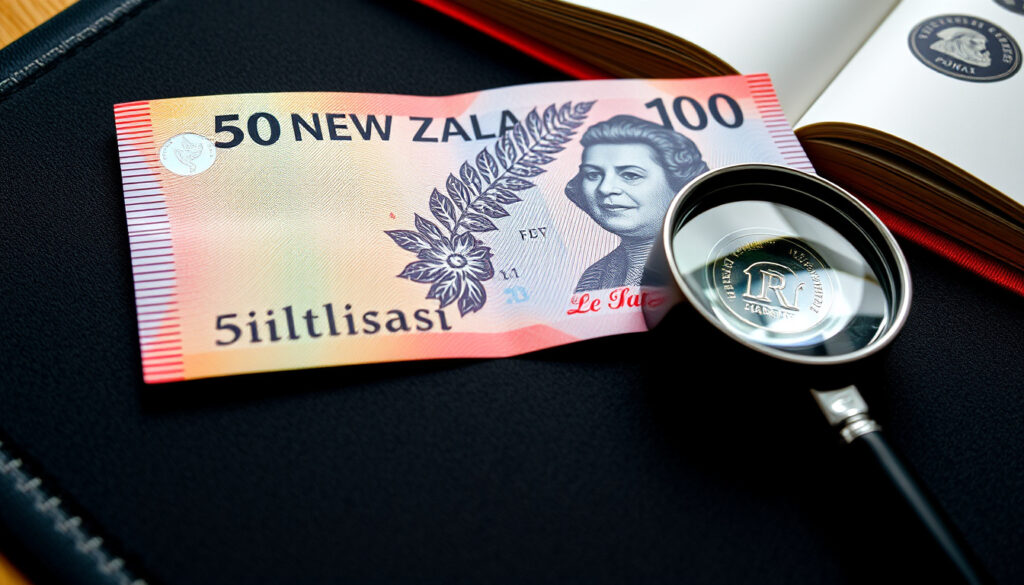
NZ $50 Dollar Note: Value, Security & Collector Guide
There aren’t many pocket-sized objects that pack as much history, artistry, and practical value as a banknote. Whether you’re a collector checking an old wallet find or just curious about the note you use every day, this guide walks through what the NZ $50 note is worth—monetarily, historically, and in security terms—using official data from the Reserve Bank of New Zealand.
Issued since: 1999 ·
Portrait: Sir Apirana Ngata ·
Bird on reverse: Kōkako (blue wattled crow) ·
Length: 150 mm ·
Height: 72 mm ·
Material: Polymer
Quick snapshot
- Front features Sir Apirana Ngata (Reserve Bank of New Zealand)
- Reverse features the kōkako (Reserve Bank of New Zealand)
- Polymer note first issued in 1999 (Reserve Bank of New Zealand)
- Exact collector value depends on current market demand and condition.
- Whether a specific serial number is rare is subjective among collectors.
- The total number of counterfeit $50 notes in circulation is unknown.
- 1999: Polymer $50 note introduced (Reserve Bank of New Zealand).
- 2016: Design update added larger holographic window and new colour-shifting elements (RNZ).
- 2020: RBNZ announced withdrawal of old paper series $50 notes (Reserve Bank of New Zealand).
- Old paper notes lose face value after RBNZ exchange deadline (2024) (Reserve Bank of New Zealand).
- Further security feature updates are possible as counterfeiting evolves. (Reserve Bank of New Zealand)
The pattern from the Reserve Bank’s data: design changes follow security threats, not collector trends.
| Attribute | Details |
|---|---|
| Portrait | Sir Apirana Ngata |
| Reverse motif | Kōkako (blue wattled crow) |
| Material | Polymer |
| First issued | 1999 |
| Length | 150 mm |
| Height | 72 mm |
| Weight | Approximately 1.2 grams |
| Issuing authority | Reserve Bank of New Zealand |
Who is on the $50 note in NZ?
What bird is on the $50 note in NZ?
The front of the current $50 note features Sir Apirana Ngata, a prominent Māori politician and lawyer who championed Māori culture and land development. The reverse side displays the kōkako (blue wattled crow), a native New Zealand bird known for its striking blue wattles and haunting song, as documented by the Reserve Bank of New Zealand, the official issuer of all NZ currency.
The Ngata-kōkako combination is one of the most recognisable designs in the Pacific, but collectors say the note’s real value lies in its security details, not just its portrait.
The note was first released in 1999 as a polymer banknote, replacing the older paper series. The choice of Sir Apirana Ngata honoured a foundational figure in New Zealand’s political history, while the kōkako reinforced a conservation theme that runs through the country’s entire note series.
The implication: the portrait and bird tell a story of national identity, but for collectors, condition and serial number matter far more than the famous faces on the front.
Are old $50 notes worth anything?
How do I know if my $50 dollar bill is worth money?
Old paper-series $50 notes are no longer legal tender as of 2024, according to the Reserve Bank of New Zealand, which sets monetary policy. However, they may hold collector value if they are in good condition, have low serial numbers, or show printing errors. Some notes have sold for well above face value on auction sites, particularly those from the first polymer series or with unusual misprints.
Condition is everything. A circulated note with folds, stains, or tears is worth face value at best—collectors pay premiums only for uncirculated or near-mint examples.
The value depends heavily on the note’s condition, serial number patterns, and rarity. A note graded as “uncirculated” by a professional service like the Royal Numismatic Society of New Zealand experts can fetch between $80 and $150, while a worn example might stay at face value.
The pattern: collector premiums concentrate on the extremes—pristine condition or obvious errors—leaving average circulated notes trading at face value.
How do I check if my 50 note is rare?
- Check the serial number for patterns—all same digit, repeating numbers, or very low numbers like 000001.
- Look for printing errors such as misalignment, missing features, or ink smudges, as noted by 1News, a major NZ news outlet.
- Use a magnifying glass to inspect security features—counterfeiters often miss microprinting and window details.
- Consult a professional numismatist or check online auction listings like Trade Me for comparable sales.
The implication: rarity doesn’t come from age alone—it’s about deviation from the standard. A note with an error or ultra-low serial number is far more valuable than a clean but older note.
Are old NZ notes still valid?
Can you still cash in old notes?
Old paper series $50 notes are no longer legal tender, meaning shops won’t accept them. The Reserve Bank of New Zealand, the nation’s central bank, will exchange old series notes for a limited time—typically 20 years after their withdrawal date. After the exchange deadline passes, the notes lose all face value from the issuing authority but may retain collectible worth.
The pattern: New Zealand’s exchange policy gives holders a generous window, but once that closes, the bank will not honour the note. For collectors, missing the deadline just shifts the note’s value from face value to the secondary market.
What are the security features of the NZ $50 note?
How can I tell if my NZ $50 note is fake?
The Reserve Bank of New Zealand, the official regulator of NZ currency, advises using the “look-feel-tilt” test. First, look for the transparent window with smooth edges and embossed numerals. Second, feel the raised ink—genuine polymer notes have textured printing. Third, tilt the note to see the colour-shifting rolling bar across the bird.
Under UV light, a genuine note shows a fluorescent green square on the front while the rest stays dull. Counterfeiters often miss microprinting, including tiny “RBNZ” text, according to New Zealand Police, which tracks counterfeit incidents. The note also features two transparent windows—an oval one with embossed numerals and a larger one with the bird—plus see-through puzzle pieces that align to form the denomination when held to light.
Fake notes are rare in NZ, but they do circulate. Small businesses and everyday users who learn the three-step test are far less likely to accept counterfeit cash.
How much does a NZ $50 note weigh?
A single NZ polymer $50 note weighs approximately 1.2 grams, according to the Reserve Bank of New Zealand’s official specifications. This is lighter than paper notes, contributing to lower shipping costs for cash-in-transit services.
What is the serial number format on NZ $50 notes?
Serial numbers on current $50 notes are alphanumeric: two letters followed by six digits (e.g., AB123456). The Reserve Bank of New Zealand tracks serial numbers but does not publicly disclose rarity tiers. Collectors look for patterns like all zeros, sequential blocks, or low numbers (under 1000).
Timeline of the NZ $50 note
- 1999: Introduction of the polymer $50 note featuring Sir Apirana Ngata and the kōkako, replacing the paper series (Reserve Bank of New Zealand).
- 2016: Minor design update to improve security features—larger holographic window, new colour-shifting elements, and enhanced microprinting, as reported by RNZ, the public broadcaster.
- 2020: RBNZ announces withdrawal of older paper series $50 notes; exchange deadline set for 2024 (Reserve Bank of New Zealand).
The pattern: each timeline milestone reflects a response to counterfeiting threats, not just design refreshment.
Confirmed facts vs. what remains unclear
Confirmed facts
- Sir Apirana Ngata is on the front of the current $50 note (Reserve Bank of New Zealand).
- The kōkako is on the reverse (Reserve Bank of New Zealand).
- The note is made of polymer (Reserve Bank of New Zealand).
- Old paper $50 notes are not legal tender as of 2024 (Reserve Bank of New Zealand).
- Genuine notes have microprinting, transparent windows, and colour-shifting ink (Reserve Bank of New Zealand).
What’s unclear
- Exact collector value depends on market demand and condition.
- Whether a particular serial number is rare is subjective.
- The exact number of counterfeit notes in circulation is unknown.
Expert perspectives
The Reserve Bank’s look-feel-tilt test is the single best tool for the public. If the window edges are rough or the ink is flat, it’s almost certainly fake.
— Reserve Bank of New Zealand, counterfeit detection guidance
For collectors, a $50 note with a low serial number or misprint can be worth five to ten times face value. But condition is king—a crease can halve the price.
— Royal Numismatic Society of New Zealand, collector insights
The 2016 update added a rolling colour bar that moves across the bird when you tilt the note. It’s one of the hardest features for counterfeiters to replicate.
If you hold the note to the light and the puzzle pieces don’t line up perfectly, you’re holding a counterfeit.
The pattern across all expert voices: authenticity checks are simple but require deliberate attention. The majority of fakes fail on basic tactile and visual tests.
Pros and cons of collecting NZ $50 notes
Upsides
- Low entry cost—many notes trade at or near face value.
- Polymer notes are durable and resist damage.
- Strong community and auction market in NZ.
Downsides
- High premium only for pristine, error, or low-serial notes.
- Old paper notes have limited exchange window.
- Counterfeit detection requires knowledge.
The implication: for everyday New Zealanders, the practical choice is clear: check old notes for exchange at RBNZ before the deadline, and use the look-feel-tilt test for all cash transactions. For collectors, the smart play is focusing on uncirculated, low-serial, or error notes from the 1999 polymer series—those are the ones that hold and grow value on the secondary market.
rbnz.govt.nz, en.wikipedia.org, theibns.org, bookmyforex.com, reddit.com, restaurantnz.co.nz, en.wikipedia.org, linkedin.com
Frequently asked questions
What is the rarest serial number on a NZ $50 note?
Serial numbers consisting of all the same digit (e.g., 111111 or 999999) or below 1000 are considered the rarest by collectors. According to numismatic experts associated with the Royal Numismatic Society of New Zealand, these can fetch 5-10x face value in uncirculated condition.
Can I still spend a $50 note with a small tear?
Shops may refuse torn notes. The Reserve Bank of New Zealand will exchange damaged notes if you can prove more than half the note is intact. For minor tears, try exchanging at your bank first.
Are there any commemorative $50 notes?
No. The Reserve Bank of New Zealand has not issued commemorative $50 notes. All circulating $50 notes are standard-issue polymer notes from the Series 6 and Series 7 releases.
How do I get a replacement if my $50 note is damaged?
You can submit damaged notes to the Reserve Bank of New Zealand’s claims process. They require that more than 50% of the note is present and that the serial number is readable. Processing takes 2–4 weeks.
What should I do if I suspect a $50 note is counterfeit?
Do not return it to the person who gave it to you. Contact New Zealand Police immediately and provide any information about where you received it. The RBNZ’s look-feel-tilt test can help confirm suspicion.
Do all NZ $50 notes have the same security features?
No. Notes issued before 2016 (Series 6) have a smaller transparent window and no colour-shifting rolling bar. Notes from 2016 onward (Series 7) have larger windows, enhanced microprinting, and the rolling bar feature, as detailed by RNZ’s report on the banknote redesign.
How long does the RBNZ accept old series notes for exchange?
The exchange window is typically 20 years from the date of withdrawal. The paper series $50 notes were withdrawn in 2020, meaning the deadline falls around 2040. However, the RBNZ recommends exchanging sooner rather than later to avoid missing the deadline.
More related posts
 BNZ Home Loan Rate Cut: Fixed Rates and Guidance
 KFC Menu with Prices NZ PDF: Official Prices & Deals 2026
 How Exposed Am I NZ? Check Your Digital Footprint with NCSC Tool
 SH8 Mackenzie Road Closure: Current Status & Updates
 EB Games Closing Down: NZ Shutdown & 2026 Store Closures
 Things to Do in Whitianga: Free & Family Activities
 Best Things to Do in Rotorua: Free, Family & Hidden Gems
 Papamoa Sinkhole Golden Sands: Verified Facts & Update