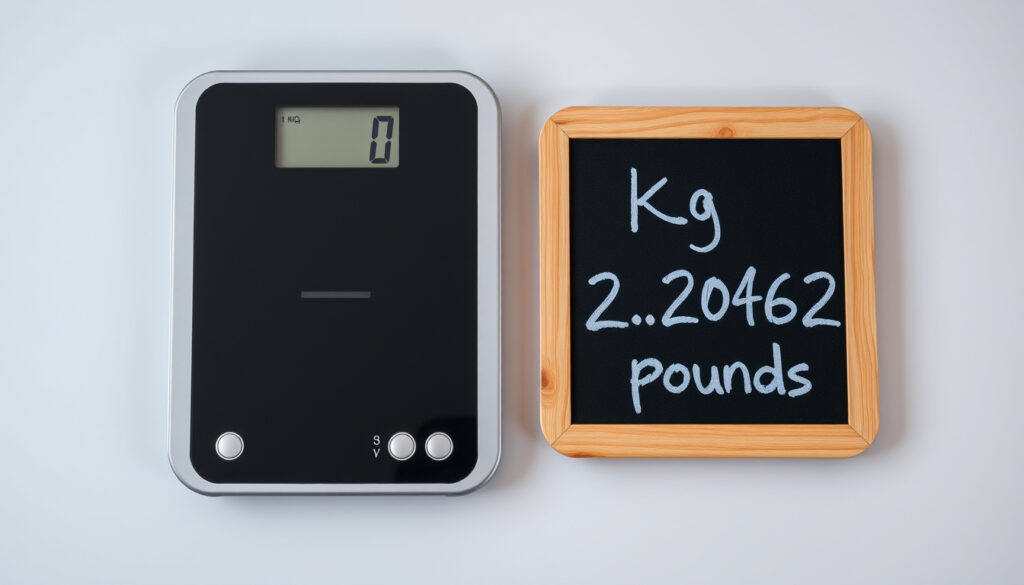
Convert kg to pounds: exact formula & quick examples
If you’ve ever stared at a weight in kilograms and wondered how it measures up in pounds—or stones—you’re not alone. The metric and imperial systems don’t always play nice, but converting between them is simpler than it looks. Thanks to the International Yard and Pound Agreement of 1959, one kilogram equals exactly 2.204623 pounds, a figure officially adopted by the U.S. National Institute of Standards and Technology (NIST). In this guide, you’ll get the exact formula, a quick-reference table, and step-by-step examples for everyday weights like 70 kg, 69 kg, and 68.5 kg—plus how to handle stones if you live in the UK or Commonwealth.
1 kilogram in pounds: 2.20462 lb · 1 stone in pounds: 14 lb · 1 kilogram in stones: 0.157473 st · 1 pound in kilograms: 0.453592 kg
Quick snapshot
Kilograms to Pounds
1 kg = 2.20462 lb. Multiply kg by 2.20462 for pounds.
Kilograms to Stones
1 kg = 0.157473 st. Divide pounds by 14 for stones.
Pounds to Kilograms
1 lb = 0.453592 kg. Multiply pounds by 0.453592 for kg.
Stone to Pounds
1 stone = 14 lb exactly. Multiply stones by 14 for pounds.
Reference table
- 1 stone = 14 lb = 6.35029318 kg – The Calculator Site (UK conversions reference)
- Pound defined as 0.45359237 kg by international agreement – NIST Guide to SI Appendix B.9
- The International Yard and Pound Agreement of 1959 fixed the pound at 0.45359237 kg – CleverCalculator (converter reference)
Conversion table: kg to pounds and stones
| Kilograms (kg) | Pounds (lb) | Stones (st) |
|---|---|---|
| 1 kg | 2.20462 lb | 0.157473 st |
| 68.5 kg | 151.016 lb | 10 st 11.0 lb |
| 69 kg | 152.119 lb | 10 st 12.1 lb |
| 70 kg | 154.323 lb | 11 st 0.3 lb |
| 80 kg | 176.370 lb | 12 st 8.4 lb |
| 90 kg | 198.416 lb | 14 st 2.4 lb |
| 100 kg | 220.462 lb | 15 st 10.5 lb |
Pattern: each additional kg adds roughly 2.2 lb; stone boundaries occur at 14 lb increments.
How much is 1 kg to 1 pound?
The core relationship is defined by international standards: one kilogram equals exactly 2.20462262185 pounds. The pound itself is defined as 0.45359237 kg, a number set by the 1959 agreement and maintained by NIST.
For everyday use, the conversion formula is simple:
- Pounds = kilograms × 2.20462
- Kilograms = pounds ÷ 2.20462 (or × 0.45359237)
The practical takeaway: whether you’re weighing luggage at the airport or tracking your body weight, multiplying by 2.2 gives you a quick estimate that’s accurate to within 0.2 lb per kg. For exact numbers, the full factor of 2.20462 keeps things precise without overcomplicating the math.
How heavy is 70 kg in stones?
Converting 70 kg to stones and pounds
To convert 70 kg to pounds: 70 × 2.20462 = 154.323 lb. Then divide by 14 to get stones: 154.323 ÷ 14 = 11.023 st. In stones and pounds, that is approximately 11 stone 0.3 lb (or 11.02 st) per The Calculator Site chart.
The two-step process is always the same: kg → lb (multiply by 2.20462), then lb → st/lb (divide whole pounds by 14, keep the remainder).
“70 kg is above 11 stone, but just barely over the threshold.”
Where this matters in practice:
- Health clinics (UK): Body weight is recorded in stones and pounds; 70 kg appears as 11 st 0.3 lb.
- Fitness apps: International users often toggle between kg and lb – 70 kg = 154 lb is a common input.
The analytical takeaway: 70 kg sits just above a major stone milestone, making it a useful benchmark for anyone tracking weight loss or gain in the UK system.
How heavy is 69 kg in stones?
Converting 69 kg to stones and pounds
69 kg is approximately 152.119 lb (The Calculator Site chart). Dividing by 14 gives 10.866 st, or 10 stone 12.1 lb.
How 69 kg compares to other weights
The pattern: a single kg changes the stone category only when crossing the whole-stone boundary (14 lb). Since 69 kg is 2.1 lb below 11 stone, it remains in the 10-stone range—a distinction that matters on UK health forms.
For context, 69 kg is 0.9 lb less than 70 kg’s 154.3 lb total. That small difference keeps 69 kg under the 11-stone threshold, which can be psychologically meaningful for people tracking milestones.
The analytical takeaway: knowing exactly where a weight sits relative to stone boundaries helps avoid rounding confusion in medical or fitness settings.
What is 68.5 kg in stones and pounds?
Converting 68.5 kg to stones and pounds precisely
The process for any decimal weight is identical: multiply by 2.20462 to get pounds, then divide by 14. So 68.5 × 2.20462 = 151.016 lb (The Calculator Site chart). Dividing by 14: 151.016 ÷ 14 = 10.787 st, or 10 stone 11.0 lb.
The Calculator Site’s chart lists 68.5 kg as exactly 10 st 11.0 lb, confirming the calculation.
Decimal kilograms give more granular data, but the stone-and-pounds result can feel less intuitive because 0.5 kg is only about 1.1 lb – barely noticeable on a bathroom scale. For medical records, kilograms or pounds alone are often preferred.
The analytical takeaway: decimal precision in kg translates to small, often imperceptible shifts in stone/pound terms, making rounded units more practical for most personal use.
What is 8 stone 0 in kg?
Converting stones to kilograms
Since 1 stone = 14 lb, 8 stone = 112 lb. Then convert pounds to kilograms: 112 × 0.45359237 = 50.802 kg (rounding to 50.8 kg).
Where this conversion appears:
- Common in weight charts: 8 stone (112 lb, 50.8 kg) is a typical healthy weight for a female of average height in the UK.
- Medical records: The NHS standardises weight in kg, but many people remember their weight in stones; converting both ways prevents errors.
The analytical takeaway: for anyone using UK-style health scales, knowing your weight in both systems avoids confusion during doctor visits or when using international apps.
Step-by-Step Manual Conversion
Converting between kg, lb, and st is straightforward with these steps:
- Write down the weight in kilograms. For example, 70 kg.
- Multiply by 2.20462 (or 2.204623 for even higher precision). 70 × 2.20462 = 154.323 lb.
- If you need stones: Divide the pounds by 14. 154.323 ÷ 14 = 11.023 st.
- Separate whole stones and remainder: 11 st and 0.023 × 14 = 0.3 lb. So 70 kg = 11 st 0.3 lb.
- Round to taste: For most purposes, round pounds to one decimal or half-pound increments.
Rounding too early (e.g., using 2.2 instead of 2.20462) can introduce errors of up to 0.5 lb per 10 kg. For precise measurements, always use the full factor; for quick estimates, 2.2 is acceptable if you acknowledge the small deviation.
The analytical takeaway: mastering this two-step conversion (kg → lb → st/lb) gives you full fluency across metric, imperial, and UK-specific units—no calculator needed beyond basic arithmetic.
nist.gov, irelandbrief.org, nist.gov, irelandledger.net, go-tools.org, unitplanet.com, bulkcalculator.com, metric-conversions.org
Frequently asked questions
How many kilograms in a stone?
1 stone = 6.35029 kg. This is derived from 14 lb × 0.45359237 kg/lb.
What is 10 stone in kg?
10 stone = 140 lb = 63.50 kg (exact: 63.5029 kg).
How do I convert pounds to kilograms?
Divide pounds by 2.20462, or multiply pounds by 0.45359237. Example: 150 lb ÷ 2.20462 = 68.0 kg.
What is the difference between a pound and a kilogram?
A kilogram is the base SI unit of mass, about 2.2 lb. A pound is a unit defined as 0.45359237 kg, used primarily in the US, UK, and Commonwealth.
How many pounds in a stone?
1 stone = 14 lb exactly.
How do I convert kg to stones manually?
Divide kilograms by 6.35029 (or by 14 after converting to pounds). Example: 70 kg ÷ 6.35029 = 11.02 st.
For anyone managing weight, travel luggage, or fitness goals across metric and imperial systems, the skill of manual conversion is a quiet superpower. The numbers are fixed by international standards – what changes is how you apply them. UK readers dealing with stones should master the two-step (kg → lb → st/lb), while international travellers can rely on the single factor of 2.20462 to keep luggage under limit. Whether you’re tracking a 0.5 kg fluctuation or planning a 70 kg luggage allowance, these formulas give you exact answers every time.
More related posts
 Biggies Pizza Green Island Menu, Hours, Delivery & Reviews
 Bank Holiday Social Welfare Payments: When You Get Paid in 2026
 Parliament Petition Playground Safety: Latest Updates and Guide
 Class 2 License NZ Theory Test: The Complete Guide
 Best Program to Learn Spanish in 2026: Top 5 Compared
 True Detective Season 3: Review, Cast, and Is It a True Story
 Solar Eclipse NZ 2025: Time, Visibility & Safety