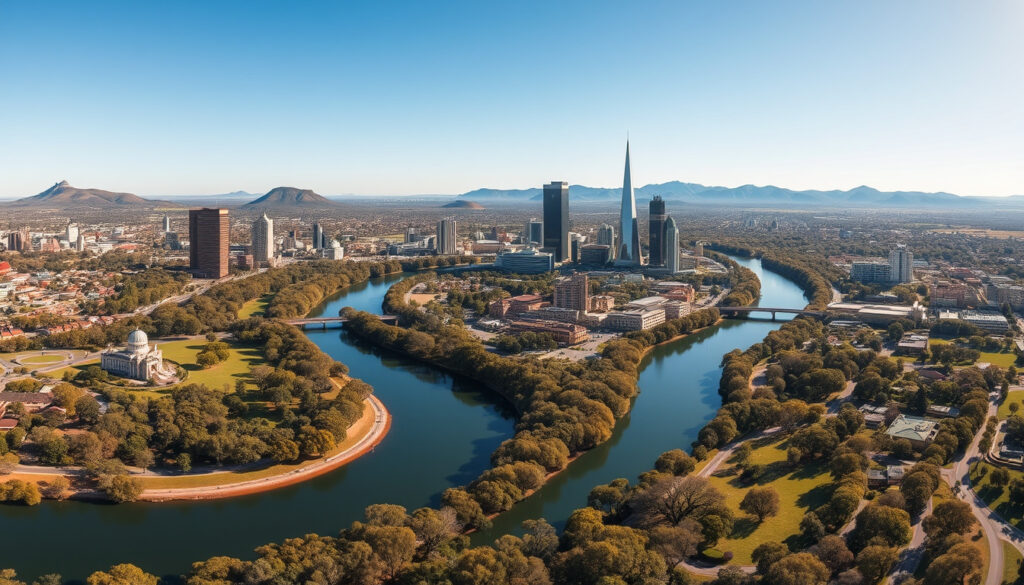
Things to Do in Adelaide: Plan Your 20-Minute City Trip
Adelaide packs surprisingly more variety into a 20‑minute radius than most capital cities – making it a perfect destination for efficient travel. This guide uses that compact design to help you build an itinerary‑driven visit that covers food, wine, nature, and culture without wasting time on travel.
Known as: the 20-minute city · Population (metro): 1.4 million · Cost of living: lower than Sydney and Melbourne · Major wine regions nearby: Barossa, McLaren Vale, Adelaide Hills · Average commute time: under 20 minutes
Quick snapshot
- Adelaide’s compact layout means most central attractions are within a 20-minute drive or walk (South Australia Tourism Trade (official tourism authority))
- Adelaide was named Best Place to Travel in 2026 (Tourism South Australia (state tourism body))
- The city has a burgeoning small-bar scene, world-class art, and a festival calendar that rivals other Australian capitals (Tourism Australia (national tourism agency))
- The exact number of wineries in the Adelaide Hills varies by source (Visit Adelaide Hills (region tourism board))
- Safety perceptions of specific suburbs can differ — always check current local advisories (GOV.UK Foreign travel advice (UK government travel guidance))
- Australia Tourism Exchange 2026 is scheduled for May 2026 in Adelaide (Minister for Trade and Tourism media release (Australian government))
- Adelaide’s Best Place to Travel 2026 title signals a surge in international interest (Tourism South Australia)
- ATE26 will give international buyers first-hand exposure to South Australia’s tourism offerings (Tourism Australia (national tourism agency))
Six key facts at a glance — one pattern: Adelaide blends urban convenience with nature access, making it easy to switch between city and countryside without long transfers.
Here’s how Adelaide stacks up against the other major capitals.
| Category | Adelaide | Sydney & Melbourne |
|---|---|---|
| Cost of living | Lower | Higher |
| Average hotel price | $150–250/night | Typically higher |
| Average meal price | $20–30 AUD | Typically higher |
| Category | Details |
|---|---|
| Best time to visit | March–May or September–November for mild weather |
| Currency | Australian Dollar (AUD) |
| Language | English |
| Time zone | ACST (UTC+9:30) |
| Airport | Adelaide Airport (ADL), 7 km from city center |
| Getting around | Adelaide Metro trains, trams, and buses; free City Connector bus |
Is there anything fun to do in Adelaide?
What are the top attractions in Adelaide?
- Adelaide Zoo — home to the only giant pandas in the Southern Hemisphere (Tourism Australia)
- Art Gallery of South Australia — free entry to a collection spanning 45,000 works (Art Gallery of South Australia (state cultural institution))
- Adelaide Central Market — a 150-year-old food market with more than 70 stalls (Tourism Australia)
What outdoor activities can I do in Adelaide?
- Hike Mount Lofty Summit for panoramic city views (South Australia Parks (state park authority))
- Cycle the River Torrens Linear Park trail — a 30‑km path from the hills to the coast
- Swim at Glenelg Beach, just 20 minutes by tram from the city center (Adelaide Metro)
Is Adelaide good for wine lovers?
Absolutely. The city sits at the doorstep of three world-famous wine regions: Barossa Valley, McLaren Vale, and Adelaide Hills. A day trip to any of them is doable in under an hour by car, and many cellar doors offer tastings without a booking (South Australia Tourism Trade).
The implication: visitors can mix experiences that would require separate trips in larger cities.
Is 3 days enough in Adelaide?
Yes — 72 hours gives you time to absorb the city’s highlights and one day trip. The key is sequencing your activities to minimise backtracking.
What is a good 3-day itinerary?
- Day 1 – City core: North Terrace museums, Adelaide Central Market for lunch, Rundle Mall shopping, evening small‑bar crawl in the East End.
- Day 2 – Wine country: Join a guided tour to Barossa Valley or McLaren Vale; most include tastings and lunch (Tourism South Australia).
- Day 3 – Coast & hills: Morning at Glenelg Beach, afternoon drive to Mount Lofty or Cleland Wildlife Park to see koalas and kangaroos.
Can you visit Adelaide Hills in one day?
Easily. The Adelaide Hills are 20–30 minutes from the city center. You can visit Hahndorf (a historic German village), sample wine at Henschke, and walk the Mount Lofty Botanic Garden in a single day (Visit Adelaide Hills).
Three days is enough to experience Adelaide’s diversity without feeling rushed — but only if you plan by geography, not just by attraction.
The catch: sticking to a geography‑based itinerary prevents backtracking and makes the most of limited time.
Why is Adelaide called the 20 minute city?
What does the 20-minute city concept mean?
Adelaide’s original 1830s layout — a grid with wide streets and encircling parklands — means most places are physically close. According to South Australia Tourism Trade, the term “20‑minute city” reflects that beaches and hills are reachable in about 20 minutes by car, and central destinations are walkable in about 20 minutes.
How does Adelaide’s layout benefit visitors?
- No need for a rental car if you stay central — the free City Connector bus covers key stops.
- You can switch from a museum visit to a beach sunset in under half an hour.
- Day trips to wine regions fit comfortably into a half‑day schedule.
A 2019 ABC News report noted that urban sprawl and road bottlenecks have stretched the “20‑minute” promise in outer suburbs (ABC News (public broadcaster)). The concept still holds for the tourist core, but be aware that fringe districts can take longer.
The pattern: the 20‑minute label is a reliable guide for central and coastal areas, not for every suburb.
Is Adelaide expensive or cheap?
How does Adelaide compare to other Australian cities?
Adelaide is consistently more affordable than Sydney and Melbourne. Accommodation, dining, and transport all come at a lower price point. Experience Adelaide (city visitor bureau) highlights that the city’s lower cost of living — around 12% below the national average — extends to tourists.
What is the cost of accommodation, food, and transport in Adelaide?
- Meal: A main course at a mid‑range restaurant averages $20–30 AUD.
- Accommodation: City‑centre hotels from $150–250 AUD per night; hostels from $30–50 AUD.
- Transport: One‑way bus/tram ticket $3.50 AUD; day cap $9.70 AUD (Adelaide Metro).
For a 3‑day trip, budget around $600–$900 AUD per person including accommodation, food, and one day tour.
What this means: the money saved on daily expenses can be redirected to unique experiences that are often budget‑busters elsewhere.
What are the rough areas of Adelaide?
Which suburbs should tourists avoid?
The northern suburbs — particularly Elizabeth, Davoren Park, and parts of Salisbury — have higher crime rates and fewer tourist amenities. The U.S. Department of State (U.S. government travel advisory) and GOV.UK Foreign travel advice both note that urban crime exists but is concentrated in specific areas.
Is Adelaide a safe city for visitors?
Tourist zones — the city center, North Adelaide, Glenelg, and the Adelaide Hills — are considered very safe. Experience Adelaide notes the city consistently ranks in the top 10 most liveable cities globally, a factor that supports its safety reputation. As with any city, stay aware in quiet areas at night and keep valuables secure.
Safety concerns are real but localised. A visitor sticking to the inner ring and beach suburbs will likely never encounter the areas with higher crime — but it’s worth knowing the map.
The implication: tourists who stay within the core and popular beach areas can enjoy a safe visit without worrying about crime.
Confirmed facts
- Adelaide’s 20‑minute layout is a genuine advantage for tourists (South Australia Tourism Trade)
- Adelaide is more affordable than Sydney and Melbourne (Experience Adelaide)
- Adelaide Hills is a viable day‑trip destination (Visit Adelaide Hills)
What’s unclear
- Exact winery counts in Adelaide Hills vary by source (Visit Adelaide Hills)
- Safety perceptions can differ — check local advisories (GOV.UK)
- Future traffic congestion may stretch the 20‑minute promise in outer suburbs (ABC News)
“Adelaide’s 20‑minute layout means you can experience a wine tour and a beach sunset in the same day without rushing.”
Time Out travel writer (Time Out Adelaide (travel guide))
“You’ll find plenty of places to visit in the Adelaide Hills — from cellar doors and farmers’ markets to walking trails and wildlife parks.”
For a visitor making a 2026 travel decision, the implication is clear: Adelaide delivers variety at a lower cost than Australia’s eastern capitals, provided you stay within the inner ring and plan around the 20‑minute geography. For budget‑conscious travellers or families who want a mix of city, nature, and wine without long transfers, Adelaide is the practical choice — and the recently added international attention from the ATE26 event only strengthens the case.
Leveraging the city’s compact layout, you can follow this ultimate 3-day itinerary to make the most of every hour without wasting time on transit.
Frequently asked questions
Is Adelaide safe for tourists?
Yes, tourist areas like the city center, North Adelaide, Glenelg, and the Adelaide Hills are very safe. Outer northern suburbs have higher crime rates, but visitors rarely need to go there. Check GOV.UK or U.S. State Department for current advice.
Do I need a car in Adelaide?
Not if you stay central. The free City Connector bus, tram to Glenelg, and train to Outer Harbor cover most tourist needs. For wine regions or Adelaide Hills, a car or guided tour is convenient (Adelaide Metro).
What is the best time of year to visit Adelaide?
March–May (autumn) and September–November (spring) offer mild weather and fewer crowds. Summer (Dec–Feb) is hot but full of festivals; winter (Jun–Aug) is cooler and quieter.
Can I see kangaroos in Adelaide?
Yes. Cleland Wildlife Park in the Adelaide Hills lets you hand‑feed kangaroos and see koalas. Kangaroo Island, a 30‑minute flight or 2‑hour drive + ferry, has abundant wildlife (South Australia Parks).
What public transport is available in Adelaide?
Adelaide Metro operates trains, trams, and buses. The tram runs from the city to Glenelg Beach. The free City Connector loops the main shopping and cultural districts (Adelaide Metro).
Are there any free walking tours?
Yes. Adelaide Free Walking Tours offers a daily 1.5‑hour tour of the city center covering history, architecture, and local tips. Book online or meet at the South Australian Museum steps (Adelaide City Council).
More related posts
 Online Jobs from Home in Ireland: No Experience Needed
 Te Ika-a-Māui: Meaning, Story, and Cultural Significance
 BNZ Home Loan Rate Cut: Fixed Rates and Guidance
 Houses for Sale Oxford NZ: Buying Guide & Market Insights
 What Does Collate Mean When Printing? Examples & Guide
 Song Joong-ki 2025: Divorce, Wife, Children, Net Worth
 Dunedin Houses for Sale: Find Your Next Home in New Zealand
 Dodgers vs Toronto Blue Jays Match Player Stats: Game 7