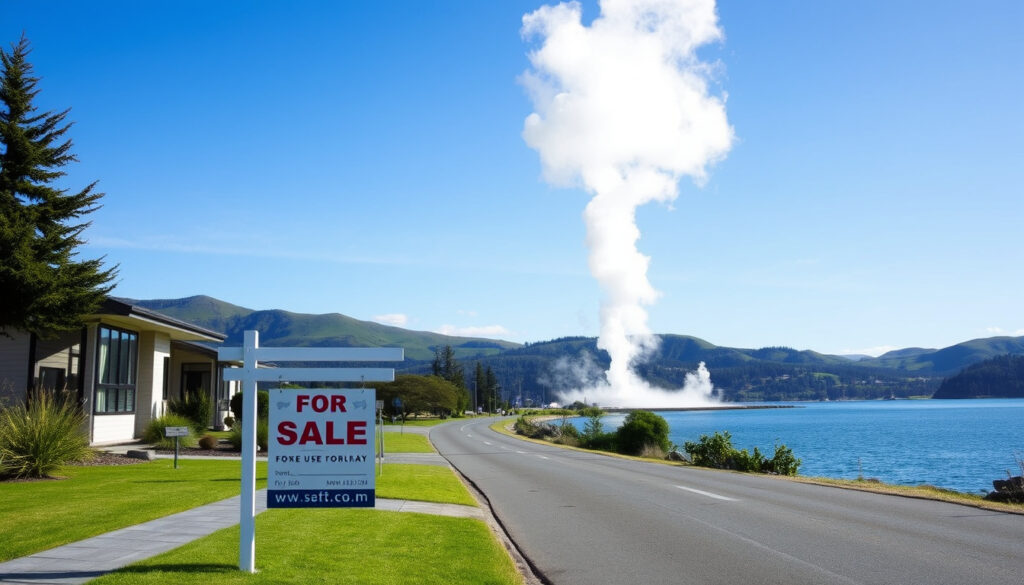
Homes for Sale Rotorua: Prices, Best Suburbs & Buying Guide
If you’ve been scanning Trade Me or OneRoof for homes for sale in Rotorua, you’ve probably noticed a market that rewards patience. Prices are below the national spotlight centres, but the foreign-buyer ban and changing values make local knowledge essential. This guide pulls together current listing counts, average values, suburb signals, and buying rules so you can see the full picture before you book viewings.
Homes for Sale Rotorua: Your Complete Guide
Here are the key numbers from current Rotorua listings and market data:
| Metric | Figure | Reference |
|---|---|---|
| Homes listed on RealEstate.co.nz (Sep 2026) | 302 | RealEstate.co.nz listings |
| Homes listed on OneRoof (property filter) | 304 | OneRoof’s property search |
| Homes listed on OneRoof (broader search) | 435 | OneRoof’s broader search |
| Average property price (Aug 2026) | $672,961 | Opes Partners market report |
| National QV change (3 months to Aug 2026) | -1.9% | QV House Price Index |
| Sample asking prices from current listings | $519,000–$685,000 | Rotorua listings page |
What’s the average house price in Rotorua?
Opes Partners, citing QV data, put Rotorua’s average property price at $672,961 in August 2026. The same report showed prices down 3.52% over the previous three months and 4.80% over the previous year. Nationally, QV’s House Price Index reported residential values fell 1.9% in the three months to the end of August 2026, so Rotorua’s dip was sharper than the national average.
Asking prices on current listings varied widely. Recent examples included 32 Gem Street at $519,000 and 8 Devon Street at $685,000, and one Rotorua listings page included homes up to $950,000. Use these as ballparks, not benchmarks.
For buyers, that means the market is not moving in one direction. A wide asking-price range plus falling quarterly values suggests there may be room to negotiate, especially on properties that have been listed for a while.
What is the best area to live in Rotorua?
Trade Me’s Rotorua residential-sale search included homes across Ōwhata, Mangakakahi, Pukehangi, Western Heights, Glenholme, Lynmore, Kawaha Point, Ngongotahā, and Selwyn Heights. That list is a good starting point because it shows where inventory is concentrated.
The right suburb depends on your daily routine. If you want to be close to the lake, Ōwhata and Kawaha Point are worth a look. If you need easy access to shops and schools, Pukehangi and Western Heights may fit better. For a slightly more rural feel, Ngongotahā and Selwyn Heights sit further out while staying practical.
For families, Rotorua Lakes High School is a useful anchor. Listings near the school tend to attract wider buyer interest, which can help with resale later. Spend an afternoon driving through the streets at different times of day before you decide.
The best area is the one that balances your commute, school catchment, and budget. A lower-priced home in a less central suburb can work if the travel time still feels reasonable.
Is Rotorua a good place to invest in property?
Rotorua’s average price is lower than many New Zealand centres, which can make rental returns easier to achieve. But the same forces that cool the market — including the foreign-buyer ban and softer values — can also slow capital growth.
The foreign-buyer ban has been in place since 2018. OneRoof’s explainer notes that foreign buyers can still purchase some lifestyle or residential property as defined by the local council valuation roll, but they cannot buy sensitive land such as properties over 5 hectares without approval. That creates a two-tier market: standard residential sections face less overseas competition, while lifestyle blocks face more scrutiny.
Specific rental yield data requires up-to-date local sources, but Rotorua’s affordability suggests the numbers can work. Run the figures for your target suburb rather than relying on national averages.
For investors, the bigger risk may be overpaying in a soft market. Patience and suburb-level analysis matter more than chasing a headline yield.
Can a foreigner buy a house in New Zealand?
Under current New Zealand rules, most overseas people cannot buy an existing house. LINZ’s overseas investment guidance states that people on temporary, limited, interim, or transit visas, as well as overseas people without a visa, cannot buy or build a home in New Zealand.
The restriction has been in place since 2018, when the government banned many foreigners from buying existing homes. BBC News reported that the ban applies to non-residents, but Australians and Singaporeans are exempt because of free-trade agreements.
There is an important technicality. The Treasury’s guidance explains that the ban does not apply to residential houses or dwellings, but to land zoned residential or lifestyle that is deemed sensitive. That distinction matters for buyers looking at lifestyle blocks or bare sections.
If you are not a New Zealand citizen or resident, check your visa status and get professional advice before making an offer. The rules are strict, and the consequences of getting it wrong are serious.
Is it cheaper to buy a house in NZ or Australia?
Rotorua’s average property price of $672,961 is well below the median in Sydney or Melbourne. New Zealand also has no stamp duty, though GST applies to new builds. That can lower the upfront cost of buying in Rotorua compared with many Australian states, where stamp duty adds to the deposit needed.
But the comparison is not just about the sticker price. You also need to weigh local wages, council rates, insurance, and the likely direction of prices. Rotorua’s market has been softening, while some Australian cities have shown stronger growth, so a cheaper home does not always mean a better investment.
For most buyers, the real answer depends on your income, deposit, and long-term plans. If you can buy in Rotorua with less debt, that may be worth more than chasing a faster-growing market elsewhere.
How to handle the buying process in Rotorua
Start by searching the local portals such as RealEstate.co.nz, OneRoof, and Trade Me. Use filters for price, suburb, and school zones to narrow down the list before you start viewing.
Get pre-approval from a bank or broker before you start making offers. In a soft market, a pre-approved buyer can negotiate harder and move faster.
If you are not a New Zealand citizen or resident, confirm your visa status with a lawyer before signing anything. Foreign buyers face extra restrictions, and the earlier you check, the better.
Finally, use a local lawyer for conveyancing. They will check the title, zoning, and any issues with the property before you go unconditional.
For buyers, that means acting on current listings data and local advice before making an offer can turn a promising search into a confident purchase.
Related reading: Opes Partners
Frequently Asked Questions
Is Rotorua a wealthy area?
Not by New Zealand standards. With an average price around $673,000, Rotorua is more affordable than the country’s biggest centres, and the market has been cooling recently.
What salary is needed to live comfortably in NZ?
It depends on your lifestyle and whether you rent or buy. In Rotorua, the lower property prices can reduce the income needed for a mortgage compared with Auckland or Wellington, but you still need enough for rates, insurance, and everyday costs.
What’s the cheapest place to buy a house in New Zealand?
Rotorua is often cited as one of the less expensive urban areas, but cheaper towns exist outside the main centres. The best way to know is to compare current listings in your target price range.
Is it cheaper to live in NZ or UK?
The answer depends on the city and your lifestyle. Rotorua’s property prices are lower than many UK cities, but everyday costs like groceries and rates can balance that out.
For buyers, that means weighing affordability against the rules and market conditions before making an offer.
More related posts
 100,000 USD to NZD: Current Live Rate 162,000 NZD
 Oceans of the World – Guide to the Five Oceans
 Chicken n Things NZ: Online Butcher Menu, Prices & Reviews
 US to NZ Dollar: Live Exchange Rate & Conversion Guide
 Hari Hara Veera Mallu: Release Date, Hit/Flop & Sequel
 Under the Tuscan Sun: Real Story, Locations & Cast
 Attack on Titan Reddit: Community Guide, Ending, Reviews & FAQ
 City Fitness Lower Hutt: Age, Hours, Showers and Rules