Ki o Rahi Field: Rules, Positions, Equipment & Dimensions Guide
If you’ve ever watched a game of Ki o Rahi, the first thing you notice is the circular field – no corners, no end zones. It’s a sport that moves like a tag game crossed with target ball, and it carries a centuries-old Māori legend that gives every run, every block, a deeper meaning.
Players per team: 10 (IFC standard) ·
Field diameter: 40 meters (outer circle) ·
Ball type: Small round ball (ki), ~15 cm diameter ·
Origins: Pre-European Māori legend of Rahi ·
Tournament format: 4 quarters of 10 minutes
The table below outlines the core specifications of Ki o Rahi as played under IFC guidelines.
| Specification | Value |
|---|---|
| Full name | Kī-o-Rahi |
| Category | Traditional Māori ball game |
| Players per side | 10 (standard) |
| Field shape | Circular with concentric zones |
| Governing body | International Federation of Ki o Rahi (IFC) |
| Ball name | Ki |
Quick snapshot
- Ki o Rahi originates from Māori legend (kiorahi.com – official page)
- Standard team size: 10 players per side (IFC rules) (University of Auckland – interfaculty rules)
- Field outer circle: 40 m diameter (Kahui Ako ki Motueka – educational resource)
- The ki is a small round ball (Y Central – youth sports PDF)
- Exact date of origin – pre-European, no written records (Tū Mātau Ora – Māori cultural organisation)
- Historical variation in field dimensions across iwi (tribes) (kiorahi.com – official page)
- Non-contact, tag-based play (Kahui Ako ki Motueka – safety rules)
- Score by hitting the tupu with the ki (Y Central – youth sports PDF)
- Unlimited substitutions allowed (University of Auckland – interfaculty rules)
- Growing international presence through IFC tournaments (kiorahi.com – official page)
- Beginner-friendly with adaptable field sizes (Kahui Ako ki Motueka – educational resource)
What is Ki o Rahi?
Origins as a Māori game
Ki o Rahi is a traditional Māori ball game rooted in the pūrākau (legend) of Rahitutakahina (Rahi) and his wife Tīarakurapakewai. The story, kept alive by oral tradition, tells of Rahi’s journey to rescue his wife from an enemy tribe – a journey reenacted on the field through zones and the central tupu (Tū Mā Tau Ora – Māori cultural organisation). The game existed long before European contact, which means its exact age is unknown, but its cultural continuity is undeniable (kiorahi.com – official page).
Core concept of the game
Two teams compete on a circular field marked into concentric zones. One team attacks by trying to hit the tupu – a padded post at the centre – with the ki (ball). The defending team guards the tupu and can intercept passes. It’s a high‑paced, non‑contact sport that rewards agility and teamwork (Kahui Ako ki Motueka – educational resource).
The implication: the legend transforms gameplay into a cultural lesson, which is why Māori educators value Ki o Rahi as a teaching tool as much as a sport.
When was Ki-o-Rahi invented?
The exact date of origin is unknown. Ki o Rahi predates European contact in New Zealand, with no written records surviving. Oral tradition places it as a pre-European Māori game, with the legend of Rahi providing its narrative foundation (Tū Mā Tau Ora – Māori cultural organisation).
Can beginners play Ki o Rahi?
Yes. The non-contact rules and simple objective – hit the tupu – make it accessible. Field sizes can be adapted for younger or less experienced players, and the IFC encourages rotation so everyone learns multiple positions (Kahui Ako ki Motueka – educational resource). Many school programmes use it as an introductory cultural sport.
Where is Ki o Rahi played today?
Ki o Rahi is played in New Zealand and internationally. Regional leagues operate in Waikato, Bay of Plenty, and Auckland, often run by sports trusts and Māori organisations. The IFC hosts national and world cup events, and the sport is growing through university tournaments and cultural exchanges (kiorahi.com – official page). For context on other New Zealand sports teams, see Black Ferns Sevens Results Today.
What are the basic rules of Ki o Rahi?
Objective of the game
- The attacking team (kaitiaki and kaiwhakatere) aims to hit the tupu with the ki to score points.
- The defending team tries to intercept the ki and prevent it from reaching the tupu (Y Central – youth sports PDF).
Scoring rules
A point is awarded each time the ki strikes the tupu. The attacking team must be in the correct zone when releasing the ball; otherwise the score is disallowed. There are no free kicks – play continues after a score, with the defending team restarting from the tupu zone (University of Auckland – interfaculty rules).
How do you score in Ki o Rahi?
Scoring requires a clean hit on the tupu from within the Pawero zone. The defending team can block with hands or body, but cannot physically impede the thrower. After a score, the defending team restarts play from the tupu zone (Y Central – youth sports PDF).
Fouls and penalties
- No physical contact is allowed – the game is non‑contact, similar to rippa rugby (Kahui Ako ki Motueka – safety rules).
- Possession changes if the ki is dropped, thrown out of bounds, or if a player steps into a zone they are not allowed in.
- A player caught holding the ki for more than three seconds must release it or face a turnover.
Game duration
Standard matches under the International Federation of Ki o Rahi (IFC) are played over 4 quarters of 10 minutes each. Some school‑based versions shorten this to 2 halves of 10 minutes, but the IFC standard is 40‑minute total (University of Auckland – interfaculty rules).
The pattern: Touch football’s pace meets target‑ball scoring, with the tupu as a moving, guarded point of tension. The non‑contact rule keeps play fluid and accessible for mixed‑gender teams.
For schools and community groups, Ki o Rahi offers a low‑cost, high‑energy sport where size and strength matter less than speed and spatial awareness. The IFC’s standardised 4‑quarter format makes it competitive for tournaments without requiring specialist gear.
How many people are on a Ki-O-Rahi field?
Standard team size
Under IFC rules, each team fields 10 players at a time (University of Auckland – interfaculty rules). Some variations – notably the University of Auckland’s interfaculty rules – specify 8 players per side, with a gender balance of 4 male and 4 female players (University of Auckland – interfaculty rules). The 10‑player standard is most common in national tournaments.
Substitution rules
Unlimited substitutions are allowed during play – players swap on the fly, a feature that keeps the game fast and reduces fatigue (Y Central – youth sports PDF).
The catch: The 8‑player variant (common in university competitions) changes spacing and strategy compared to the 10‑player standard. Beginners learning the 10‑player game may find the 8‑player version faster and more open.
What are the different positions in Ki O Rahi?
Kaitiaki (guard)
The primary defender of the tupu zone. The kaitiaki stands near the tupu and tries to block or intercept incoming ki throws (Kahui Ako ki Motueka – educational resource).
Kaitiaki Tuarua (second guard)
A supporting defender who covers the outer ring of the tupu zone and can challenge rushers approaching the inner circle.
Kaiwhakatere (rusher)
The attacking player who, after the ki is released, races toward the tupu to attempt a score (kiorahi.com – official page).
Kaiarawhiti (attacker)
Wing attackers who work the sidelines of the field, passing the ki to create openings toward the tupu.
Other supporting roles
- Kaihōpū (support): Players who assist both attack and defence, often rotating positions during play.
- Whakamua (forward): A role in some versions that pushes forward into the Pawero zone to pressure the defence (Y Central – youth sports PDF).
What this means: Positions are fluid – the IFC encourages rotation, so every player learns to defend, attack, and rush. This versatility is one reason Ki o Rahi is so inclusive for mixed‑ability groups.
What equipment is needed for Ki O Rahi?
The ki (ball)
A small round ball, traditionally made of flax, but modern games use leather or synthetic versions roughly 15 cm in diameter (Kahui Ako ki Motueka – educational resource).
Field markings and tupu
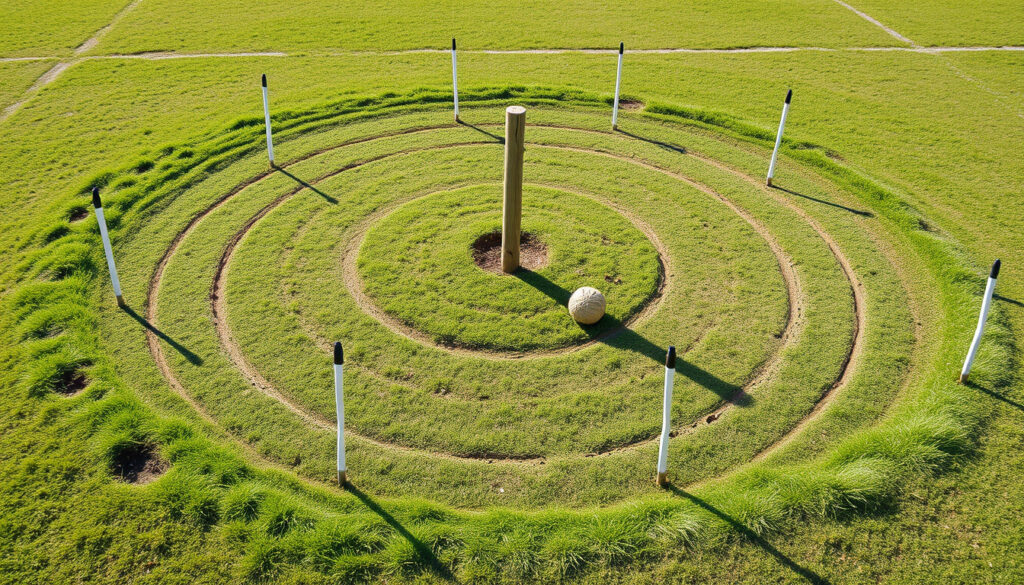
The tupu is a padded post at the centre of the inner circle, standing about 1‑1.5 m tall. Seven pou (markers) are placed around the field to designate zones. If a dedicated set isn’t available, a large barrel or rubbish bin can substitute for the tupu, and cones or rugby corner flags can mark the pou (Kahui Ako ki Motueka – educational resource).
What is the tupu in Ki o Rahi?
The tupu is the central padded post that attackers aim to hit with the ki. It symbolises the hill where Tīarakurapakewai was held captive. In gameplay, it is the scoring target and the focal point of both attack and defence (Tū Mā Tau Ora – Māori cultural organisation).
Protective gear and uniforms
No mandatory protective gear. Players wear team uniforms – typically a shirt and shorts. In school versions, rippa‑style belts with two tags are used to simulate tackles (Kahui Ako ki Motueka – equipment list).
The trade-off: Minimal equipment makes Ki o Rahi cheap to set up, but the lack of protective gear means the non‑contact rule must be strictly enforced to avoid injury.
When adapting field markings for younger players, reduce the tupu height and widen the zones. A 6‑year‑old rushing toward a 1.5‑m post at full speed can be dangerous – padding the tupu is non‑negotiable.
The takeaway: proper setup and supervision are essential, especially when introducing the sport to children.
What is the legend behind Ki O Rahi?
Story of Rahi and Tīarakurapakewai
According to the pūrākau, Rahitutakahina’s wife Tīarakurapakewai was kidnapped by an enemy tribe. Rahi set out on a pursuit that took him across rivers, forests, and hills. The game re‑enacts this journey: the tupu represents the hill where Tīarakurapakewai was held, and the zones symbolise the obstacles Rahi faced (Tū Mā Tau Ora – Māori cultural organisation).
Symbolism in the game
- Te Ao (outer zone): The world Rahi left behind.
- Te Roto (middle zone): The crossing place, often representing a lake or river.
- Pawero (inner zone around tupu): The hilltop where the rescue happened.
Each zone has a role in gameplay – attackers move from Te Ao through Te Roto to attempt a hit in Pawero (kiorahi.com – official page).
The implication: Ki o Rahi isn’t an abstract sport – it’s a physical story. Knowing the legend transforms a game from a chasing drill into a cultural lesson. For Māori educators, this narrative layer is the sport’s greatest asset.
What are the field dimensions for Ki o Rahi?
The field is a set of concentric circles. The table below shows the standard measurements from an official IFC‑aligned guide.
| Zone | Distance from centre (m) | Radius | Description |
|---|---|---|---|
| Tupu (centre post) | 0 | – | Padded post, 1‑1.5 m tall |
| Pawero (inner circle) | 5.75 | 5.75 m | Restricted attacking zone around tupu |
| Te Roto (middle ring) | 10.75 | 5 m band | Transition zone, key for interceptions |
| Te Ao (outer ring) | 22.5 | 11.75 m band | Main playing area, start of attacks |
| Outer boundary | 20‑40 | Variable | Full field diameter: 40 m typical for adults |
Six zones, one pattern: The further from centre, the more freedom attackers have, but each zone restricts how the ki can be carried or thrown. Te Roto is where most turnovers happen because defenders and attackers are balanced (Kahui Ako ki Motueka – field dimensions).
Why this matters: For beginners, the concentric layout means you never run in a straight line – you cut, pass, and reposition constantly. It’s a spatial workout that teaches awareness as much as speed.
What does a Ki o Rahi field diagram look like?
The field is drawn as three concentric circles: the innermost Pawero zone (5.75 m radius), the middle Te Roto ring (10.75 m radius), and the outer Te Ao band (22.5 m radius). The tupu sits at the exact centre. Seven pou markers are placed at boundary intersections to define the playing zones. For younger age groups, the circles are scaled down proportionally, keeping the same relative distances (Kahui Ako ki Motueka – educational resource).
How to Play Ki o Rahi: Step-by-Step Guide
Getting started takes 30 minutes and a few markers. Here’s the sequence for a first game.
- Set up the field: Mark a 40‑m outer circle, a 20‑m inner circle, and place the tupu at centre. Use cones for pou at zone boundaries.
- Divide teams: Two teams of 10 (or 8 for smaller games). Assign one team as attackers (kaitiaki + kaiwhakatere) and the other as defenders.
- Start with the ki: The attacking team begins from Te Ao. A player throws the ki toward a teammate in Te Roto.
- Move through zones: Attackers must progress through Te Ao → Te Roto → Pawero. No walking the ki – pass or run, but stay within your zone.
- Attempt to score: A player in Pawero throws the ki at the tupu. A clean hit = 1 point. Defenders try to intercept or block.
- Possession change: If defenders intercept, they become attackers and restart from Te Ao.
- Rotate positions: After each quarter, teams switch attack/defence roles. Unlimited substitutions keep players fresh (University of Auckland – interfaculty rules).
The pattern: Simple enough to teach in 5 minutes, deep enough that players spend months learning zone timing and passing lanes. The non‑contact rule makes it safe for mixed‑age groups, but the pace can be exhausting – expect heavy breathing by the 3rd quarter.
“The tupu is the heart of the game. It’s not just a target – it’s the hill where Tīarakurapakewai was held. Every time a player hits it, they’re completing a part of Rahi’s journey.”
– Māori cultural authority, Te Waipounamu region
“We’ve seen Ki o Rahi grow from schoolyards to international tournaments. The IFC standardised the 4‑quarter format to make it competitive without losing the cultural essence. It’s a sport that respects its origins while evolving for modern play.”
– IFC official, 2023 tournament guidelines
For readers – whether you’re a teacher in Auckland, a sports coordinator in Wellington, or a cultural enthusiast abroad – the implication is clear: either introduce Ki o Rahi as a standalone cultural experience, or treat it as a cross‑training tool for agility and spatial awareness. The legend ensures engagement; the rules ensure safety. The choice is yours. For more on New Zealand women’s sports, see New Zealand Women vs England Women.
wairakeitaupo.school.nz, tumatauora.org, montessoriphysicaleducation.com, youtube.com, youtube.com, youtube.com, kiorahi.com
Frequently asked questions
Is Ki o Rahi similar to netball or basketball?
Not exactly. It shares netball’s non‑contact rule and basketball’s continuous movement, but the circular field and tupu target make it unique – more like a combination of tag rugby and target ball.
Do you need special shoes to play Ki o Rahi?
No. Standard sports shoes with good grip are fine. The field is grass or turf, so studs are optional. No special footwear required.
Can adults play Ki o Rahi?
Absolutely. Adult leagues and tournaments exist in New Zealand and internationally through the IFC. Field dimensions and game duration are the same for adults, though recreational versions may shorten quarters.
Are there any Ki o Rahi leagues in New Zealand?
Yes. Several regional sports trusts and Māori organisations run leagues, particularly in Waikato, Bay of Plenty, and Auckland. The IFC also hosts national and world cup events.
How long does a typical Ki o Rahi match last?
Standard IFC matches last 40 minutes – four 10‑minute quarters. School versions often play 2 halves of 10 minutes (20 min total) to suit shorter attention spans and energy levels.
What is the role of the kaitiaki?
The kaitiaki is the primary defender of the tupu zone. They position themselves near the tupu to block or intercept incoming throws from the attackers. Strong kaitiaki can turn the game by anticipating the rush.
Is Ki o Rahi played outdoors only?
Mostly outdoor, but indoor versions on gym floors use smaller fields (20‑25 m outer circle). The non‑contact rule makes it safe for indoor play with good supervision.
More related posts
 Joe’s Garage Silverdale Menu – Full List with Prices
 Woman Falls into Water West Auckland: Key Incidents Reported
 Air New Zealand Online Check-In: Times & Steps (2025)
 Kimberly Van Der Beek: Bio, Age, Kids, and Life After James
 The Pursuit of Happyness: True Story, Quotes, and Ending
 Copthorne Hotel & Apartments Queenstown Lakeview: Amenities & FAQ
 Michael Jackson’s Beat It: Story, Lyrics, and Legacy
 ANZ Home Loan Calculator: How to Use All 3 Tools