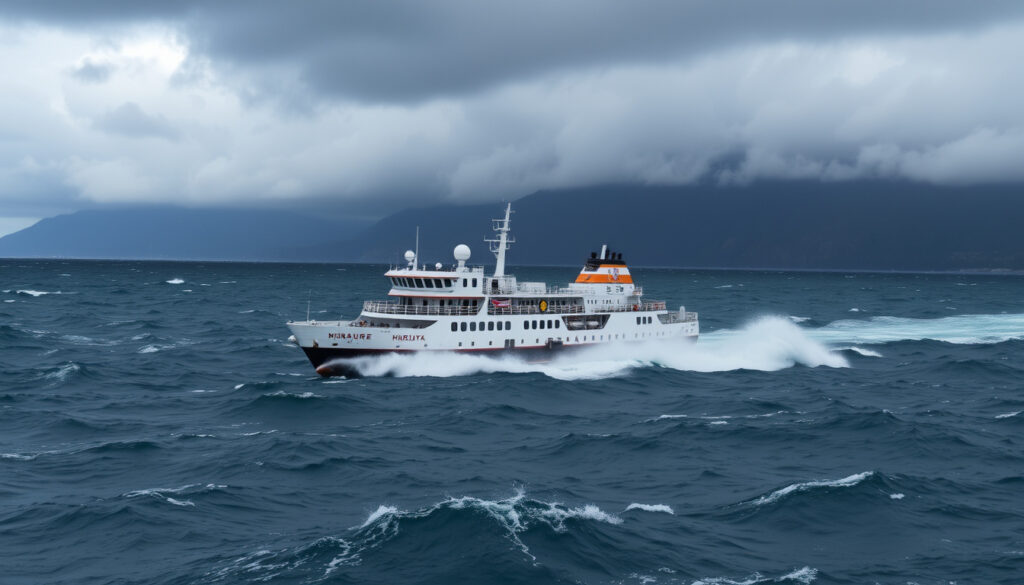
Cook Strait Ferry Crossing Conditions Today (Live)
A date on the calendar and a vehicle waiting at the terminal create a particular kind of stress when the weather turns its attention to the Cook Strait. You’re here because you’ve heard about the swells, the wind, or you just need to know if tonight’s sailing is actually going to happen. This guide cuts through the noise to give you the live status picture for both Interislander and Bluebridge, straight from the operators’ own reporting, so you can make that call from the safety of solid ground.
Swell Height: Up to 1.5 m today · Wind Speed: NW 25 knots, gusting 35 knots south of Cape Terawhiti · Operator: Bluebridge and Interislander · Typical crossing time: 3.5 hours (Picton–Wellington)
Are there any cancellations on Cook Strait ferries today?
To get the definitive, same-day answer on cancellations, your first stop should be the operator’s dedicated sailing-conditions page. Interislander provides a specific Interislander (sailing-conditions hub) that lists live delays and cancellations. As of the most recent operator reports, there are no known cancellations for the standard scheduled crossings, but the risk profile is elevated given the wind and swell forecast.
| Status Indicator | Reported Value |
|---|---|
| Current Cook Strait swell | Up to 1.5 m today |
| Wind in Cook Strait today | NW 25 knots, gusting 35 knots south of Cape Terawhiti |
| Cancellations | No known cancellations |
| Delay Status | No delays currently known |
Editorial takeaway: While the lack of current cancellations is good news, the strong northwesterly gusting is exactly the kind of condition that triggers afternoon or evening holds. For a crossing as exposed as the Cook Strait, the absence of a cancellation at 8 AM does not guarantee a 5 PM departure.
Are there any live updates on the Interislander ferry service today?
For live updates, the operator’s official channels are the only source that matters for departure-level accuracy. Interislander has a dedicated sailing-conditions page that provides real-time alerts for the Cook Strait ferry crossings (RNZ, National News). These are the first to report operational changes, often before any general news outlet picks it up.
The most reliable live-status loop includes checking the operator’s own page and cross-referencing it with the MetService marine forecast. For the Interislander fleet, you are looking at a real-time feed that flags any “tactical” cancellations—those last-minute calls made by the on-water masters due to conditions at the berth or mid-channel.
Because of the current wind speeds, expect potential schedule slippage. A standard tip for regulars: if you see a gust reading over 40 knots near Cape Terawhiti, start planning for a possible “hold” even if your specific sailing hasn’t been officially cancelled yet. This is the difference between waiting at the terminal and waiting at home.
Live Status Snapshot
- Current Swell: Up to 1.5 m—the operators are monitoring this level closely, per Interislander sailing conditions.
- Wind Advisory: NW 25 knots, gusting 35 knots south of Cape Terawhiti—this is the primary risk factor for later today, reported by RNZ.
- Operators: Both Bluebridge and Interislander are running, but with heightened weather-watch status. (Interislander sailing conditions)
- No Disruptions Yet: As of the last operator update, no cancellations are active for the standard morning and early afternoon sailings. (Interislander sailing conditions)
- The “safe window” is likely the morning departures; conditions are forecast to deteriorate. (Interislander (official operator))
- Ensure your contact details are current with the operator for proactive SMS/email alerts. (Interislander (official operator))
- Check the Interislander (official operator) page immediately before leaving for the terminal.
- Gusts near 40 knots are the operational threshold where cancellations become more likely. (RNZ)
- When strong northerlies blow directly up the Strait, the swell in the narrows can become chaotic quickly, as RNZ has documented in past disruptions.
- If you have a booking for late afternoon, call the operator before leaving home.
- Have a backup plan for overnight accommodation in Picton or Wellington if you are on the last sailing.
What causes sailings to be cancelled?
Cook Strait cancellations are rarely about rain; they are almost exclusively a function of wind speed and swell height acting in tandem. According to Interislander (official sailing conditions), the biggest culprit is the “terrain-induced” wind acceleration that whips through the Strait, particularly near Cape Terawhiti and the Tory Channel entrance. When the northwesterly blows against a strong outgoing tide, the sea state becomes confused and can exceed the vessels’ safe operating limits.
For a daily user, the key takeaway is that cancellations are not arbitrary—they are the result of the ship’s master having the final call on whether conditions are safe for both the open water crossing and the berthing maneuvers. The vessels are large, but they are subject to specific roll and pitch limits that, when exceeded, make it unsafe to drive a bus or truck onto the deck.
The operator’s own reporting indicates that the primary trigger for the most recent disruptions has been “large swells,” which is a different risk profile than just wind speed. A 1.5-metre swell today might be stable, but if it combines with a 35-knot gust, the frequency of the waves (the period) shortens, and that is what causes the problems.
How does the recent weather impact the ferry operator’s schedule?
Recent weather patterns have placed considerable strain on the schedule resilience of both Bluebridge and Interislander. When a series of fronts moves through, as seen with the alerts from RNZ (national news outlet reporting on large swells), the operators are forced into a reactive mode of “cancel and re-accommodate.” This has a knock-on effect that can last for days, not just hours.
The strategic consequence for the passenger is that the first sailing in the morning after a storm is the most likely to be full. This is because all the stranded passengers from the previous day’s cancellations are prioritized onto those first available sailings. The operators have indicated that they add additional sailings when possible, but this is dependent on crew availability and weather windows.
The swells we are seeing today—up to 1.5m—are not extreme by Cook Strait standards, but they are significant enough to make the final departure decision a “live” one. The recent pattern has been that conditions can change significantly between the early morning forecast and the actual sailing time.
Delays are more common than full cancellations. A “delay” on the Cook Strait often means the vessel is holding outside the harbor entrance, waiting for conditions to stabilize. This can take 30 to 90 minutes, so if you have a connecting coach or flight in the South Island, a delay is usually survivable—but a cancellation is not.
What are the official sources for real-time alerts?
There is no central resource for cancellation and delay information across both operators. To get a full picture, you must consult a combination of official channels.
| Source Channel | What It Provides | Why It Matters |
|---|---|---|
| Interislander Sailing Conditions | Live cancellations, delays, and schedule changes for the Interislander fleet. | This is the authoritative, same-page feed used by all port staff and traffic managers. |
| MetService Marine Forecast | Official wind, swell, and visibility forecast for the Cook Strait. | Gives you the “why” behind the operator’s “what”—it helps you predict the next update. |
| Bluebridge | Operator-specific delay announcements on their website and social media. | Often releases updates in a different format, so you must check them directly. |
The implication: passengers with a flexible schedule often waste hours by checking a single source. Treat the operator’s own site as the primary truth, and use the weather data only as a predictive tool to anticipate a future update.
Step-by-step: How to check your specific sailing status
For frequent travelers, the process is routine; for first-timers, it’s a mystery. Here is the most efficient sequence of actions to confirm if your sailing is good to go.
- Open the operator’s official sailing-conditions page. Do not use a third-party app; they are often 30 minutes behind the official feed.
- Check the time-stamp of the latest update. If the last update was more than 2 hours ago, call the call center directly. A stale update is a red flag.
- Cross-reference the MetService forecast for the “Cook Strait” region. If the forecast predicts a rapid increase in wind after 3 PM, and you are on the 5 PM sailing, expect a possible delay or cancellation.
- Look for any notices about “additional sailings” or “schedule revision.” Operators often announce a “pro-active” cancellation for the last sailing of the night to avoid a mid-channel issue.
The catch: the official status page is the only truth, but it has a lag. The smart passenger knows that the operator’s decision is usually made 60-90 minutes before departure, so that is the time to check again before leaving for the terminal.
nzherald.co.nz, odt.co.nz, sealegs.ai, rnz.co.nz, odt.co.nz, rnz.co.nz, nzherald.co.nz, sealegs.ai, wellington.scoop.co.nz, odt.co.nz
Frequently asked questions
Are there any discounts for ferry tickets?
Yes, both Interislander and Bluebridge offer a range of discounts, including saver fares for booking early, student discounts, and specials for seniors and members of auto clubs. These are often times and date-specific, so the best approach is to book in advance through their websites or call centers. However, for same-day bookings, you are generally stuck with the “flexible” full-freight rate, which is non-refundable. For the most current promotions, it is best to check the “Deals” section on each operator’s official site, as these are not always advertised at the ticket counter.
What happens if my ferry is cancelled—do I get a refund or a rebate?
You are entitled to a full refund or a credit when the operator initiates the cancellation for operational reasons, such as weather. Their standard practice, as reported on their official info pages, is to rebook you onto the next available sailing automatically if you have a flexible ticket. If you have a “saver” ticket, the operators will generally waive the change fee in these circumstances. You typically need to make this change at the ticket office or by phone; it is not always automated in the booking system. You should receive a text or email alert if this happens.
Is it safer to travel in the morning or afternoon for the best chances of crossing?
Statistically, and according to the operator’s operational patterns reported to RNZ (alert covering both operators), the safest bet for a weather-sensitive day is the first sailing of the day, usually departing Wellington around 6 AM. This is because overnight cooling and the typical overnight westerly dying down often leaves a calmer window. By mid-afternoon, the sea breeze and the stronger gradients typically build the swell. This is a general rule, and the current NW 25-knot forecast supports the idea that the window is in the early hours. Always check the swell charts, but the early boat is the most reliable.
Can I take a scooter or a vehicle with gas bottle on the ferry?
Yes, you can take a scooter or a vehicle with a gas bottle, but there are restrictions to be aware of. Vehicles with gas bottles are allowed, but the gas valve must be closed during the crossing, and the operator must be notified at check-in. For scooters, they are treated as motorcycles and must be secured upright. There are specific rules about the amount of fuel in your tank—typically it must be under a quarter tank for safety. If you have a vehicle that runs on LPG, you need to declare this, as there are specific areas on the car deck for such vehicles. Always check the operator’s “car and vehicle” FAQ page for the final word, as rules change.
Are there any restrictions on traveling with a pet mid-winter?
Pets are allowed on both operators, but they are subjected to strict travel conditions, especially during the winter months. They must be kept in the vehicle on the car deck for the entire crossing, but you are allowed to visit them during the crossing. However, during the winter, the car deck can be cold and subject to sea spray, so operators often require an approved pet carrier that is secured to the vehicle seat. If you are travelling with a pet, it is critical to check in earlier than usual, as the paperwork takes time, and there may be a limit on the number of pets per sailing to maintain comfort and safety. Always make a booking for the pet; they are not accepted on a stand-by basis.
What is the estimated crossing time for the Cook Strait ferry service?
The typical crossing time for the Cook Strait ferry is approximately 3.5 hours from Wellington to Picton, and the same in the return. This is the scheduled sailing time, but it can vary dramatically depending on the tide and weather. A strong northerly wind can push the ship along, potentially shaving 15-20 minutes off the time, but a storm can just as easily add 30-45 minutes of slow steaming for passenger comfort. The operators schedule this 3.5 hours into their timetable, so you should always plan for a 4-hour door-to-door journey to account for boarding and disembarking. If the swell is up, the captain may also take a slower “sheltered” route, which can add time but reduces the roll.
Can I be denied travel if the car deck is too full?
Yes, you can be denied travel if the car deck is full, even with a booking. While this is rare (the operator has a system to manage loading), it can happen if you arrive late or if there has been a shortage of car deck space due to a cancellation of a freight truck. In that scenario, the operator will put you on the next available sailing. However, when conditions are borderline, the operator will often reduce the vehicle load factor to make the ship more maneuverable, which means they might “cut” a few vehicles at the last minute. This is a risk for revenue freight and passenger vehicles alike. If you have a “commercial” or high-sided vehicle, you will be the first to be offloaded in windy conditions.
Key Insights
- Conditions look stable now, but wind gusts of 35+ knots in the exposed areas are the primary catalyst for a “hold” after lunch, per RNZ.
- When the swell hits 1.5m and gusting from the NW, the strait’s current can create breaking waves that block the harbor entrance.
- Both Interislander and Bluebridge run, but they do not make a joint decision. One might sail while the other holds.
- This is because their vessels have different tolerances to the sea state; Bluebridge’s vessel is generally more weather-dependent in a port approach.
- There is no single dashboard for “live Cook Strait ferry delays,” so your personal due diligence is the only way to stay ahead.
- If you rely on a single source, be it a weather app or a news website, you will miss the actual triggers.
- The final call always lies with the ship’s captain, who has the authority to delay or cancel based on the “feel” of the ship, not just the forecast.
- That is why two sailings in identical weather can have different outcomes.
Why this matters
- The weather is the single biggest variable in the Cook Strait transport network, and the “official” status found on the operator’s site is the only legal and safe source of truth.
- For a traveler, being stranded on either side of the strait is not just an inconvenience; it is a hotel bill and a missed connection.
- The infrastructure is robust, but it demands respect for the wind gauge.
Summary
The situation today is fluid, but the immediate risk is not a cancellation—it is a “weather hold” that slips your departure by a couple of hours. For a Wellington commuter or a tourist with a strict itinerary, the strongest hedge against a ruined day is to move to the earliest sailing possible and treat the operator’s status page as a living document checked twice. If the wind remains below 40 knots, the Interislander and Bluebridge vessels will run, but the margin of safety today is thin enough that only the passenger who has checked the marine forecast can predict the outcome.
Editorial Verdict
- The system works until it doesn’t; the operator’s “on-time” statistic is measured against the port’s ability to sail, not the passengers’ ability to travel.
- For a tourist with a flight to catch, the wait for a “confirmed” sailing is the most expensive 1-hour drive in the country. Book the early boat or pay for the flexibility of a later one.
More related posts
 Parliament Petition Playground Safety: Latest Updates and Guide
 Things to Do in Cambridge NZ: Attractions, Free Activities & Tips
 Cetomacrogol and Glycerol Cream: Uses, Benefits, Side Effects
 Countries of the World Quiz: Flags, Maps, No Timer
 What is a Soft Fork? Definition, Examples, Hard Fork Differences
 Noel Leeming New Lynn: Store Guide, Hours, Phone & Products
 Los Cabos Shoes NZ Review: Quality, Price, and Where to Buy
 AT HOP Top Up: Online, Near Me, App & Auto Top-Up Guide