Pork Belly in Air Fryer: Times, Temps & Safety Tips
Anyone who has wrestled a slab of pork belly into a pan knows the promise of crackling is more dare than recipe; the air fryer changes the math by delivering blistered, shatter-crisp skin in under an hour — if you respect a few rules. Australian Pork’s official method cooks rind-side up at 200°C for 45 minutes, and the difference between crisp crackling and leathery skin usually comes down to moisture, scoring, and heat — done right, it’s the highest reward-to-effort dish a countertop appliance can produce.
Baseline Cook Temp: 350°F (175°C) · Final Crisping Temp: 400°F (205°C) · Safe Internal Temp: 145°F (63°C) · Total Cook Time (1kg): 45–60 minutes · Top Safety Risk: Aluminum foil misuse
Quick snapshot
- Two-stage heat — a moderate first cook, then a hot blast — is the pattern across tested home recipes (SuperGolden Bakes (recipe developer)).
- Anything that blocks airflow — loose foil included — undermines the cook (Daily Maverick (news outlet)).
- Pork reaches the safe doneness target at 145°F (63°C) (USDA Food Safety and Inspection Service).
- Exact time depends on thickness, weight, air-fryer model, basket position, and airflow.
- Why owners are getting rid of air fryers — cleaning, device failure, or a passing trend — is unresolved.
- No official data tracks how many home cooks nail crackling on the first attempt.
- Most tested recipes pass the 30-minute mark before the final crisp stage (Beat the Budget (budget recipe blog)).
- Cuisinart Australia’s tested recipe totals 55 minutes of air-fry time (Cuisinart Australia (appliance manufacturer)).
- A larger 1.5 kg piece pushes the curve toward 75 minutes. (Beat the Budget (budget recipe blog))
- Rest the meat, then slice against the grain.
- Serve with ssamjang or a vinegar-chili dip to cut the fat.
- Let a thermometer decide when it’s done, not the timer.
The pattern in the four cards: prep does more work than temperature.
Six numbers, one pattern: the recipes that reliably deliver crackling treat “cooked” and “crackled” as two separate checkpoints, and the one non-negotiable number — 145°F (63°C) — is in the snapshot above.
| Factor | Value |
|---|---|
| Best Temp for Crackling | 400°F (205°C) final blast |
| Total Time (1 kg) | 45–60 minutes |
| Internal Safe Temp | 145°F (63°C) |
| Top Mistake | Using wet batter or marinades |
| Foil Rule | Avoid in basket; damages element |
| Preferred Doneness | Golden brown, bubbling skin |
How do I air fry pork belly?
Air-frying pork belly — the fatty cut from the pig’s belly (Wikipedia (pork belly)) — is closer to roasting than frying: a fan pushes hot air over scored, dried skin until it blisters. The machine is the easy part; the prep is what separates a crackling win from a chewy one.
How do you prepare pork belly for the air fryer?
- Score the rind at roughly 1 cm intervals, dry it uncovered in the fridge overnight, and keep oil off the skin — the three prep rules in Australian Pork’s air-fryer recipe.
- Rub salt into the scored rind to draw out moisture before cooking (Taste.com.au (recipe publisher)).
- A light spray on the meat side helps it brown; keep it off the rind (Taste.com.au (recipe publisher)).
From there, the cook is a controlled sequence:
- Score the rind at 1 cm intervals, stopping before the meat.
- Salt the rind, then dry the belly uncovered in the fridge — overnight if you can.
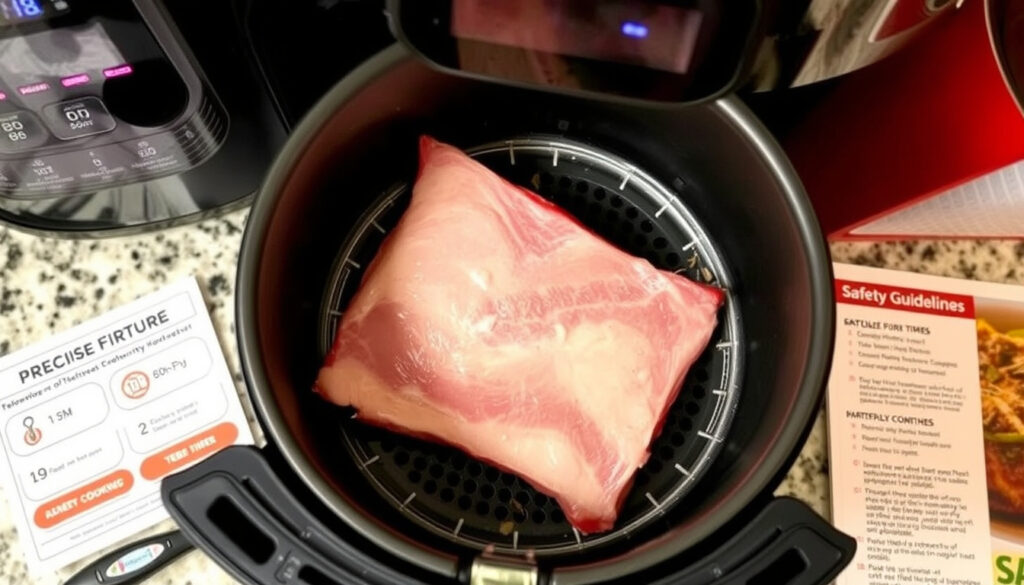
- Set the belly rind-side up in the basket, leaving space for airflow.
- Cook the first stage at 350°F (175°C) for 30 minutes as the baseline; SuperGolden Bakes uses 320°F (160°C) for its opening stage (SuperGolden Bakes (recipe developer)).
- Raise the temperature to 375–400°F (190–205°C) and cook 8–20 minutes until the rind bubbles (SuperGolden Bakes (recipe developer)).
- Check the center, rest, and slice against the grain.
Sliced belly behaves differently from a whole slab: strips cook faster and need a shorter render, so watch the skin rather than the clock.
What temperature should I use for air fryer pork belly?
- The reliable home answer is two-stage: around 350°F (175°C) for the render, then around 400°F (205°C) for the finish — a rounded version of the tested range above.
- The manufacturer answer is different: Cuisinart Australia’s tested recipe runs 220°C (428°F) for 20 minutes, then 170°C (338°F) for 35 minutes (Cuisinart Australia (appliance manufacturer)).
Temperature is the only lever you adjust mid-cook; time follows the piece of meat. A thicker 1.5 kg belly needs more render time before the heat climbs.
How do I make crispy roasted pork in an air fryer?
Crispy skin is a moisture fight. Every method that works starts with a dry rind and finishes with a temperature spike; every method that fails skips one of those steps.
How do you get crispy skin on pork belly in an air fryer?
- Use two stages: Beat the Budget’s recipe runs 360°F (180°C) for 30 minutes, then 390°F (200°C) for 15–20 minutes, for a total of 40–50 minutes (Beat the Budget (budget recipe blog)).
- Keep the rind dry before it goes in — the fridge trick from the snapshot is the most repeated prep step in tested recipes.
- Score the skin so the fat can render upward and the skin can blister; stop before the meat.
Home recipes largely agree on the curve: long enough at a moderate temperature to melt the fat, then a short, hot finish to turn the rind into bubbles.
Why is my pork belly skin not crispy in the air fryer?
Skin that stays chewy is usually skin that stayed damp. Overcrowding and flipping are the other two culprits — both interrupt the airflow and let the rind steam instead of crackle.
The catch: no amount of heat rescues a wet rind. The fridge, not the fryer, does the hardest work.
How long to cook pork belly in air fryer ninja?
Ninja air fryers cook with the same convection logic as other basket models: the basket size and fan speed shape the time more than the brand name. Published times are starting points, not promises.
How long to cook 1.5 kg pork roast in an air fryer?
- A 1.5 kg piece typically lands closer to 60–75 minutes total, because the extra thickness extends the render stage.
- Australian Pork’s official method, noted in the intro, runs rind-side up at 200°C (400°F) for 45 minutes and is built around crackling.
- For a 1 kg belly, the tested window is roughly 45–60 minutes before resting.
The first stage at 320–360°F is where most timing errors happen. If the rind is still rubbery at the 30-minute mark, give it another 10 minutes before the final blast.
What is the best temperature for air fryer pork belly time?
- A general two-stage approach — 150–160°C (300–320°F) for 35–45 minutes, then 200–220°C (390–430°F) for 15–25 minutes — covers most home machines (Simple Air Fryer (recipe site)).
- Always check the center reaches 145°F (63°C) before resting; that target is the one non-negotiable number in the table above.
What this means: published times are starting points, not promises. The thermometer and the rind’s appearance are the real controls.
Do you wrap pork in foil in an air fryer?
Short answer: no. Pork belly in an air fryer does not need a foil wrap, and loose foil can cause real problems if it touches the heating element.
Why can’t you put aluminum foil in an air fryer?
- Foil blocks airflow. The fan’s whole job is to move hot air over the rind; a foil sheet in the basket redirects or traps that air (Daily Maverick (news outlet)).
- Loose foil can be lifted by the fan and pressed against the heating element, damaging the machine.
- Wrapping pork in foil is also unnecessary — none of the tested recipes above use it.
A tray, rack, or foil arrangement can catch rendered fat and reduce cleanup — but only if it stays clear of the airflow path. The moment it blocks the fan, it stops being a shortcut and becomes a hazard.
What can I use instead of foil in an air fryer?
- Parchment paper, weighed down by the meat, is the usual substitute.
- A small oven-safe tray or trivet under the pork catches drips without covering the basket.
- No liner at all also works: a dry rind and a quick soak after cooking handle the cleanup.
Why this matters: the air fryer is a convection oven, not a roaster. Anything that blocks the fan — foil included — turns a fast machine into a dangerous one.
What 5 foods should you not put in an air fryer?
The honest list is less about specific foods and more about physics: light things fly, wet things drip, and blocked airflow ruins the cook. Five offenders cover most of the damage.
What can ruin an air fryer?
- Bacon — a light strip can lift in the fan and scorch on the heating element before it crisps.
- Wet-battered foods — the coating drips and bakes onto the basket before it sets.
- Anything wrapped in loose foil — it blocks airflow and can touch the element.
- Overcrowded batches — too much food steams instead of crisps because the fan can’t reach the surface.
- High-fat cuts without a drip plan — rendered fat pools, smokes, and burns onto the base; a tray or rack solves it (Daily Maverick (news outlet)).
Why should you never cook bacon in your air fryer?
The same airflow that makes pork belly crackle is exactly what makes bacon and wet batters misbehave. The solution is not to ban the air fryer — it’s to respect the fan.
Bacon is the extreme case: it is light, it spatters, and the fan can lift a strip straight into the heating element. The usual workaround is a rack or toothpicks to pin it down, but for most people, a pan is easier.
The trade-off: the air fryer rewards foods that stay put, stay dry, and leave room for air. Foods that break those rules will test both your smoke alarm and your patience.
What are the ingredients in pork belly dipping sauce?
A great dab of sauce makes the crackling taste even better. The two classic options come from opposite ends of the flavor scale: fermented and bright.
How do you make Korean ssamjang for pork belly?
- Ssamjang is a Korean table dip built on fermented soybean paste (doenjang) and gochujang.
- Garlic, sesame oil, and a little scallion or onion round out the paste.
- It is spooned onto the pork or lettuce wrap, not used as a thin dipping liquid.
What dipping sauce goes best with air fried pork belly?
- A simple blend of vinegar, salt, and chili flakes cuts the fat without hiding the crackling.
- Gochujang-based sauces add heat and sweetness that balance the richness of the meat.
- Slice the pork into bite-sized pieces and serve with kimchi or a crunchy slaw to keep the plate from feeling heavy.
The implication: crackling is rich, so the sauce’s job is to cut — acid, salt, and heat do that better than anything creamy.
Confirmed facts
- Two-stage cooking — moderate first, hot finish — is the most consistent route to crackling.
- The safe internal target for pork is 145°F (63°C).
- Loose foil in the basket blocks airflow and risks the heating element.
What’s unclear
- Exact time varies with thickness, weight, model, basket position, and airflow.
- Whether the air-fryer backlash is about cleaning, failures, or a passing trend is unresolved.
- First-try crackling success rates are undocumented.
What the experts say
Three tested approaches, three temperature philosophies — each worth reading in full before you commit to a method:
The crackling sequence in Cuisinart Australia’s recipe runs hot first — 220°C (428°F) for 20 minutes — then drops to 170°C (338°F) for 35 minutes, with a stated total air-fry time of 55 minutes.
Cuisinart Australia (appliance manufacturer)
The salt-crust route from Eat, Little Bird dries the rind at 120°C (248°F) for 30 minutes, then finishes at 200°C (392°F) for 30–40 minutes to crisp the skin.
Beat the Budget’s home-recipe window is 40–50 minutes total: 30 minutes at 180°C (360°F), then 15–20 minutes at 200°C (390°F), with the caveat that thickness and airflow shift the numbers.
Beat the Budget (budget recipe blog)
The pattern: there is no single right temperature curve, but every method converges on the same end point — rendered fat, dry skin, and a final spike that makes the bubbles appear. The takeaway: The payoff is bigger than the hype: blistered, shatter-crisp skin and tender meat from a countertop appliance in under an hour. The ritual is simple — dry the rind, score it, cook in two stages, and let the thermometer decide when it’s done. For home cooks who want crackling without the smoke alarm, the choice is clear: prep the pork the night before and finish at 400°F with a drip tray below the basket — or skip the final blast and accept a chewier rind in exchange for a quieter kitchen.
Related reading: Egg Salad Recipe NZ: Classic, Healthy & Easy Tips
Frequently asked questions
Can you cook frozen pork belly in an air fryer?
Yes, but expect a longer total cook. Thaw in the fridge if you want crackling, because a damp or icy rind steams instead of blisters.
Do I need to flip pork belly in an air fryer?
No. The rind should face the circulating air for the entire cook so it dries and blisters; the tested recipes above all leave it rind-side up.
What temperature do you cook pork belly in an air fryer?
The reliable pattern is two-stage: around 350°F (175°C) for the first 30 minutes, then 400°F (205°C) for 8–20 minutes until the skin bubbles. Australian Pork’s simpler method holds 200°C (400°F) for 45 minutes.
Can you use oil when air frying pork belly?
Yes — a light spray on the meat side encourages browning (Taste.com.au (recipe publisher)). Keep oil off the rind, and don’t overdo it; excess oil adds smoke and mess.
How do you reheat pork belly in an air fryer?
Reheat at a moderate temperature in short bursts until the skin crackles again. Skip the microwave, which turns the rind rubbery.
Is air fryer pork belly healthier than pan fried?
It depends on your definition. The air fryer renders fat into the tray instead of leaving the meat sitting in it, but pork belly is still a high-fat cut. Treat it as less greasy, not light.
More related posts
 Matariki E Ara E: Lyrics, Meaning & Translation Guide
 How to Tame a Silver Fox Dailymotion – Science-Based Guide
 KitchenAid Food Processor NZ: Best Models & Prices Compared
 How to Make Netherite Armor in Minecraft: Full Guide
 Where to Find Cheap Textbooks: Best Sites and Saving Tips
 L&P Bottle Change: Brown Bottles Go Clear in April 2026
 How Fast Does the Earth Spin? MPH, KM/H at Equator & More
 Is Friday a Public Holiday? Country Guide