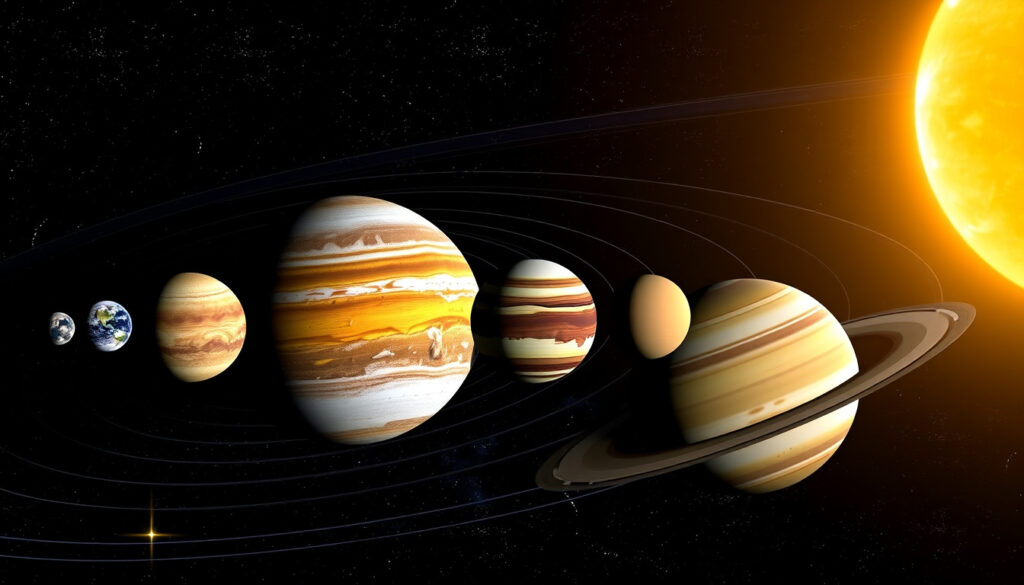
Planets in Our Solar System: Count, Order, and Facts
Few things spark curiosity quite like looking up at the night sky and wondering what planets are out there. Whether you’re trying to recall the order of the planets from school or wondering why Pluto got demoted, the reality of our solar system is more fascinating than the myths — with eight official planets and countless surprises that explain how our cosmic neighborhood is organized and why Mars keeps stealing the headlines.
Number of planets: 8 · Closest planet to the Sun: Mercury · Farthest planet from the Sun: Neptune · Largest planet: Jupiter · Oldest planet: Jupiter (4.6 billion years) · Hottest planet: Venus (465°C)
Quick snapshot
- Eight official planets recognized by the IAU (NASA Science – Planetary Portal)
- Dwarf planets include Pluto, Ceres, Eris, Makemake, Haumea (NASA Solar System Exploration)
- Inner terrestrial planets vs outer gas giants (NASA – Planet Types)
- Mercury, Venus, Earth, Mars, Jupiter, Saturn, Uranus, Neptune (NASA – Planet Order)
- Common mnemonic: “My Very Educated Mother Just Served Us Noodles” (NASA – Planet Order)
- Distance from the Sun drives the order (NASA – Planets Order)
- Thin CO₂ atmosphere; no rain; extreme temperature swings (NASA Mars Facts)
- Human survival requires a pressurized suit and oxygen (NASA – Mars Exploration)
- No liquid water on surface; ice at poles (NASA Mars Facts)
- 19th-century discoveries led to 11+ planets (asteroids included) (International Astronomical Union – History)
- Pluto’s reclassification in 2006 reduced count to 8 (International Astronomical Union – Official Definition)
- No planet discovered by a 17-year-old (IAU – Historical Discoveries)
The 2006 IAU definition fundamentally reshaped how we count planets. Without it, the solar system would still be cluttered with dozens of spherical bodies—and the name “planet” would lose its scientific precision.
Key Planetary Specs
A quick-reference table for the eight official planets, compiled from NASA data.
| Planet | Distance from Sun (AU) | Orbital Period (Earth years) | Day Length (hours) | Diameter (km) | Known Moons |
|---|---|---|---|---|---|
| Mercury | 0.39 | 0.24 | 1407.6 | 4,879 | 0 |
| Venus | 0.72 | 0.62 | −5832 (retrograde) | 12,104 | 0 |
| Earth | 1.00 | 1.00 | 24.0 | 12,756 | 1 |
| Mars | 1.52 | 1.88 | 24.6 | 6,792 | 2 |
| Jupiter | 5.20 | 11.86 | 9.9 | 142,984 | 95 |
| Saturn | 9.54 | 29.46 | 10.7 | 120,536 | 146 |
| Uranus | 19.19 | 84.01 | −17.2 (retrograde) | 51,118 | 27 |
| Neptune | 30.07 | 164.8 | 16.1 | 49,528 | 16 |
The pattern: the inner planets are small and rocky with few or no moons; the outer planets are massive, gaseous, and orbited by dozens of moons.
What is the solar system?
The solar system is the Sun and everything that orbits it — eight planets, five officially named dwarf planets, hundreds of moons, and thousands of asteroids and comets, according to NASA Solar System Exploration (the U.S. space agency’s central portal). The Sun itself contains 99.86% of the system’s mass, and the whole system formed about 4.6 billion years ago from a collapsing molecular cloud. The eight planets orbit in nearly the same plane, called the ecliptic, each following a path determined by gravity and the nebular disk. The pattern is orderly, but the details — from Venus’s scorching surface to Neptune’s supersonic winds — are anything but uniform.
Are there 9 or 8 planets in the Solar System?
The question sparks endless debate online. The answer, according to the International Astronomical Union (IAU), is eight. The IAU defines a planet as a celestial body that orbits the Sun, has enough mass to pull itself into a nearly round shape, and has “cleared its orbital neighborhood” of debris. Pluto fails the third criterion, so it was reclassified as a dwarf planet in 2006 (IAU – Pluto Decision). The eight official planets are: Mercury, Venus, Earth, Mars, Jupiter, Saturn, Uranus, and Neptune — listed in order from the Sun.
How many planets are there in solar system name them?
- Mercury
- Venus
- Earth
- Mars
- Jupiter
- Saturn
- Uranus
- Neptune
The list hasn’t changed since 2006. No new planets have been added, though astronomers continue searching for a possible Planet Nine in the outer reaches.
How to remember the planets in order?
The most common trick is a mnemonic sentence where the first letter of each word matches the first letter of each planet: My Very Educated Mother Just Served Us Noodles — Mercury, Venus, Earth, Mars, Jupiter, Saturn, Uranus, Neptune. Variations exist: some replace “Noodles” with “Nachos” or use “My Very Eager Mother Just Served Us Nine Pizzas” (the old version that included Pluto). The key is repetition and associating each planet with a vivid image.
Step-by-step mnemonic strategy
- Write the letter sequence: M V E M J S U N.
- Create a sentence: choose any words that start with those letters.
- Say it out loud five times.
- Visualize each planet: picture Mercury close to the Sun, Venus shrouded in clouds, Earth blue and green, Mars red, Jupiter with its Great Red Spot, Saturn with rings, Uranus tilted, Neptune blue.
- Test yourself by writing down the first letters and recalling the sentence.
The pattern: distance from the Sun drives the order, so internalizing the sequence helps understand planetary zones — rocky inner worlds and gaseous outer giants.
Why can’t it rain on Mars?
Mars has a thin atmosphere, about 1% of Earth’s pressure, composed mostly of carbon dioxide. With so little water vapor and pressure far below the triple point of water, liquid water cannot exist on the surface. Any precipitation would be frost or snow — not rain. NASA Mars Facts (the agency’s official planetary data hub) confirms the atmosphere is too thin and cold for liquid water.
Can it get hot on Mars?
- At the equator in summer, temperatures can reach 20°C (68°F).
- But at the poles, winter lows plunge to –130°C (–202°F).
- Average surface temperature is –53°C (–64°F), according to NASA JPL – Mars at a Glance (the agency’s interplanetary mission data).
Mars can feel “hot” near the equator on a summer afternoon, but the thin atmosphere offers no insulation, so temperatures drop sharply at night. The extreme swings make human survival impossible without a pressurized, insulated habitat.
How long could a human survive on Mars?
Without a spacesuit, a person would die within minutes — not from cold alone, but from asphyxiation due to the lack of breathable oxygen and the low atmospheric pressure. Even with a suit, radiation exposure and dust storms pose long-term risks. NASA notes that no human has yet set foot on Mars, but rovers like Perseverance are paving the way for future crewed missions (NASA Science – Mars Overview).
Is Mars full of gold?
No. Mars’s surface is rich in iron oxide — that’s what gives it the reddish color. No confirmed gold deposits have been found. The planet’s crust is similar to Earth’s basaltic rocks, but without the hydrothermal activity that concentrates precious metals.
How much is 1 minute on Mars?
A minute is the same length as Earth’s minute — 60 seconds — because time itself is universal. But a Martian day (a sol) lasts about 24 hours, 39 minutes, 35 seconds, slightly longer than an Earth day. So while a minute is identical, the rhythm of a day on Mars is different: sunlight rises and sets about 40 minutes later each Earth day.
How many years does Mars have left?
Mars has no “doomsday clock.” Like all planets, it will continue orbiting the Sun until the Sun expands into a red giant in about 5 billion years. At that point, the Sun’s outer layers may engulf the inner planets, but Mars, being farther out, might survive as a charred, airless world. So in human terms, Mars has billions of years left — plenty of time for exploration.
Did we have 11 planets in our solar system?
Yes, at various times in the 19th century, the solar system had 11 or more recognized planets. When Ceres, Pallas, Juno, and Vesta were discovered, they were considered planets. By the mid-1800s the count reached 11. But as more asteroids were found, astronomers realized they belonged to a separate population — the asteroid belt. The 2006 IAU decision codified the three-part planet definition, reducing the count to eight.
What are the 12 planets?
Some proposals in the early 2000s suggested including Ceres, Pluto, Charon (Pluto’s moon), and Eris to make 12. That idea never became official. The IAU rejected it in favor of the three-criteria definition, creating a separate “dwarf planet” category for bodies like Pluto, Ceres, Eris, Makemake, and Haumea (NASA – Dwarf Planet Classification).
What planet was found by a 17 year old?
None. The popular myth that a 17-year-old discovered a planet is unfounded. Uranus was discovered by William Herschel (age 43), Neptune by Johann Galle and Urbain Le Verrier (adults), Pluto by Clyde Tombaugh (age 24), and Eris by Mike Brown and his team (all adults). No teenager has ever discovered a planet in the solar system.
Comparison: Inner vs Outer Planets
Four small rocky worlds close to the Sun versus four giants far out — the differences are as striking as their shared origin.
| Feature | Inner planets (Mercury, Venus, Earth, Mars) | Outer planets (Jupiter, Saturn, Uranus, Neptune) |
|---|---|---|
| Composition | Rocky (silicate mantle, iron core) | Gas (hydrogen, helium) / Ice (water, methane, ammonia) |
| Size | Diameter ≤ 12,742 km (Earth) | Diameter ≥ 49,528 km (Neptune) up to 142,984 km (Jupiter) |
| Moons | Earth: 1; Mars: 2; others: 0 | Jupiter: 95; Saturn: 146; Uranus: 27; Neptune: 16 (as of 2024) |
| Rings | None | All four have ring systems, with Saturn’s being most prominent |
The implication: the inner planets are dense, small, and rocky — products of the hotter, debris-cleared inner solar system — while the outer planets are massive, gaseous, and surrounded by moons and rings, having formed in the colder, volatile-rich outer disk.
Confirmed Facts vs What Remains Unclear
Confirmed facts
- Eight planets orbit the Sun in fixed order (NASA Science)
- Jupiter is the oldest planet, formed 4.6 billion years ago (NASA Jupiter Facts)
What’s unclear
- Existence of Planet Nine (a hypothetical ninth planet)
- Possibility of microbial life on Mars (no evidence yet)
- Mars having liquid water rain — the atmosphere is too thin for surface rain (NASA Mars Facts)
- Pluto’s classification — while officially a dwarf planet, public debate persists (IAU – Pluto Decision)
- Whether Venus ever had surface oceans
- The exact mechanism of Jupiter’s Great Red Spot formation
Expert Perspectives
“Our solar system has eight planets: Mercury, Venus, Earth, Mars, Jupiter, Saturn, Uranus, and Neptune.”
NASA Space Place – All About the Planets (the agency’s education portal for young audiences)
“A celestial body that orbits the sun, has sufficient mass to assume hydrostatic equilibrium, and has cleared its orbital neighborhood is a planet.”
International Astronomical Union – Planet Definition (the global authority on astronomical nomenclature)
The tension between the official definition and public sentiment remains. Many people still call Pluto a planet, but scientists prefer the precision that the IAU classification provides.
science.nasa.gov, spaceplace.nasa.gov, science.nasa.gov, solarsystem.nasa.gov, science.nasa.gov, jpl.nasa.gov, www1.grc.nasa.gov
Frequently Asked Questions
What is the oldest planet in the solar system?
Jupiter is the oldest planet, estimated to have formed about 4.6 billion years ago, shortly after the Sun (NASA Jupiter Facts – Formation).
Can you survive on Mars for 2 minutes?
No. Without a spacesuit, the thin atmosphere, extreme cold, and lack of breathable oxygen would cause death within a couple of minutes.
What is a dwarf planet?
A dwarf planet orbits the Sun, is nearly round, but hasn’t cleared its orbital neighborhood. Examples include Pluto, Ceres, and Eris (IAU – Dwarf Planet Definition).
What are the differences between inner and outer planets?
Inner planets are small, rocky, and close to the Sun. Outer planets are large, gaseous/icy, and far from the Sun with many moons and rings.
How far are the planets from the Sun?
Distances range from 0.39 AU (Mercury) to 30.07 AU (Neptune). One AU is the distance from Earth to the Sun (about 150 million km).
While eight planets are official, the search for a ninth is still active. If Planet Nine is confirmed, the solar system could have another member — but for now, the count stays at eight.
For anyone curious about our place in the universe, the facts are both humbling and thrilling. The solar system’s eight planets offer a rich range of extremes, from Mercury’s scorched surface to Neptune’s icy gales. The classification debate is settled for now, but Mars continues to drive exploration — and the possibility of finding life there remains the biggest open question. The reader can explore the data, look up at the night sky, and let the numbers tell the story.
More related posts
 Samsung Flip Phone NZ: Prices, Durability, and Buying Guide
 KFC Menu with Prices NZ PDF: Official Prices & Deals 2026
 All Blacks Player Ratings 2026: Top Performers & Salaries
 $2 Degrees Top Up Online: How to Add Credit & Data
 Summerset by the Dunes: Costs, Features, Beach Lifestyle
 Trade Me Insurance Login: Step-by-Step Guide and Tips
 Pak N Save Logo – Design, History & Downloads
 What Does Collate Mean When Printing? Examples & Guide