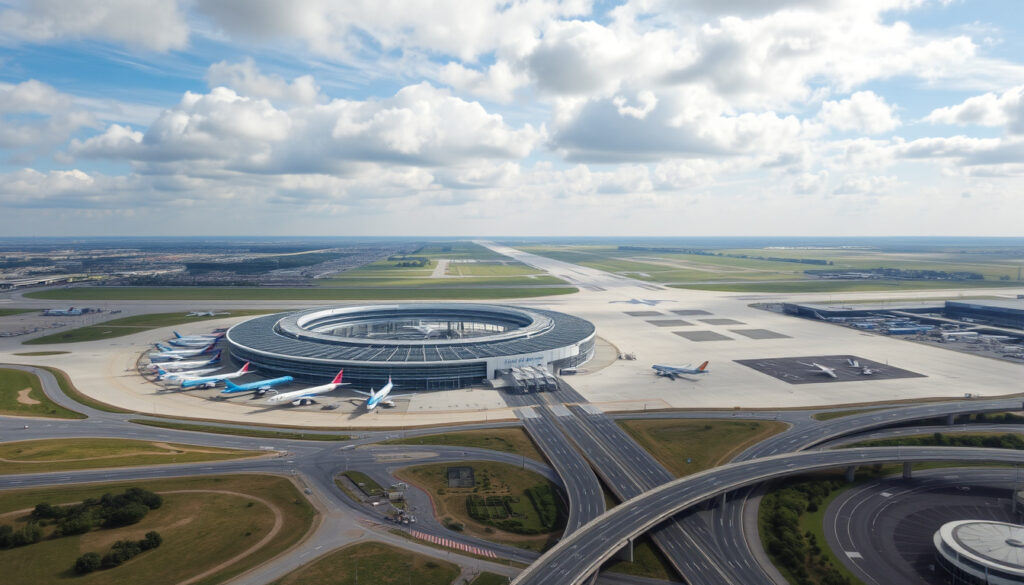
Charles de Gaulle Airport Guide: Transport, Terminals & Tips
Anyone who’s landed at Charles de Gaulle Airport knows that first impression can set the tone for an entire trip, and with 67.4 million passengers passing through in 2023, Paris’s main international gateway is continental Europe’s second-busiest hub — a sprawling operation that rewards advance planning. Whether you’re connecting through its three terminals or heading into the city, knowing the fastest transfer, the quietest security lane, and where to rest during a layover makes the difference between a smooth journey and a stressful one.
Annual passengers (2023): 67.4 million ·
Distance from Paris centre: 23 km northeast ·
Number of terminals: 3 (Terminals 1, 2, 3) ·
Opened: 1974 ·
Named after: Charles de Gaulle
Quick snapshot
- CDG is 23 km from Paris centre (Wikipedia)
- RER B ticket costs €11.80 (2025) (RATP official fare site)
- No free shuttle to the city (Paris Aéroport official site)
- Exact security wait times vary by day and terminal (AirlineAirport)
- Future expansion of Terminal 4 timeline uncertain (Wikipedia)
- Reliability of PARAFE biometric gates is inconsistent (AeroGreet VIP services guide)
- Fast-track availability may be limited during peak demand (Paris CDG fast-track guide)
- RER B service is subject to strikes and delays (RATP official fare site)
- CDG opened in 1974 (Wikipedia)
- Ongoing upgrades to security and terminal connectivity (Paris Aéroport investment page)
Key facts at a glance
Seven key data points, one picture: CDG is a large, busy airport that has grown steadily over five decades.
| Detail | Value |
|---|---|
| IATA code | CDG |
| Location | Roissy-en-France, 23 km NE of Paris |
| Number of runways | 4 |
| Total terminals | 3 (1, 2, 3) with sub-terminals 2A–2G |
| 2019 passenger volume | 76.8 million |
| Busiest airline | Air France |
| Year opened | 1974 |
How do I get from Charles de Gaulle Airport to the city centre?
RER B train
- Fast and reliable: The RER B line runs directly from CDG to Gare du Nord in about 35 minutes (Paris Aéroport train page).
- A single ticket costs €11.80 as of 2025 (RATP official fare site).
- Trains run every 10–15 minutes from about 5 AM to midnight.
Roissybus
- Direct service from CDG to Opéra in central Paris every 15 minutes (Paris Aéroport bus page).
- Journey time: 60–70 minutes depending on traffic.
- Ticket price: €13.70 (2025), purchased at the bus stop or online.
Taxis and ride-hailing
- Flat-rate to Paris: €35 for Right Bank (Paris intra-muros), €35 for Left Bank as of 2025 — officially set by Paris Aéroport (Paris Aéroport taxi page).
- Ride-hailing services like Uber and Bolt operate from designated pick-up zones but charge dynamic pricing.
- Estimated cost via Uber: €35–€55 depending on demand and destination (Uber Paris city page).
Private transfer services
- Pre-booked private cars from CDG to central Paris start around €55–€70 for a sedan (Paris Aéroport private transfer page).
- Best for groups of 3+ or when carrying lots of luggage.
Cheapest option breakdown
The RER B train at €11.80 is the cheapest way into Paris — by a significant margin. Roissybus at €13.70 costs slightly more but drops you closer to the commercial centre. Taxis and private transfers offer door-to-door convenience at 3–5 times the cost. No free shuttle to the city exists (Paris Aéroport access page).
RER B is cheap and fast — but it’s also a commuter line that runs through several suburban stations. Travellers with heavy luggage or late-night arrivals may prefer the taxi flat rate: €35 for Right Bank, €35 for Left Bank.
The implication: most travellers should weigh the cost savings of the RER B against the door-to-door convenience of a taxi, especially for late-night or luggage-heavy trips.
Can you walk between terminals in Paris airport?
Terminal 1 and Terminal 3 connection
- Walking between Terminal 1 and Terminal 3 is not possible — you must use the CDGVal automated shuttle (Travel Vient CDG guide).
- CDGVal is free, runs 24/7, and connects all three terminals plus parking lots.
Terminal 2 internal connections (2A-2G)
- Terminal 2 is split into sub-terminals 2A through 2G, connected by walkways and shuttle buses (Paris Aéroport terminal maps).
- 2A to 2F are linked via walkways; 2G requires a dedicated shuttle bus (Travel Vient CDG guide).
CDGVal automated shuttle
- Free, 24/7 service connecting Terminals 1, 2, and 3 (Paris Aéroport shuttle page).
- Journey time: about 8 minutes between Terminal 1 and Terminal 2.
Walking distances and time estimates
- Same-terminal transfers: approximately 15 minutes (Travel Vient CDG guide).
- Different-terminal transfers: allow 1 hour.
- Domestic-to-domestic connections: about 30 minutes.
- Domestic-to-international connections: about 1 hour.
- International-to-domestic connections: about 1 hour 30 minutes.
CDG’s layout is not pedestrian-friendly for cross-terminal moves. The CDGVal solves this, but budget at least an hour for any transfer between different terminal buildings — more if you’re connecting from an international to a domestic flight.
The pattern: even with the CDGVal, transfer times at CDG are longer than at many other European hubs, so plan accordingly.
How long does it take to get through security at Charles de Gaulle?
Average wait times by terminal
- Terminal 1: 15–25 minutes at peak hours, 1–14 minutes at minimum (AirlineAirport CDG security wait times).
- Terminal 2: 1–10 minutes normally, 20–25 minutes at peak (Paris CDG International Airport security fast-track guide).
- Terminal 3: generally under 10 minutes (AirlineAirport CDG security wait times).
- Terminal 2E reportedly has the longest lines.
Peak hours and seasonal factors
- Peak periods: 6–9 AM and 5–8 PM daily (Paris Aéroport security wait times page).
- Summer (June–August) and holiday seasons see longer average waits.
- Security queues can surge to 45–60 minutes during peak holiday travel weeks (Paris Aéroport security wait times page).
Tips to speed through security
- Book the optional fast-track service (from about €10–€15) to reduce waits to 5–10 minutes (AeroGreet CDG fast-track guide).
- Use PARAFE biometric e-gates for EU/Swiss/Norwegian passport holders; they process passengers in under 12 seconds when functioning (AeroGreet VIP services guide).
- Pack liquids in a single resealable bag and wear shoes that are easy to remove.
TSA PreCheck equivalent (not applicable)
There is no CDG equivalent to the US TSA PreCheck scheme. The fast-track option is pay-per-use and widely available across all terminals.
Security wait times vary dramatically by terminal — Terminal 3 is consistently the quietest, Terminal 2E the busiest. A passenger flying from Terminal 2E during the 6–9 AM peak could face a 25-minute queue, while someone in Terminal 3 at the same hour may breeze through in under 10 minutes.
The catch: knowing your terminal and departure time can save you 15–20 minutes of waiting, so choose your flight and terminal wisely.
Is Charles de Gaulle the biggest airport in Europe?
Size by passenger traffic
- CDG handled 67.4 million passengers in 2023, making it the second busiest in Europe after Heathrow (79.1 million) (Wikipedia list of busiest airports in Europe).
- In 2019, before the pandemic, CDG processed 76.8 million passengers.
Size by land area
- CDG covers about 32 square kilometres, making it larger in land area than Heathrow (12.27 km²) (Wikipedia Charles de Gaulle Airport).
- Schiphol covers about 27 km².
- CDG has four runways; Heathrow has two.
Comparison with Heathrow and Amsterdam Schiphol
Heathrow handles more flights and more passengers annually, but CDG has more terminal space and a larger physical footprint. Schiphol is more compact and generally considered more efficient for transfer connections (Wikipedia Schiphol Airport).
| Metric | CDG | Heathrow | Schiphol |
|---|---|---|---|
| 2023 passengers | 67.4 million | 79.1 million | 65.0 million |
| Land area | 32 km² | 12.27 km² | 27 km² |
| Runways | 4 | 2 | 6 |
| Year opened | 1974 | 1946 | 1916 |
Future expansion plans
A proposed Terminal 4 at CDG has been discussed but remains in planning stages, with no confirmed timeline for construction (Wikipedia Charles de Gaulle Airport).
The pattern: while CDG wins on raw size, Heathrow wins on passenger throughput, which affects transfer times and queue lengths.
Can I stay overnight at Charles de Gaulle Airport?
Airport lounges with sleep facilities
- Several lounges (e.g., Air France, Star Alliance) have recliners and quiet zones (Paris Aéroport lounges page).
- Priority Pass holders can access lounges in Terminals 1 and 2.
- No dedicated sleep pods exist at CDG as of 2025.
Sleeping areas inside terminals
- Airside sleeping is permitted but seating is limited — no padded benches at most gates (Sleeping in Airports CDG guide).
- Terminal 2 in the early morning hours (midnight–5 AM) empties out significantly.
- Security may ask for a boarding pass during night hours (midnight–5 AM).
Nearby hotels (connected by CDGVal)
- Sheraton Paris Airport Hotel — connected to Terminal 2 (Marriott Sheraton page).
- Novotel Paris Charles de Gaulle Terminal — accessible via CDGVal from Terminal 3 (Accor Novotel page).
- ibis Styles and citizenM hotels are also within the airport zone, connected by free shuttle.
Safety and comfort considerations
- CDG is generally safe overnight, but travellers report feeling comfortable only in well-lit areas near security (Sleeping in Airports CDG guide).
- Airside areas require a valid boarding pass for the following day.
- 24-hour food options are limited: some vending machines and a McDonald’s in Terminal 2 are available.
CDG is not designed for overnight stays. The best option for a comfortable sleep is booking a hotel room in the airport zone — the Sheraton in Terminal 2 offers direct access without leaving security. For budget travellers, the Novotel (€80–€120 per night) provides solid value and is connected by the free CDGVal.
The implication: if you have a long layover, plan to spend €80–€150 for a hotel rather than trying to sleep on a terminal bench.
Verified vs. unverified: What’s settled and what’s not
Confirmed facts
- CDG is 23 km from Paris centre
- RER B ticket costs €11.80 (2025)
- No free shuttle to the city
- CDGVal is free and operates 24/7
- Taxi flat rate to Right Bank is €35 (2025)
What’s unclear
- Exact security wait times vary by day and terminal — reported estimates range from 1–10 minutes to 45+ minutes depending on conditions
- Future expansion of Terminal 4 has no confirmed timeline
- Reliability of PARAFE biometric gates is inconsistent
- Fast-track availability may be limited during peak demand
- RER B service is subject to strikes and delays
The pattern: confirmed facts are backed by official sources, while the unclear items rely on user reports and official uncertainties.
What travellers are saying about CDG
“CDG is a city of an airport — there’s so much walking. The CDGVal saves you, but you need to know where you’re going.”
— Anonymous traveller report via Sleeping in Airports
“The RER B is the best value option to get into Paris. Just be careful with pickpockets and know your stop.”
— Verified user review on Paris Aéroport train page
“Terminal 3 security is a breeze compared to Terminal 2E. I’d fly from Terminal 3 if possible.”
— AirlineAirport user report
“PARAFE biometric gates are quick when they work — I was through in under 20 seconds.”
— User experience cited on AeroGreet VIP services
For more airport guides, check out our Auckland Airport Shopping Centre Guide and Wellington Airport Departures Today.
qsensor.co, paris-cdg-international-airport.com, qsensor.co, jetsettingjam.com, heathrowairport-info.co.uk, meetandgreetheathrow.com, flightqueue.com
Frequently asked questions
Do I need a visa to transit through CDG?
If you are a non-EU national transiting between two non-Schengen flights and you remain in the international transit zone, you generally do not need a Schengen visa. However, US, Canadian, Australian, Japanese, South Korean, and many other nationals can transit visa-free for up to 24 hours. Check the French Ministry of Foreign Affairs entry requirements for your specific nationality.
Is there free Wi-Fi at Charles de Gaulle Airport?
Yes, free unlimited Wi-Fi is available throughout all terminals, provided by Paris Aéroport. Connect to the network “Paris Aéroport Wi-Fi” and accept the terms (Paris Aéroport Wi-Fi page).
Can I change terminals without re-entering security?
It depends. If you are transferring from a Schengen flight to another Schengen flight, you can stay airside. For non-Schengen to non-Schengen connections, you typically can also remain airside. However, changing from Schengen to non-Schengen (or vice versa) will require passing through passport control but not necessarily re-entering security — the CDGVal operates in the public zone, so you will exit security. Allow at least 1 hour for cross-terminal transfers (Travel Vient CDG transfer guide).
Are there showers available at CDG?
Yes, showers are available in some lounges and a dedicated shower facility in Terminal 2 (near Gate E). Access costs around €15 and includes a towel (Paris Aéroport showers page).
What is the best time to fly from CDG to avoid crowds?
Early afternoon (1–3 PM) and late evening (after 9 PM) see the lowest passenger volumes. Avoid the morning peak (6–9 AM) and early evening (5–8 PM) when security queues can be longest.
Is there a train from CDG to Disneyland Paris?
Yes, the TGV high-speed train runs directly from CDG’s TGV station (adjacent to Terminal 2) to Marne-la-Vallée Chessy (Disneyland Paris) in about 10 minutes. Tickets cost around €20–€30 one-way (SNCF Connect).
How early should I arrive at CDG for a flight?
Paris Aéroport recommends arriving 3 hours before long-haul international flights and 2 hours before short-haul/Schengen flights. During peak summer or holiday periods, add another hour.
What is the cheapest transport option from CDG to the city centre?
The RER B train at €11.80 is the cheapest option (2025 fare). The Roissybus at €13.70 is the next cheapest and drops you closer to commercial areas (RATP official fare site).
Whether you’re a first-time visitor or a seasoned traveller, understanding CDG’s layout, transport options, and security quirks can save you time and stress. The key takeaway: plan your terminal route, book fast-track if you’re in a hurry, and consider a hotel for overnight stays.
More related posts
 NYT Mini Crossword Answers Today: Latest Solutions & Clues
 Health Insurance NZ Compare: Plans & Exclusions for 2026
 Things to Do in Auckland City: Itineraries & Top Spots 2026
 How to Get Rid of Acne Scars: Proven Treatments & Home Remedies
 Rodd & Gunn Christchurch: Store Guide & Brand Insights
 Kai-Ji Adam Lo Faces 42 Charges for Lapu Lapu Day Attack
 Lena The Plug and Johnny Sins Collaboration: Key Facts
 Convert kg to pounds: exact formula & quick examples