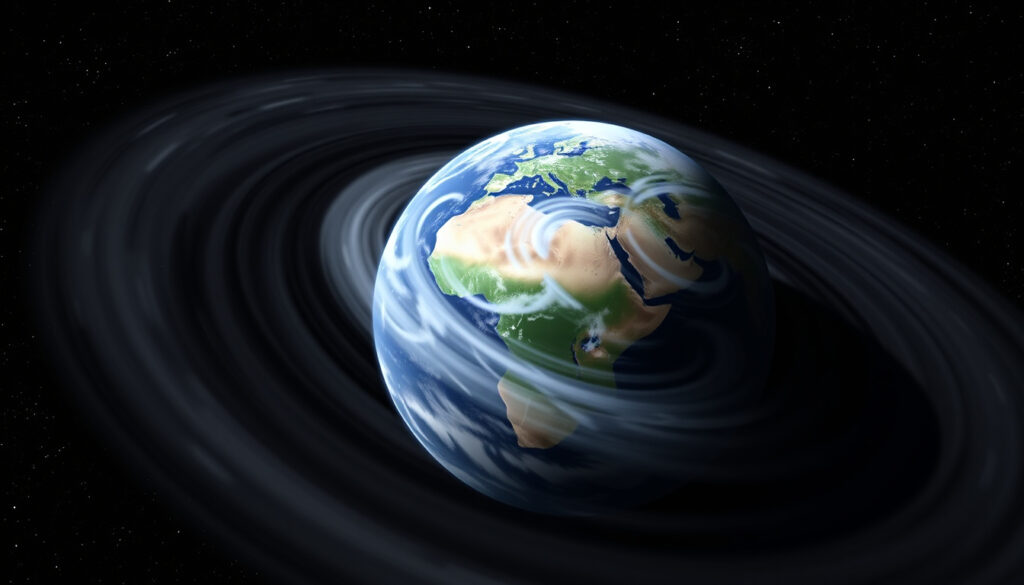
How Fast Does the Earth Spin? MPH, KM/H at Equator & More
If you’ve ever watched a plane take off and wondered how anything on Earth can stay still while hurtling through space at roughly 1,000 miles per hour, you’re not alone. The planet beneath your feet is spinning fast—yet it feels utterly motionless. This piece breaks down the exact speed of Earth’s rotation, explains the physics keeping us blissfully unaware of our cosmic spin, and tackles the scenarios that would change everything.
Equatorial spin speed: 1,040 mph (1,674 km/h) · Rotation period: 24 hours · Speed at 45° latitude: 735.8 mph · Sidereal rotation: 23h 56m
Quick snapshot
- Earth’s equator rotates at 1,040.6 mph (Wikipedia)
- At 45° latitude, speed drops to 735.8 mph (Wikipedia)
- Poles have zero tangential speed (Discover Magazine)
- Rotational acceleration is only 0.03 m/s² at equator—below human perception (Caltech/NASA)
- Gravity at 9.8 m/s² dwarfs rotational effects 300× over (Live Science)
- Atmosphere co-rotates with the surface—no relative wind (EarthSky)
- Planes inherit Earth’s momentum—they don’t need to “catch up” (Space.com)
- Air masses rotate alongside the ground at matching speeds (EarthSky)
- Spin speed runs twice commercial jet cruise (~1,000 mph vs ~500 mph) (Discover Magazine)
- Earth’s rotation has been steady for billions of years—no sudden changes in human history (Space.com)
- Annual slowdown adds roughly 1.7 milliseconds to the day per century (BBC Sky at Night Magazine)
- Any sudden stop would fling objects and reshape oceans instantly (Space.com)
These four categories capture the scientific consensus on Earth’s spin, from raw velocity data to the physics that keep us blissfully unaware of the motion.
| Measurement | Value |
|---|---|
| Equatorial speed | 1,040 mph / 1,674 km/h |
| Mid-latitude example (45°) | 735.8 mph |
| Full rotation time | 23h 56m (sidereal) |
| Annual slowdown | 1.7 ms per century |
The equatorial velocity of 1,040 mph represents the maximum surface speed on Earth—everything else is a fraction of that.
How fast does Earth spin in mph?
Earth’s equatorial surface races through space at 1,040.6 miles per hour—a figure derived by dividing the planet’s 24,901-mile circumference by the sidereal rotation period of 23 hours and 56 minutes (Wikipedia). That’s roughly 1,674.7 km/h at the equator, or 465.1 meters per second (Wikipedia). The math works because the planet’s equatorial radius measures 6,378,137 meters under the WGS84 ellipsoid model (Wikipedia).
The sidereal day distinction matters here. A solar day—the time from one sunrise to the next—is 24 hours, but Earth actually completes a full 360° rotation in just under 24 hours relative to the stars. That’s because the planet also orbits the Sun while spinning, adding about four minutes to the solar day. The sidereal day runs 23.93 hours, and using this figure gives the precise 1,040.6 mph value rather than a rounded approximation (Wikipedia).
Speed at the equator
- The equator traces the widest circle around Earth, covering roughly 40,075 km (24,901 miles)
- Dividing this distance by the sidereal day yields the maximum rotational velocity
- Objects at the equator experience the strongest centrifugal effect from this spin
Speed by latitude
Rotational speed varies predictably with latitude. The formula is straightforward: speed at latitude = equatorial speed × cos(latitude). At the equator (0°), you get the full 1,040.6 mph. At 45° north or south, the value drops to approximately 735.8 mph (Wikipedia). By the time you reach the poles, tangential speed reaches zero—the planet simply rotates beneath you with no sideways motion. This is why satellite imagery shows polar regions stationary while equatorial zones sweep sideways at over a thousand miles per hour.
Earth spins at roughly twice the speed of a commercial jet in cruise. If the planet were a highway, every point on the equator would be speeding—and getting a ticket at that speed would carry a very different kind of fine.
Why can’t we feel Earth’s rotation?
The answer comes down to physics and reference frames. Every object on Earth’s surface—your body, the air around you, the oceans, even the clouds—moves together at the same constant velocity. Since there’s no acceleration involved, your inner ear detects nothing, and there’s no relative motion between you and your surroundings (Space.com).
“Human perception thresholds are tuned to acceleration, not steady speed. The accelerations associated with these motions are very small, about 0.03 m/s² due to Earth’s spin at the equator,” according to Caltech/NASA researchers (Caltech/NASA). Compare that to gravity’s pull of 9.8 m/s², and you see the imbalance: rotational effects register roughly 300 times weaker than what keeps your feet on the ground (Live Science).
Constant velocity principle
Newton’s first law tells us that objects in motion stay in motion unless acted upon by a force. On a spinning Earth, everything is already moving at the same rate, so no net force acts on you to change your state of motion. You’re effectively coasting through space—perpetually moving sideways at 1,000 mph without feeling a thing. This mirrors the experience of flying in an airplane: at cruising altitude, turbulence aside, you feel stationary even though you’re hurtling through air at 500 mph.
Atmosphere co-rotates
The atmosphere wasn’t handed a separate ticket to ride. Over billions of years, friction between Earth’s surface and the air above it has locked the atmosphere into co-rotation—meaning the atmosphere circles the planet at the same speed as the ground beneath it (EarthSky). There are no 1,000 mph winds at the equator because the air is already moving at the same velocity as everything else. The lack of reference points in space makes the motion imperceptible anyway—you can’t see the stars whizzing past because they’re too far away to provide a motion cue.
If Earth suddenly started spinning with different speed than its atmosphere, the atmosphere would continue moving at 1,000 mph relative to the surface, generating winds far stronger than any hurricane. We’d notice that change instantly.
How do planes fly if the Earth is spinning?
Planes don’t need to compensate for Earth’s rotation because they inherit its motion. When an aircraft sits on the runway in São Paulo, it’s already moving eastward at 1,040.6 mph alongside the ground and the air above it. When it takes off, it maintains that inherited momentum, adding its own airspeed on top. From the plane’s perspective, it’s simply flying through air that’s already rotating with Earth (EarthSky).
Air mass rotation
The concept extends to weather patterns and jet streams. High-altitude wind currents like the polar jet stream owe their direction to Earth’s rotation via the Coriolis effect, but the air itself isn’t catching up to anything—it was born spinning with the planet. Flying from New York to Los Angeles doesn’t require fighting a 1,000 mph headwind; the air mass you’re traveling through is already moving at roughly your ground speed relative to the stars.
Inherited momentum
This principle applies universally: satellites, birds, rockets, and people jumping in the air all retain Earth’s rotational velocity. When you leap upward, you don’t land miles to the west—you land in place because you, the air, and the ground all share the same sideways motion. The physics is the same reason astronomers calculate launch windows by accounting for Earth’s rotation to optimize fuel efficiency, not to counteract it.
“If you’re in a car and you’re going at a constant speed on the highway, if you close your eyes and tune out the road noise, you would feel stationary.”
— Stephanie Deppe, Astronomer, Vera C. Rubin Observatory (Live Science)
The takeaway: planes, birds, and humans all carry Earth’s spin like a hidden passport. They never need to apply for a new one when they change altitude.
What would happen if Earth stopped spinning?
This is where the thought experiment turns alarming. Earth’s rotation has been steady for billions of years without sudden changes, and the scenarios for stopping range from gradual to instantaneous—but both carry catastrophic implications (Space.com). A gradual slowdown over millennia would let ecosystems adapt, but an abrupt halt would be violent.
Sudden vs gradual
If Earth stopped rotating in an instant, Newton’s first law would assert itself immediately. Everything not physically attached to the ground—oceans, buildings, vehicles, people—would continue moving eastward at 1,040.6 mph. The result would be global tsunamis as oceans surge forward, winds reaching supersonic speeds as the atmosphere continues rotating, and objects flung thousands of miles from their original positions.
Catastrophic effects
A stopped Earth means no Coriolis effect, which governs ocean currents and weather patterns. Without it, the climate system that redistributes heat from the equator to the poles shuts down, leading to extreme temperature differences between the sunny and dark sides of the planet. The sunny side would experience permanent daylight and scorching heat; the dark side would freeze in eternal night. Ocean water would migrate toward the poles due to the loss of centrifugal bulge, flooding regions near the equator while exposing new continental shelves near the poles.
We owe our stable climate to the planet’s spin, and the same rotation keeps us from feeling its full force. Humans have never experienced the planet’s true velocity—and that stability is what allows civilization to exist at all.
How fast does the Earth spin at the equator?
The precise equatorial spin velocity is 465.1 meters per second, or 1,674.7 km/h, or 1,040.6 mph—depending on your preferred unit of measurement (Wikipedia). This represents the maximum surface velocity because the equator traces the largest circumference as the planet rotates.
Calculation basis
The formula is elegant: equatorial circumference divided by rotation period. Earth’s equatorial circumference measures 40,075 km (24,901 miles) based on the WGS84 ellipsoid. Dividing by the sidereal rotation period of 23 hours, 56 minutes, and 4 seconds yields the figures above. Note that using a 24-hour solar day instead of the sidereal day produces an incorrect value of 1,669.8 km/h, a distinction that matters for precision calculations (Wikipedia).
Variations over time
Earth’s rotation isn’t perfectly constant. Tidal friction from the Moon-Sun system slowly transfers angular momentum, adding roughly 1.7 milliseconds to the day per century (BBC Sky at Night Magazine). Over millions of years, these increments accumulate—a day in the age of dinosaurs lasted about 23 hours, for instance. Minor variations also occur due to atmospheric weather patterns, ocean circulation shifts, and even earthquakes that redistribute mass. None of these changes affect daily life perceptibly, but they’re measurable with atomic clocks.
There’s also the matter of Earth’s oblate shape. The planet isn’t a perfect sphere—it’s slightly flattened at the poles and bulged at the equator due to centrifugal force from the spin itself. This means speed varies slightly depending on whether you’re measuring at sea level or slightly above, but the differences are negligible for human perception (Caltech/NASA).
Earth spins at a blistering speed of about 1,000 miles per hour relative to its axis.
Earth’s spin is measurably slowing, and the oblate shape confirms the rotation has been shaping the planet for eons. Both facts point to a system in long-term equilibrium.
Related reading: Earth’s oceans
Frequently asked questions
Do astronauts feel the Earth spinning?
No. Astronauts aboard the International Space Station share Earth’s rotational velocity and fall around the planet in free fall—the same physics that keeps them weightless also means they feel no spin sensation. Looking down, they see Earth’s surface rotating beneath them, but the spacecraft and everything inside it moves with the planet at the same rate.
How fast does the Earth spin per second?
Earth’s equatorial surface moves at approximately 465.1 meters per second, or 1,523 feet per second, at the equator (Wikipedia). This is roughly Mach 1.35 in air at sea level—faster than the speed of sound.
How fast does the Earth spin in a day?
In one sidereal day (23h 56m), Earth completes one full rotation. In one solar day (24 hours), Earth rotates slightly more than 360° to realign with the Sun. Either way, the surface at the equator travels approximately 24,901 miles relative to space each rotation.
What will happen if the Earth stops spinning for 1 second?
If Earth stopped for just one second, everything not anchored to bedrock would continue moving eastward at 1,040.6 mph. Furniture, vehicles, and people would be launched sideways. The oceans would surge, carving paths inland. The one-second pause would be followed by catastrophic restarting forces when rotation resumed.
How fast does the Earth spin in mach?
At the equator, Earth’s surface velocity of 465.1 m/s equals approximately Mach 1.35 (the speed of sound in air at sea level is ~343 m/s). The speed of sound varies with temperature, so the Mach number changes with altitude and latitude, but the rotation always outpaces the local speed of sound near the equator.
How fast does the Earth spin around the sun?
Earth orbits the Sun at approximately 67,000 mph—roughly 64 times faster than its spin rate at the equator (Study.com). We don’t feel this motion either because it’s steady orbital movement with no acceleration component. The orbital acceleration around the Sun is only 0.006 m/s², well below human perception thresholds (Caltech/NASA).
How fast does the Earth spin in a minute?
At the equator, Earth travels 1,040.6 miles per hour. Dividing by 60 gives roughly 17.3 miles per minute, or about 0.29 miles per second. Over the course of a typical commute (say, 30 minutes), a point on the equator covers over 500 miles of lateral distance.
These questions reflect the most common misconceptions about Earth’s spin, and the answers consistently reveal how invisible this motion is to human perception.
Bottom line
Earth spins at 1,040.6 mph at the equator—a velocity twice the cruising speed of a commercial jet—yet we feel nothing because we, the atmosphere, and the oceans all share that motion in a constant reference frame. Gravity masks the tiny 0.03 m/s² rotational acceleration, and without nearby space landmarks, our brains register no motion. For anyone who has ever worried about being flung off a spinning planet or wondered why planes don’t need to chase the rotation, the answer is straightforward: we’re already moving. The planet’s spin never stops, and that unbroken motion is precisely why the surface beneath your feet feels perfectly still.
More related posts
 Profit and Loss Statement: How to Prepare for Small Business
 Ki o Rahi Field: Rules, Positions, Equipment & Dimensions Guide
 What Is a Lavender Marriage? Definition and Modern Examples
 KitchenAid Food Processor NZ: Best Models & Prices Compared
 What Is an Overdraft? How It Works, Costs, and Alternatives
 Jamie Oliver Eat Yourself Healthy Recipes: Full Cookbook Guide
 Translate English to Samoan: Free Tools & Apps
 Conversational Spanish for Beginners: Easy Methods & 80/20 Rule