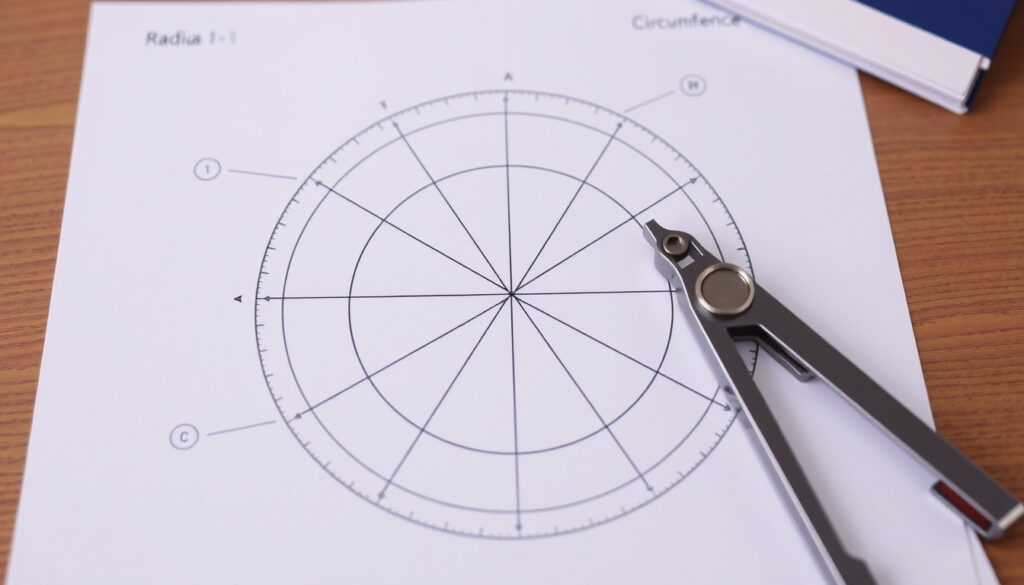
Parts of a Circle: Complete Guide with Diagram & Examples
Few geometry topics come up as often as the parts of a circle. Whether you’re helping a child with homework or revisiting high school math, the words radius, diameter, and circumference probably sound familiar – but there are more. This guide maps out every named part of a circle, from the center outwards, with clear definitions and real-world examples drawn from trusted educational sources.
Radius: distance from center to edge ·
Diameter: twice radius; longest chord ·
Circumference: total distance around circle ·
Segment: region bounded by chord & arc ·
Sector: pie-shaped region between two radii ·
Arc: part of circumference between two points
Quick snapshot
- The radius is half the diameter (Study.com (accredited education platform))
- The circumference equals π × diameter (Study.com)
- A chord divides a circle into two segments (BBC Bitesize (UK exam board resource))
- Whether some educational sources count 8, 9, or 10 parts (e.g., including secant as separate from chord) (Third Space Learning (math tutorial provider))
- Exact naming for “triangle with curved line” – some call it a circular segment (BBC Bitesize)
- Learning progression: center → radius → diameter → circumference → chord → arc → sector → segment (BCcampus Pressbooks (Canadian open education publisher))
- Apply these definitions to solve real-world problems: area of a sector, length of an arc, construction of tangents (BBC Bitesize)
The table below shows the ten parts that appear in most standards-aligned curricula, with definitions sourced from UK and US exam board resources.
| Part | Definition |
|---|---|
| Center | The equidistant point from all circumference points. |
| Radius | Line from center to circumference. |
| Diameter | Line through center connecting two circumference points; length = 2x radius. |
| Circumference | Total distance around the circle; formula: 2πr. |
| Arc | Part of the circumference. |
| Chord | Line segment connecting two points on the circumference. |
| Secant | Line that cuts through the circle, intersecting at two points. |
| Tangent | Line that touches the circle at exactly one point. |
| Sector | Region between two radii and the included arc. |
| Segment | Region between a chord and its arc (minor or major). |
What are the 8 parts of a circle?
The most commonly taught parts of a circle can be grouped into three categories: core parts (center, radius, diameter, circumference), line-based parts (chord, secant, tangent), and region-based parts (sector, segment, arc). Counting varies slightly: some lists include an arc under line-based, others include area as a part. Here is a breakdown of each part with its definition and source.
Center
- The fixed point inside the circle equidistant from all points on the circumference. All other parts are defined relative to it. (learnmath.org (geometry learning site))
Radius
- The line segment from the center to any point on the circumference. Represented by r or R in formulas. (BCcampus Pressbooks)
Diameter
- The line segment across the circle through the center. It is twice the radius and the longest chord. (Study.com)
Circumference
- The total distance around the circle, also called the perimeter. Formula: 2πr. (BBC Bitesize)
Arc
- A section or portion of the circumference. If the arc is less than half the circumference it is a minor arc; if greater, a major arc. (BBC Bitesize)
Chord
- A straight line segment joining two points on the circumference. The diameter is the longest chord. (Math Monks (geometry reference))
Secant
- A line that cuts through the circle, intersecting it at two points. Sometimes described as an extended chord. (Math Monks)
Tangent
- A straight line that touches the circumference at exactly one point. It never crosses the circle. (BBC Bitesize)
Sector
- The region enclosed by two radii and the arc between them. Often compared to a pizza slice. (BBC Bitesize)
Segment
- The area enclosed by a chord and the arc it subtends. A minor segment is smaller than a semicircle; a major segment is larger. (BBC Bitesize)
The implication: the exact count matters less than understanding how each part relates to the center. Start with the center and radius; everything else builds from there.
What are the three main parts of a circle?
Many introductory textbooks and teaching resources highlight three essential parts that form the foundation of circle geometry: the radius, diameter, and circumference. These are the first concepts taught to children and appear in every standard curriculum.
Why the radius, diameter, and circumference are core
- The radius gives the distance from center to edge, the diameter spans the full width through the center, and the circumference measures the outer distance. Together they define the circle’s size and shape. (Vedantu (maths tutorial site))
- Every other part – chord, arc, sector, segment – is derived from these three. For example, a chord becomes a diameter only if it passes through the center. (Third Space Learning (US math tutorials))
The pattern: once learners master these three, the rest – chords, tangents, segments – become logical extensions rather than new facts.
What is the center of a circle called?
The center is simply called the center or center point. In geometry, it is the fixed point from which all points on the circle are equidistant. The notation is often the uppercase letter O in diagrams.
Center point definition
- “The center is the fixed point from which all points on the circle are equidistant.” (learnmath.org)
- In coordinate geometry, the center is given as (h, k) in the standard circle equation (x – h)² + (y – k)² = r². (Study.com)
How the center defines all other parts
- The radius extends from the center to the circumference.
- The diameter is a chord through the center.
- A sector is bounded by two radii (lines from the center).
- A segment does not directly involve the center, but its chord can be located relative to it.
The catch: while the center seems obvious, it is the one part that is not a line or region – it is a point. Recognizing that all measured distances in a circle start from this single point simplifies every geometry problem that follows.
What is a segment of a circle?
A segment of a circle is the region bounded by a chord and the arc cut off by that chord. The chord creates two regions: the minor segment (smaller, less than a semicircle) and the major segment (larger, more than a semicircle).
Minor segment
- The region enclosed by a chord and its minor arc (the shorter arc). (BBC Bitesize)
Major segment
- The region enclosed by a chord and its major arc (the longer arc). The major segment is always larger than half the circle. (YouTube (instructional video))
Segments appear in problems about chord lengths, area calculations, and in real-world contexts such as determining the cross-section of a pipe or the shape of a lens.
Why this matters: understanding segments opens the door to calculating areas of regions that are not conveniently pie-shaped. That’s where geometry meets practical engineering.
What is the edge of a circle called?
The edge of a circle is called the circumference. It is the curved boundary that encloses the circle. If you take a portion of that edge, you get an arc.
Circumference
- “The circumference is the length of the perimeter of the circle.” (Study.com)
- Formula: C = 2πr or C = πd. (BBC Bitesize)
Arc
- “An arc is a section or portion of the circumference.” (BBC Bitesize)
- Minor arc: shorter than half the circumference. Major arc: longer than half.
For everyday language, people might say “round edge.” In mathematics, “circumference” is the precise term.
The trade-off: using “circumference” instead of “edge” brings clarity in formulas but can confuse beginners. The key is to remember that circumference is a length, not a shape – the edge itself is the set of points at distance r from the center.
What is a triangle with a curved line called?
A shape that looks like a triangle with one curved side is not a triangle at all – it is a circular segment or a sector, depending on which lines bound it.
Circular segment
- If the shape has two straight sides (chord) and one curved side (arc), it is a circular segment. (BBC Bitesize)
Sector
- If the shape has two straight sides (radii) and one curved side (arc), it is a sector – like a pizza slice. (BBC Bitesize)
In everyday speech, people might call a curved-triangle shape a “circular segment.” Mathematically, a triangle must have three straight sides, so the correct term is segment or sector.
The catch: many students misidentify a segment as a triangle because it looks like one. The curved side is the giveaway – a true triangle never bends.
Confirmed facts vs. What’s unclear
Confirmed facts
- The radius is half the diameter. (Study.com)
- The circumference equals π times the diameter. (Study.com)
- A chord divides a circle into two segments. (BBC Bitesize)
What’s unclear
- Whether some sources count 8, 9, or 10 parts (e.g., secant vs. chord emphasis). (Third Space Learning)
- Exact naming for “triangle with curved line” – segment or something else. (BBC Bitesize)
Expert perspectives
“A circle is the set of all points in a plane that are the same distance from a fixed point called the center.”
“Children first learn the three main parts: radius, diameter, and circumference. These give the building blocks for understanding all the other parts.”
Third Space Learning (US math tutorials)
Summary
The parts of a circle – from center and radius to sector and segment – form a logical system where each part is defined by its relationship to the center. For students studying geometry, the choice is clear: learn the core four (center, radius, diameter, circumference) first, then build outward. Misidentifying a segment as a triangle is common but easily avoided once you know the rule: triangles have three straight sides; a curved edge means it’s a segment or a sector.
For anyone helping a child with homework or brushing up on math basics, the implication is straightforward: start with the center, and every other part will fall into place.
Related reading: How to Simplify Fractions · Ki o Rahi Field: Rules, Positions, Equipment & Dimensions Guide
Frequently asked questions
What is a segment of a circle?
A segment is the region bounded by a chord and the arc it cuts off. The minor segment is smaller than a semicircle; the major segment is larger. (BBC Bitesize)
What are circle segments called?
They are called minor segment and major segment. Some textbooks also use alternate segment (the one opposite a tangent). (BBC Bitesize)
What is a major segment of a circle?
The major segment is the larger region bounded by a chord and its major arc (the longer arc). It is always bigger than a semicircle. (YouTube (instructional video))
What is a segment with endpoints on a circle called?
That is a chord. A chord is a straight line segment whose endpoints lie on the circumference. (Math Monks)
What is the edge of a circle called?
The edge of a circle is called the circumference. It is the curved boundary that encloses the circle. (Study.com)
What is a curved line segment called?
A curved line segment on a circle is called an arc. Arcs can be minor (shorter than half the circumference) or major (longer). (BBC Bitesize)
What is a triangle with a curved line called?
A shape with one curved side and two straight sides is not a triangle. It is either a circular segment (if bounded by a chord and arc) or a sector (if bounded by two radii and an arc). (BBC Bitesize)
More related posts
 Travelodge Hotel Auckland Wynyard Quarter – Location, Amenities & Reviews
 Online Jobs from Home in Ireland: No Experience Needed
 Auckland Airport Shopping Centre: Terminal & Mānawa Bay Info
 How to Learn Piano Online: A Complete Guide for Beginners
 Ki o Rahi Field: Rules, Positions, Equipment & Dimensions Guide
 Mitre 10 Mega Takanini: Hours, Phone, Address & Reviews
 NZ Cheap Cars Tauranga – Best Dealers, Auctions Under $10k
 Southern Cross Pet Insurance Claim: Step-by-Step Guide & Reviews