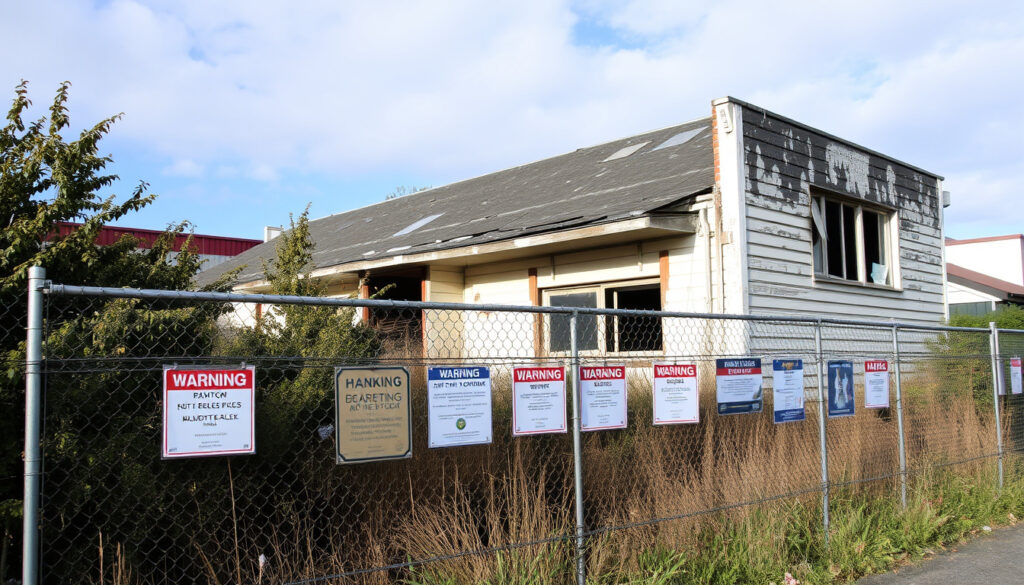
Auckland Abandoned Building Concerns: Legal & Safety
It’s a sight that’s become uncomfortably familiar in parts of Auckland: a building with windows boarded up, a sagging roof, and a fence that’s been kicked in. For the neighbours, what goes on behind those walls can range from unsettling to dangerous.
Penalties for empty buildings in New Zealand: None ·
Major abandoned developments reported in Auckland (2025): At least 3 ·
Top concerns among residents: Squatters, vandalism, rain run-off
Quick snapshot
- Auckland Council defines an abandoned building as empty, deserted, derelict, or uninhabited (Auckland Council’s Property Maintenance and Nuisance Bylaw (local government regulation))
- Breaching the bylaw can result in a fine of up to NZ$20,000 (Auckland Council bylaw document)
- Police have charged people for stripping materials from empty buildings (New Zealand Police official release)
- A rental property was illegally occupied by gang members for months (NZ Herald (major news outlet))
- Exact number of abandoned buildings in Auckland is unknown — no official database exists (Local Matters (independent Auckland news site))
- Ownership of many abandoned properties is opaque (Local Matters (independent Auckland news site))
- Effectiveness of council enforcement is unclear (Local Matters (independent Auckland news site))
- 2024: Police find three people stripping materials from a Carrington Road building (New Zealand Police)
- January 2025: NZ Herald reports abandoned builds sparking squatter fears (NZ Herald)
- Auckland Council may step up bylaw enforcement (Local Matters)
- Civil cases over illegal occupation continue (Local Matters)
Three key facts stand out from the available data — and they point to a system with real gaps.
| Label | Value |
|---|---|
| Penalty for empty buildings in NZ | None (national level); bylaw fines up to $20,000 apply (Auckland Council) |
| Major abandoned developments reported in Auckland (2025) | At least 3 |
| Top concerns reported | Squatters, vandalism, rain run-off |
Can you claim an abandoned house in NZ?
A common myth holds that if a property is empty long enough, you can simply move in. The reality is far more constrained.
What is the legal definition of abandoned property?
- Auckland Council’s bylaw defines a building as abandoned if it is empty, deserted, derelict, or uninhabited (Auckland Council bylaw definition). That’s a local definition for nuisance purposes, not a legal category that transfers ownership.
How to determine ownership of an abandoned house
- Ownership is recorded on the Land Information New Zealand (LINZ) title. Even if a building looks abandoned, the owner retains full legal rights. In one Auckland case, a Black Power member claimed ownership based on his father having lived there decades ago, but the legal owners remained the family who had rented it out (NZ Herald report).
Steps to legally acquire an abandoned property
- There is no simple claim process. Adverse possession (squatter’s rights) in New Zealand requires continuous occupation for at least 20 years with a clear intention to possess, and it rarely succeeds against a registered title. Council compliance staff note that the bylaw requires owners to secure unoccupied buildings, but it does not transfer ownership (Local Matters interview with compliance staff).
The implication: claiming an abandoned house is not a viable shortcut for any member of the public. The legal framework protects registered owners, even when they neglect their property.
Is it illegal to explore abandoned locations?
Urban exploration — known as urbex — is a popular hobby, but in New Zealand it sits on shaky legal ground.
Trespassing laws in New Zealand
- Entering private property without permission is trespassing, even if the building appears abandoned. The Auckland Council bylaw explicitly requires owners to prevent public access to abandoned buildings (Auckland Council bylaw clause).
Risks of entering abandoned buildings
- Beyond legal trouble, physical hazards include unstable floors, exposed wiring, and hazardous materials. Police have attended incidents where people were inside empty buildings allegedly smashing them up and stripping materials to sell (New Zealand Police news release).
Exceptions for public curiosity
- No general exception exists for photography, curiosity, or social media content. The law treats abandoned buildings as private property. Council can investigate complaints about unsafe or neglected buildings whether occupied or not (Local Matters reporting).
The trade-off: the risk of trespassing charges and physical danger far outweighs the appeal of a few interior photos. The safest approach is to enjoy buildings from the street.
Does Auckland have a homeless problem?
Auckland has a significant homeless population, and abandoned buildings often become de facto shelters.
How homelessness relates to abandoned buildings
- Abandoned structures offer shelter from the elements, but they also create friction with neighbours who report vandalism, drug use, and fires. One family whose rental was occupied by gang members said they had pursued both criminal and civil court action but were still waiting for a resolution (NZ Herald coverage).
Statistics on homelessness in Auckland
- While exact numbers are debated, the 2023 Census and Auckland Council’s annual housing stocktake both show thousands of people without stable accommodation. The scarcity of emergency housing drives some into empty buildings.
Shelter capacity and abandoned buildings as shelter
- Emergency housing providers report that demand far exceeds supply. Stalled development sites — of which Auckland has several — become unofficial camps. Residents in Point Chevalier have complained about squatters in a long-empty building on Carrington Road (Police incident report).
Why this matters: the connection between homelessness and abandoned buildings creates a vicious cycle — empty properties attract illegal occupation, which fuels community fear and slows investment in the area.
New Zealand has no penalty for leaving a building empty at the national level. That means owners face zero financial consequence for allowing a structure to decay — as long as it doesn’t create a nuisance under local bylaws.
How many abandoned houses are there in NZ?
You might expect the government to keep a count. It doesn’t.
No official count of abandoned houses
- No central government database tracks abandoned residential properties. Auckland Council investigates individual complaints but does not maintain a public register. Local Matters reports that compliance staff respond to reports but have no comprehensive inventory (Local Matters article).
Estimates from news reports
- Journalists have identified at least three major stalled or abandoned developments in Auckland. The NZ Herald covered a family’s year-long legal battle over their occupied rental, and The Spinoff in late 2025 ran a walking tour of empty buildings in Auckland Central — though the exact number remains unverified.
Comparison between abandoned houses and commercial buildings
- Commercial and industrial sites appear to make up a larger share of abandoned properties than residential ones, but again, no breakdown exists. The bylaw covers all structures equally (Auckland Council bylaw scope).
The pattern: without data, policymakers and neighbours alike are left guessing. The first step toward a solution is knowing the scale of the problem.
What are the main concerns about abandoned buildings in Auckland?
Residents, council staff, and police all point to a cluster of interconnected problems.
Squatters and vandalism
- Squatter activity is the most visible concern. In the Carrington Road case, police found three men inside an empty building alleged to be smashing it up and targeting materials to sell (New Zealand Police). The family whose rental was occupied by Black Power members described months of fear and frustration (NZ Herald).
Structural decay and safety hazards
- Rain run-off from unmaintained roofs, fallen debris, and overgrown vegetation damage neighbouring properties. Council compliance staff say the bylaw requires owners to prevent such nuisances, but enforcement relies on complaints (Local Matters).
Community frustration and lack of action
- Aucklanders express anger on social media and forums like Reddit, asking why owners can leave buildings to rot without consequence. Council can prosecute — breach of the bylaw carries fines up to $20,000 and additional daily penalties under the Health Act (Auckland Council bylaw penalties) — but critics say the process is slow and reactive.
What this means for residents: the current system puts the burden on neighbours to notice and report problems, and then wait for the council to contact an often-unresponsive owner.
Upsides
- Auckland Council’s bylaw provides a legal remedy for nuisances
- Residents can report issues by phone or online (Council complaint process)
- Courts can impose meaningful fines on non-compliant owners
Downsides
- No national empty-property penalty leaves owners unaccountable
- Enforcement is complaint-driven and slow
- Ownership of many sites is unclear, complicating legal action
Timeline of key events
- 2024 — Police charge three men after they were found inside an empty Carrington Road building allegedly stripping materials (Police release)
- January 2025 — NZ Herald publishes an article on abandoned builds sparking fears over squatters and vandalism (NZ Herald)
- November 2025 — The Spinoff publishes a mystery tour of empty buildings in Auckland Central
Clarity: What we know vs what we don’t
What’s confirmed
- New Zealand has no national penalty for leaving buildings empty
- Squatters and vandalism are reported in abandoned buildings across Auckland
- Entering abandoned buildings is trespassing
- The Auckland Council bylaw defines abandonment and allows penalties up to $20,000
- Police have arrested people for burglary inside empty properties
What’s unclear
- Exact number of abandoned buildings in Auckland
- Who owns many of the abandoned properties
- Legal status of exploring abandoned buildings in practice enforcement
- How effective council enforcement actually is
Expert perspectives
“Three people were found inside an empty building on Carrington Road in Point Chevalier and were alleged to be smashing it up … targeting materials to sell.”
— New Zealand Police official statement, 2024
“The owner of any building that is abandoned or wholly or partly unoccupied must ensure the building does not create specified nuisances and is secured against public access.”
— Auckland Council Property Maintenance and Nuisance Bylaw 2015
The divergence between these two perspectives — police dealing with active damage and council setting rules — illustrates the enforcement gap at the heart of the issue.
For residents living next to an empty property, the implication is clear: the current system requires you to be the watchful neighbour, and then wait.
Related reading: **Parliament Petition Playground Safety: Latest Updates and Guide**
nzherald.co.nz, rnz.co.nz, reddit.com, nzherald.co.nz, odt.co.nz, aucklandcouncil.govt.nz, rnz.co.nz, nzherald.co.nz
Frequently asked questions
Are there squatters in Auckland’s abandoned buildings?
Yes, multiple reports — from police and news outlets — confirm squatters inside empty buildings, including one family’s rental occupied by Black Power members (NZ Herald).
What is being done about abandoned buildings in Auckland?
Auckland Council investigates complaints under its Property Maintenance and Nuisance Bylaw and can fine owners up to $20,000. But enforcement is reactive, and there is no proactive citywide strategy (Auckland Council bylaw).
Where are the most abandoned buildings in Auckland?
Areas like Point Chevalier, Auckland Central, and parts of South Auckland have been highlighted in news reports and online discussions, but no official map exists.
Who owns abandoned buildings in Auckland?
Ownership is recorded on title at LINZ, but in many cases the owner is a company or trust that is difficult to trace. Council compliance staff often struggle to find responsible parties (Local Matters).
How do abandoned buildings affect property values in Auckland?
Stalled developments and neglected structures can drag down nearby home values due to safety concerns, visual blight, and the potential for squatter activity.
What are the legal consequences of entering an abandoned building in NZ?
Entering without permission is trespassing. If damage occurs, you could face burglary or vandalism charges. Police have charged individuals with burglary and drug possession after being found inside (Police release).
Are there any penalties for leaving buildings abandoned in New Zealand?
No national empty-property tax exists. However, Auckland Council’s bylaw allows fines up to $20,000 for breach, plus daily penalties under the Health Act 1956 (Auckland Council penalties document).
Where can I find reports on abandoned building concerns in Auckland?
Check sources like NZ Herald, Local Matters, and police media releases. For community views, Reddit threads under “auckland abandoned building concerns” provide real-time discussion.
Related reading: Papamoa Sinkhole Golden Sands: Verified Facts & Update · Parliament Petition Playground Safety: Latest Updates and Guide
More related posts
 How to Get Rid of Acne Scars: Proven Treatments & Home Remedies
 When to Plant Potatoes in New Zealand: Best Months & Tips
 Cheapest Electricity Provider NZ: Compare Rates & Save
 What’s My Car Worth? Free Car Valuation in Ireland (2025)
 Ant-Man and the Wasp: Hit or Flop, Cast, Plot & More
 Nottingham Forest vs Man City standings: head-to-head, charges
 Parliament Petition Playground Safety: Latest Updates and Guide
 Earthquake Felt Reports New York: Recent Shaking and History