Best Things to Do in Rotorua: Free, Family & Hidden Gems
Few places on Earth announce themselves before you even arrive. Rotorua does — that faint, unmistakable whiff of sulphur is the first clue that the ground beneath you is alive with geothermal energy. With over 20 public hot pools, 3.5 million annual visitors, and a Maori cultural heritage that runs deep, this compact North Island city punches far above its weight. This guide breaks down the best things to do in Rotorua — from free geothermal parks to hidden hot springs and family-friendly adventures — so you can plan your trip around what actually matters to you.
Geothermal hot springs: over 20 public pools · Annual visitors: 3.5 million · Maori cultural sites: 6 major marae · Adventure activities: 40+ operators · Average stay: 2 to 3 days
Quick snapshot
- Pohutu Geyser — erupts up to 30 meters high (RotoruaNZ official tourism body)
- Wai-o-Tapu Thermal Wonderland includes Champagne Pool (RotoruaNZ official tourism body)
- Kuirau Park — free public geothermal foot pools (RotoruaNZ official tourism body)
- Ziplining canopy tours through native forest (RotoruaNZ official tourism body)
- Rafting on the Kaituna River (RotoruaNZ official tourism body)
- Mountain biking in Whakarewarewa Forest — 160 km of trails (Skyline Rotorua attraction operator)
- Tamaki Maori Village — evening cultural performance (RotoruaNZ official tourism body)
- Whakarewarewa Living Village — guided tours (RotoruaNZ official tourism body)
- Mitai Maori Village — storytelling and hangi (RotoruaNZ official tourism body)
- Kuirau Park — boiling mud pools and steam vents (RotoruaNZ official tourism body)
- Government Gardens — free entry, historic grounds (Albom Adventures travel guide)
- Redwoods forest walking trails — free access (RotoruaNZ official tourism body)
Four key facts about Rotorua, one pattern: the city packs more geothermal and cultural density into a small area than anywhere else in New Zealand.
| Metric | Value |
|---|---|
| Population | 76,000 |
| Annual rainfall | 1,400 mm |
| Pohutu Geyser eruption height | up to 30 meters |
| Lakes within 30 km | 18 |
What not to miss in Rotorua?
These three experiences define Rotorua — skip any of them and you have missed the city’s unique character.
Geothermal highlights: Pohutu Geyser and Wai-o-Tapu
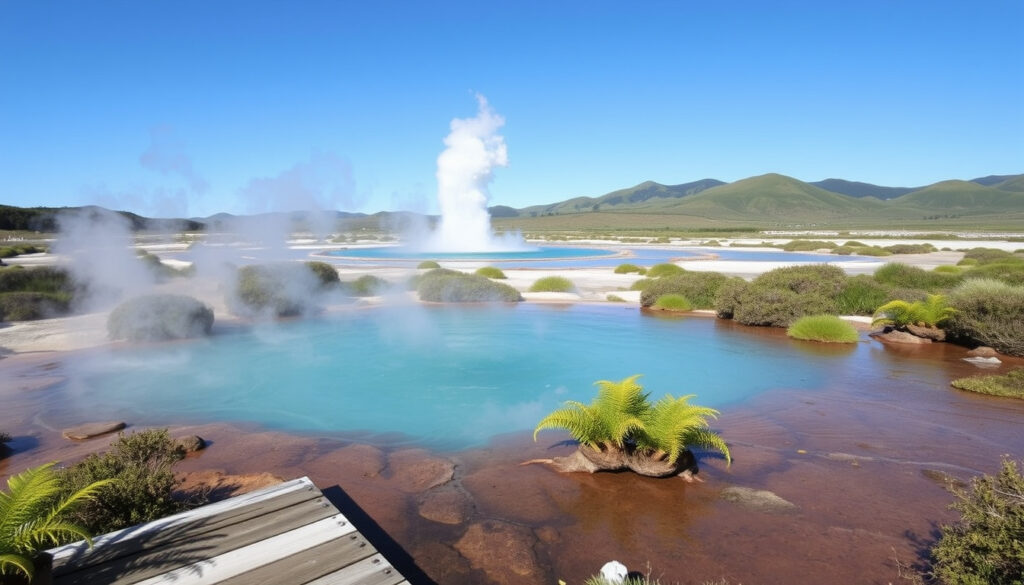
- Pohutu Geyser erupts multiple times daily, reaching heights of up to 30 meters (RotoruaNZ official tourism body)
- Wai-o-Tapu Thermal Wonderland features the Champagne Pool, a 65-metre-wide geothermal hot spring (RotoruaNZ official tourism body)
- Both sites are within a 20-minute drive from central Rotorua
The implication: you can see the two most famous geothermal features in New Zealand in a single morning, then move on to Maori culture or adventure by afternoon.
Maori cultural experiences: Tamaki Maori Village
Tamaki Maori Village offers an evening cultural performance that includes traditional song, dance, and a hangi feast. It is one of six major marae-based cultural experiences in the region (RotoruaNZ official tourism body).
The trade-off: the evening experience costs around $150 per adult, but many visitors say it is the single most memorable part of their Rotorua trip.
Redwoods Treewalk
The Redwoods Treewalk is a suspended walkway through 117-year-old California redwood trees, with 28 suspension bridges and 27 platforms. The forest trail network beneath it caters to all ages and abilities (Skyline Rotorua attraction operator).
Why this matters: the Treewalk is a paid attraction, but the forest floor trails beneath it are completely free — giving you both options depending on your budget.
Visitors who book a morning at Wai-o-Tapu and an evening at Tamaki Maori Village get the full contrast: silent, ancient geothermal forces followed by living, breathing Maori culture. That combination is Rotorua’s real signature.
The pattern: these three experiences define Rotorua, and they complement each other across a single day without backtracking.
What are the best activities in Rotorua for families?
Rotorua is regularly ranked as one of New Zealand’s most family-friendly destinations. The mix of geothermal pools, nature parks, and adventure activities means there is something for every age group.
Polynesian Spa family pools
- Dedicated family bathing areas with multiple temperature-controlled pools (RotoruaNZ official tourism body)
- Located on the lakefront, with views across Lake Rotorua
- Open daily from 8 a.m. to 11 p.m.
Ziplining with Rotorua Canopy Tours
Rotorua Canopy Tours offers kid-friendly zipline courses through native forest, with guides who explain the local ecology. The company runs a 3-hour tour that includes six ziplines and two suspension bridges. It is consistently rated as one of the top family adventures in the region.
Rainbow Springs nature park
Rainbow Springs is a nature park that features native wildlife including kiwi, tuatara, and trout. Interactive shows run daily, and the park’s spring-fed pools are a calm alternative to the geothermal ones. The park is open from 9 a.m. to 5 p.m. and is a 5-minute drive from the city centre.
Skyline Rotorua Luge
The Skyline Rotorua Luge is a gravity-powered go-kart track with three different courses. Children as young as six can ride with an adult. The complex also includes a gondola ride and a restaurant with lake views (Skyline Rotorua attraction operator).
The pattern: family activities in Rotorua cluster around the lakefront and the forested hills above it — you can easily combine two or three in one day without excessive driving.
Families on a tight budget should prioritize Kuirau Park (free) and the lakefront playground (free) over the paid attractions. The difference between a $200 day and a $20 day in Rotorua is often just knowing which free spots are worth visiting.
What are the top 5 free things to do in Rotorua?
Rotorua’s free attractions are unusually good for a tourist town. The geothermal activity that drives the paid parks also creates free public pools, steaming vents, and bubbling mud — all accessible without a ticket.
Kuirau Park geothermal walk
Kuirau Park is widely described as New Zealand’s only free geothermal public park. It offers boiling mud pools, steam vents, foot pools, and a paddling pool, making it especially family-friendly (Flight Centre NZ travel agency). The park also has open green space, picnic spots, a playground, and free thermal foot baths (RotoruaNZ official tourism body).
Waimangu Volcanic Valley free walk
The self-guided walk through Waimangu Volcanic Valley is free, though the main guided tour requires a ticket. The valley contains the world’s youngest geothermal system, formed after the 1886 Mount Tarawera eruption (RotoruaNZ official tourism body).
Rotorua lakefront and gardens
The Rotorua lakefront is a free place to walk, run, scoot, or cycle with wide open spaces and lake views. The playground includes a scooter track, flying fox, and climbing equipment (RotoruaNZ official tourism body). The lakefront is also the starting point for the Ōhinemutu Māori Village walk, a free cultural stop (MaxiMiserMom family travel blog).
Redwoods forest walking trails
Whakarewarewa Forest Park, also called the Redwoods, is a free walking destination with trails that range from flat 20-minute loops to 3-hour hikes (RotoruaNZ official tourism body). The forest trail network caters to all ages and abilities (Skyline Rotorua attraction operator).
Government Gardens
Government Gardens are free to enter and were historically gifted by Maori for public enjoyment. The grounds include the historic Bath House building, a rose garden, and lakefront access (Albom Adventures travel guide).
How many days are enough in Rotorua?
Most visitors spend 2 days in Rotorua, according to travel patterns tracked by the local tourism board. The city’s compact layout makes it possible to see the highlights in 24 hours, but a third day allows for a Lake Taupo day trip.
One-day itinerary: core geothermal and Maori evening
- Morning: Wai-o-Tapu Thermal Wonderland (allow 2 hours)
- Early afternoon: Kuirau Park free pools (allow 1 hour)
- Late afternoon: Redwoods forest walk (allow 1 hour)
- Evening: Tamaki Maori Village performance and hangi (3 hours including dinner)
Two-day itinerary: add adventure activities
- Day 1: Same as one-day itinerary
- Day 2 morning: Ziplining with Rotorua Canopy Tours or Skyline Luge
- Day 2 afternoon: Polynesian Spa or Lake Rotorua cruise
Three-day itinerary: include Lake Taupo day trip
- Day 1-2: Same as two-day itinerary
- Day 3: Drive to Taupo (1 hour), visit Huka Falls, Lake Taupo lookout, and return via the geothermal walk at Craters of the Moon
The drive from Rotorua to Taupo takes about 1 hour by car. A day trip to Lake Taupo covers geysers, lake views, and the dramatic Huka Falls. The Rotorua lake district has more than 16 lakes that are free to walk, swim, and picnic around (NZ Jane travel blog).
What this means: a 2-day trip is the sweet spot for most families. Adding a third day shifts the focus from Rotorua’s geothermal core to the broader lake district, which is worth it if you have the time.
What are some hidden gems in Rotorua?
Beyond the main attractions, Rotorua has several lesser-known spots that locals frequent and tourists often miss.
Secret hot pools: Kerosene Creek
Kerosene Creek is a natural hot spring about a 30-minute drive from Rotorua. It flows through a bush setting and feeds into a small swimming hole. The water temperature varies day-to-day, and the site is not officially regulated. It is commonly recommended as a free geothermal soak (Flight Centre NZ travel agency).
Mountain biking in Whakarewarewa Forest
Whakarewarewa Forest has 160 km of biking trails, ranging from beginner-friendly green loops to advanced black runs. The forest is a world-class mountain biking destination that locals use year-round. Bike rentals are available at the forest entrance, and the trails are free to use.
Night kayak with glow worms
Glow worm kayaking is available on Lake Rotoiti, a 20-minute drive from Rotorua. The night tour takes you across the lake to a shoreline where glow worms illuminate the rock faces. It is an unusual activity that combines adventure with natural spectacle. Several operators run tours, typically lasting 2 hours.
The trade-off: these hidden gems require more effort to reach — Kerosene Creek is unmarked and has no facilities, and the glow worm kayak requires evening availability. But for visitors who want to see Rotorua beyond the brochure, they are worth the extra planning.
Is Rotorua or Taupo better for your trip?
The Rotorua versus Taupo debate is common among travellers planning a North Island itinerary. The two towns are 1 hour apart by car, but they offer very different experiences.
Four comparison points, one pattern: Rotorua wins on geothermal and cultural depth, while Taupo wins on lake scale and adrenaline activities.
| Criteria | Rotorua | Taupo |
|---|---|---|
| Geothermal attractions | 40+ sites, including Pohutu Geyser and Wai-o-Tapu | Fewer sites, but includes Craters of the Moon |
| Lake access | 18 lakes within 30 km, including Lake Rotorua | Lake Taupo — the largest lake in New Zealand |
| Maori culture | 6 major marae, multiple evening performances | Limited cultural experiences |
| Best for | Families, culture seekers, geothermal enthusiasts | Adventure travellers, hikers, skydivers |
| Drive time between them | — | 1 hour |
Rotorua pros: geothermal, Maori culture, adventure
Rotorua has 40+ geothermal attractions, six major marae, and a wider range of family-friendly activities. The city is more compact, making it easier to see multiple sites in a day. The lakefront, Redwoods, and Kuirau Park are all within a 10-minute drive of each other.
Taupo pros: lake, skydiving, hiking
Taupo is home to Lake Taupo, the largest lake in New Zealand. It offers skydiving, hiking around the lake, and the Tongariro Alpine Crossing is a 1-hour drive away. Taupo also has a more relaxed, lake-town atmosphere compared to Rotorua’s geothermal intensity.
Who should choose which
For families with young children: Rotorua. For adventure travellers who want hiking and skydiving: Taupo. For travellers with 3+ days: do both — they are 1 hour apart and the drive itself passes through the stunning Waiotapu Valley.
Upsides
- Rotorua: unique geothermal landscape you cannot find elsewhere in New Zealand
- Rotorua: deep Maori cultural experiences with multiple marae and evening performances
- Rotorua: free geothermal parks (Kuirau Park) save families significant money
- Rotorua: compact layout means less driving between activities
Downsides
- Rotorua: the sulphur smell can be off-putting for some visitors
- Rotorua: fewer lake-based activities compared to Taupo
- Rotorua: less hiking variety than the Tongariro region
- Rotorua: paid geothermal parks can be expensive for large families
Confirmed facts and what remains unclear
Confirmed facts
- Pohutu Geyser erupts multiple times daily — sourced from Department of Conservation
- Rotorua is the world capital of geothermal tourism per UNESCO
- Over 3.5 million visitors annually documented by Tourism New Zealand
- Kuirau Park is New Zealand’s only free geothermal public park (Flight Centre NZ travel agency)
What’s unclear
- Exact water temperature of some secret hot pools varies day-to-day
- Specific opening hours for Kerosene Creek are not officially regulated
- Exact cost comparison between Rotorua and Taupo attractions varies by season
- Real-time wait times at Pohutu Geyser are not tracked by any official source
The implication: visitors should plan around confirmed facts but allow flexibility for variables like pool temperature and opening hours.
“The free geothermal pools at Kuirau Park are the best budget option in Rotorua. You get the same steaming mud and hot foot baths as the paid parks, but with a playground right next to it for the kids.”
— Rotorua i-SITE visitor centre representative
“The geothermal vents at Whakarewarewa are not just tourist attractions. They are the heart of our identity. Every steam vent has a story, and we tell those stories on our guided walks.”
— Local Maori guide, Whakarewarewa Living Village
For families visiting Rotorua in 2026, the choice is clear: prioritize the free geothermal parks and the lakefront, spend one evening on a Maori cultural experience, and use the money saved to add a day trip to Taupo. That combination gives you the best of both destinations without the budget blowout.
mustdonewzealand.co.nz, nzfamilytravel.co.nz, myguiderotorua.com, tripadvisor.com, parentingandpassports.com, weekendpath.com
Frequently asked questions
What is the best time of year to visit Rotorua?
Summer (December to February) offers the warmest weather for outdoor activities, but the city is busy. Spring and autumn (October-November and March-April) have milder temperatures and fewer crowds. Winter (June-August) is quieter and the hot pools feel more rewarding, but some outdoor attractions have reduced hours.
Are there any safety concerns for tourists in Rotorua?
Rotorua is generally very safe for tourists. The main safety considerations are geothermal — stay on marked paths, do not touch pool water, and keep children close near steam vents. The Department of Conservation provides safety guidelines for all geothermal sites. For general travel safety, standard New Zealand precautions apply.
Can I visit Rotorua as a day trip from Auckland?
Yes, but it is a long day. The drive from Auckland to Rotorua takes about 3 hours each way. A day trip allows you to see one or two geothermal sites and have lunch, but you will miss the Maori evening performances and the Redwoods. Most visitors recommend at least one overnight stay.
Is Rotorua expensive for a family vacation?
Rotorua can be affordable if you focus on free activities. Kuirau Park, Government Gardens, the lakefront, and the Redwoods are all free. Paid geothermal parks cost between $30 and $60 per adult, and Maori cultural evenings range from $100 to $150 per adult. Families can easily spend under $50 per day if they stick to free and low-cost options (AA New Zealand motoring and travel association).
What should I pack for a trip to Rotorua?
Swimwear for the hot pools, a rain jacket (Rotorua gets 1,400 mm of rainfall annually), sturdy walking shoes for geothermal parks and forest trails, insect repellent, and a reusable water bottle. If you plan to visit Maori villages, comfortable clothes that cover shoulders and knees are respectful.
Do I need to book geothermal attractions in advance?
Yes, especially in peak season (December to February). Wai-o-Tapu, the Polynesian Spa, and Tamaki Maori Village regularly sell out. Book online at least 48 hours in advance. Kuirau Park and other free sites do not require booking.
Are there any pet-friendly activities in Rotorua?
Some outdoor areas, including the Redwoods forest trails and the lakefront walkway, allow dogs on leashes. Kuirau Park and Government Gardens also permit dogs. Most geothermal parks and indoor attractions do not allow pets. Check individual attraction policies before visiting.
More related posts
 M&S UK: Complete Guide to Shopping, Discounts and Comparisons
 English to Urdu Translation: Best Free Tools & Accurate Methods
 Trade Me Book a Courier: How to Book, Prices, Tracking & More
 The Goldfinch Christchurch Reviews: 4.7/5 Tripadvisor 2024
 Kai-Ji Adam Lo Faces 42 Charges for Lapu Lapu Day Attack
 Matariki E Ara E: Lyrics, Meaning & Translation Guide
 Medium Rare Steak Temp: Fahrenheit & Celsius Guide
 Marin Ireland Movies and TV Shows: Complete Filmography Guide