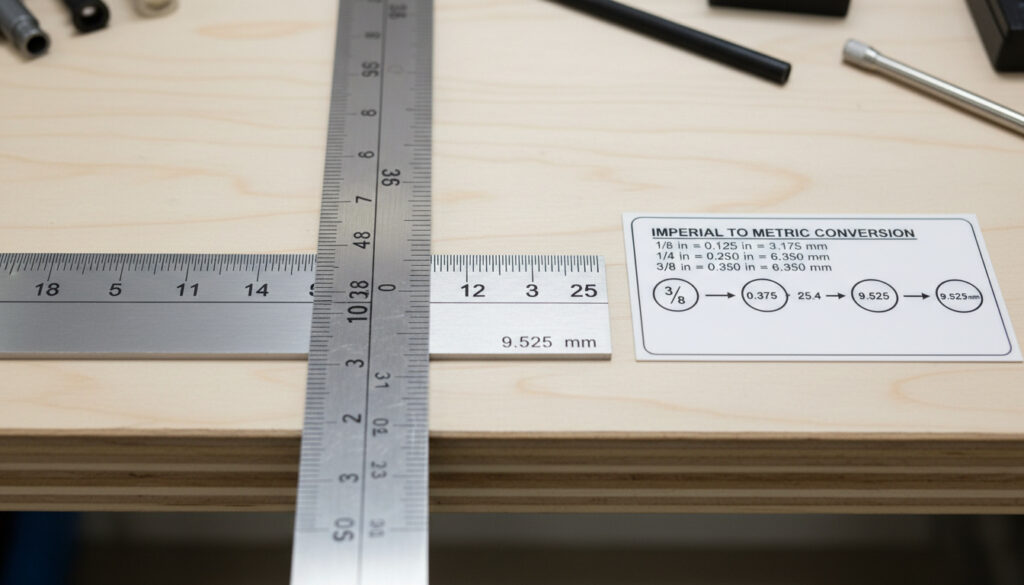
3/8 to mm – Exact Conversion, Chart and Step-by-Step Guide
Three-eighths of an inch translates to exactly 9.525 millimeters. This precise conversion relies on the international standard defining one inch as 25.4 millimeters, a value established by the National Institute of Standards and Technology (NIST) since 1959.
The fraction 3/8 represents a common imperial measurement encountered in hardware specifications, plumbing fixtures, and automotive components. Understanding its exact metric equivalent prevents assembly errors when working with international parts or metric tooling systems.
While casual applications may round this value to 9.5 mm, engineering and manufacturing contexts demand the full precision of 9.525 mm to ensure proper thread engagement and dimensional tolerances.
What Is 3/8 Inch in Millimeters?
| Property | Value |
|---|---|
| Exact Metric | 9.525 mm |
| Decimal Inch | 0.375 in |
| Conversion Factor | × 25.4 |
| Common Applications | Hardware, Plumbing, Tools |
Key facts about this conversion:
- The calculation requires multiplying 0.375 by exactly 25.4 millimeters per inch
- NIST defines the inch-to-millimeter relationship as exact, with no rounding error in the base factor
- Engineering specifications require 9.525 mm precision rather than approximated values
- Hardware manufacturers often reference 3/8 inch as nominally equivalent to M10 metric fasteners
- Fractional inch conversions must first convert to decimal (3 ÷ 8 = 0.375) before metric calculation
- Pipe and tubing applications may use nominal sizing that differs slightly from exact conversions
| Fraction (inches) | Decimal (inches) | Millimeters (mm) |
|---|---|---|
| 1/8″ | 0.1250 | 3.1750 |
| 3/16″ | 0.1875 | 4.7625 |
| 1/4″ | 0.2500 | 6.3500 |
| 5/16″ | 0.3125 | 7.9375 |
| 3/8″ | 0.3750 | 9.5250 |
| 7/16″ | 0.4375 | 11.1125 |
| 1/2″ | 0.5000 | 12.7000 |
| 9/16″ | 0.5625 | 14.2875 |
| 5/8″ | 0.6250 | 15.8750 |
| 3/4″ | 0.7500 | 19.0500 |
Conversion tables for these values are available through specialized calculator tools.
How to Convert 3/8 Inch to mm
Step-by-Step Fraction to mm
Converting fractional inches requires two mathematical steps. First, divide the numerator by the denominator to obtain the decimal equivalent: 3 ÷ 8 = 0.375. Next, multiply this decimal by the conversion factor of 25.4 millimeters per inch.
The calculation proceeds as follows: 0.375 × 25.4 = 9.525. This yields exactly 9.525 millimeters with no remainder. Video demonstrations illustrate this process for fractional measurements.
Formula: Inches x 25.4
The universal formula for imperial-to-metric length conversion multiplies the inch measurement by 25.4. NIST documentation confirms this factor is exact, stemming from the 1959 international agreement defining 1 inch as exactly 2.54 centimeters.
Always use 0.375 × 25.4 rather than rounding intermediate steps. This ensures the final result remains exactly 9.525 mm without cumulative rounding errors.
3/8 Inch Conversion Chart and Related Sizes
Common Fractions Table
Adjacent imperial fractions provide useful context for hardware sizing. The 1/4 inch measurement converts to 6.35 mm, while 1/2 inch equals 12.7 mm exactly. These values progress in increments of 1.5875 mm for each 1/16 inch step.
For reverse calculations, dividing millimeters by 25.4 yields inches. Reverse conversion tools demonstrate this relationship for various measurements.
1/4, 3/8, 1/2 Inch Equivalents
These three fractions represent the most common bolt and wrench sizes in imperial systems. The progression moves from 6.35 mm to 9.525 mm to 12.7 mm, creating approximately 3.175 mm steps between standard sizes. This spacing allows for clear size differentiation in tool sets and hardware bins.
3/8 Inch Applications: Bolts, Pipes, and More in mm
Hardware Uses
Three-eighths inch represents a standard coarse thread size under ASME B1.1 specifications. Unified National Coarse (UNC) and Unified National Fine (UNF) threads in this diameter see widespread use in machinery and construction. Engineering resources note that while 3/8 inch approximates M10 metric fasteners, the actual major diameter measures 9.525 mm.
While 3/8 inch bolts approximate M10 (10 mm), the actual major diameter is 9.525 mm. Metric equivalents are nominal values; always verify exact tolerances for machined components.
Plumbing and Tools
Nominal Pipe Size (NPS) 3/8 designates tubing with specific dimensional standards. Copper and plastic tubing marked 3/8 inch relates closely to the 9.525 mm conversion, though actual outer diameters may vary slightly by material and wall thickness specifications.
Nominal Pipe Size (NPS) 3/8 refers to a standardized designation, not necessarily the exact outer diameter of 9.525 mm. Always measure actual tubing for critical fittings.
History of Metric Standardization
- : International agreement establishes 1 inch = 25.4 mm exactly
- : Eleventh General Conference on Weights and Measures advances metric adoption
- : United States Metric Conversion Act encourages voluntary metric transition
- : Omnibus Trade and Competitiveness Act designates metric as preferred for federal agencies
- : NIST Handbook 44 reaffirms the exact 25.4 mm standard
Exact Value Confirmation
| Established Information | Practical Variations |
|---|---|
| 3/8 inch equals exactly 9.525 mm | Some charts round to 9.5 mm for simplicity |
| Conversion factor 25.4 is exact per NIST | Tool manufacturers may use 9.5 mm for labeling |
| Formula: (3 ÷ 8) × 25.4 = 9.525 | Bolt clearances vary by thread pitch and tolerance class |
When and Why Convert 3/8 Inch to mm
International manufacturing requires precise unit translation to ensure component compatibility. Automotive repair frequently encounters mixed fastener standards, particularly when servicing vehicles with both domestic and imported parts. DIY enthusiasts working with European or Asian tools often need metric equivalents for proper socket and wrench selection. For the exact conversion of 3/8 to mm, check out this 3/8 inch to mm.
For those seeking practical purchasing guides beyond technical specifications, NZ Cheap Cars Tauranga – Where to Buy Under $10,000 provides regional automotive resources.
Official Standards and Verification
1 inch = 25.4 millimeters (exactly)
NIST Special Publication 811
This exact definition eliminates conversion tolerances in scientific and engineering contexts. The standard applies universally to all inch-derived measurements, including fractional values like 3/8.
Additional verification appears in NIST conversion factor tables.
Key Takeaways on 3/8 Inch to mm
Three-eighths inch converts to exactly 9.525 millimeters using the standard factor of 25.4 mm per inch. This precision proves essential for hardware manufacturing, plumbing installations, and mechanical engineering where cumulative rounding errors could compromise fit and safety. For additional consumer resources, see NZ Cheap Cars Tauranga – Best Dealers, Auctions Under $10k.
Frequently Asked Questions
Why convert inches to millimeters?
Global manufacturing standards, international component sourcing, and scientific consistency require converting between imperial and metric systems to ensure proper fit and function.
Is 3/8 inch exactly 10 mm?
No. Three-eighths inch equals exactly 9.525 mm. While commonly approximated as M10 in hardware contexts, the precise measurement is 0.475 mm smaller than 10 mm.
What is 3/8 inch on a ruler?
On a standard imperial ruler, 3/8 inch appears as the third major mark between 0 and 1/2 inch, located midway between 1/4 and 1/2 inch markings.
Can I use 9.5 mm instead of 9.525 mm?
For most general applications, 9.5 mm provides sufficient accuracy. However, precision machining, thread cutting, and critical assemblies require the exact 9.525 mm measurement.
What is 3/8 inch pipe in mm?
Nominal Pipe Size 3/8 corresponds approximately to 9.525 mm outer diameter, though actual dimensions vary by pipe schedule and material specifications.
How do you convert 3/8 inch to mm without a calculator?
Convert 3/8 to the decimal 0.375, then multiply by 25.4 by computing 0.375 × 25 = 9.375, plus 0.375 × 0.4 = 0.15, totaling 9.525.
Is the conversion factor exact?
Yes. Since 1959, NIST defines 1 inch as exactly 25.4 millimeters, making all conversions using this factor exact rather than approximate.
More related posts
 Who Won Britain’s Got Talent 2025? Winner Revealed
 Where to Find Cheap Textbooks: Best Sites and Saving Tips
 Air New Zealand Baggage Allowance: Carry-on & Checked Limits
 What Chinese Year Is 2026? Fire Horse Meaning & Luck
 Profit and Loss Statement: How to Prepare for Small Business
 Man City vs Newcastle United Stats: Head-to-Head & Records
 Waterproof Outdoor Solar Lights NZ: Best from Bunnings & More
 Cast of Runaway Vacation 2006: Full Actors & Characters