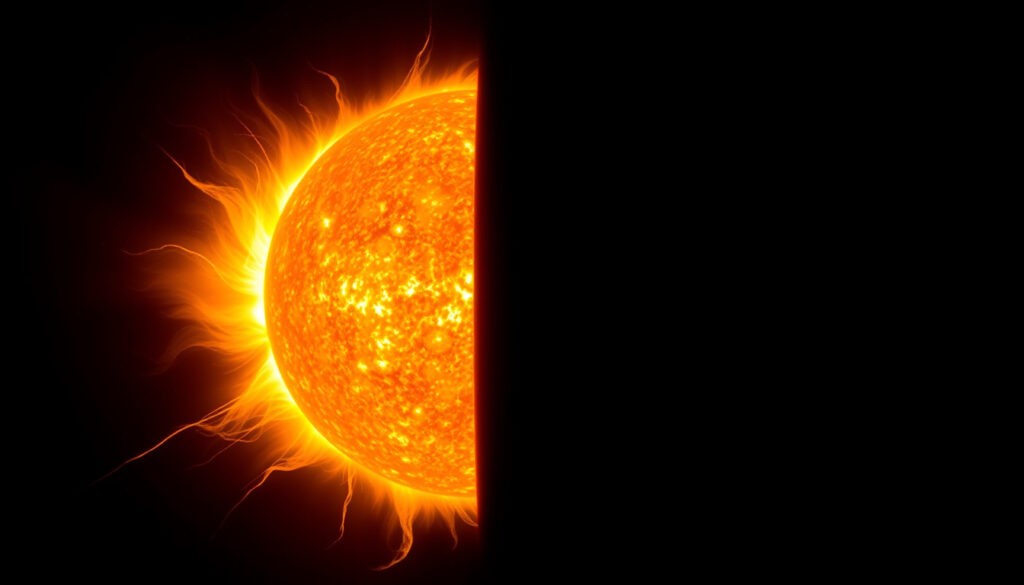
How Hot Is the Sun? Core, Surface and Corona Temperatures
Standing under the Sun on a summer day, it’s hard to imagine its surface being anything but scorching hot. Yet one of the greatest mysteries in astrophysics is that the Sun’s outer atmosphere, the corona, is millions of degrees hotter than its visible surface.
Core temperature: 15 million °C (27 million °F) ·
Surface (photosphere) temperature: 5,500 °C (10,000 °F) ·
Corona temperature: 1–3 million °C (1.8–5.4 million °F) ·
Age: 4.6 billion years ·
Distance from Earth: 150 million km (93 million miles)
Quick snapshot
- Core temperature ~15 million °C, sustained by nuclear fusion (Stanford Solar Center (solar physics research hub))
- Photosphere temperature ~5,500 °C (Stanford Solar Center)
- Corona temperature reaches 1–3 million °C (NASA Space Place (education division of NASA))
- Sun’s age ~4.6 billion years, from radiometric dating of meteorites (NASA Solar System Exploration (US space agency))
- Exact mechanism heating the corona to millions of degrees — the coronal heating problem (Stanford Solar Center)
- Short-term temperature fluctuations in the corona are not fully predictable (Stanford Solar Center)
- Precise internal temperature distribution at different depths is model-dependent (Stanford Solar Center)
- 1930s: Coronal heating problem first recognized by Grotrian and Edlén (Stanford Solar Center)
- 2018: NASA’s Parker Solar Probe launched to measure the corona up close (Popular Science (science magazine))
- 2024: Study on kinetic Alfvén waves proposed as a possible heating mechanism (Phys.org (science news outlet))
- August 2, 2027: Total solar eclipse with up to 6 min 23 sec of totality, visible across North Africa and the Middle East (NASA Eclipse Website (US government eclipse data))
- ~1 billion years: Sun’s luminosity will boil Earth’s oceans, ending most life (NASA Solar System Exploration)
- ~5 billion years: Sun becomes a red giant (NASA Eclipse Website (US government eclipse data))
| Property | Value |
|---|---|
| Core temperature | 15 million °C (27 million °F) |
| Surface temperature (photosphere) | 5,500 °C (10,000 °F) |
| Corona temperature | 1–3 million °C (1.8–5.4 million °F) |
| Age | 4.6 billion years |
| Distance from Earth | 150 million km (93 million miles) |
| Diameter | 1.39 million km (864,000 miles) |
How hot is the sun in celsius?
What is the sun’s core temperature?
- The Sun’s core reaches about 15 million °C (27 million °F) — hot enough to sustain nuclear fusion of hydrogen into helium (Stanford Solar Center).
- Energy from the core radiates outward through the radiative zone and convective zone before reaching the surface.
If the core were just a few percent cooler, the fusion reaction would stall, and the Sun would start to collapse under its own gravity. The core’s extreme temperature is what keeps our star stable.
The implication: the core’s 15 million °C is the non-negotiable baseline for all solar activity — without it, the Sun goes dark.
What is the temperature of the photosphere?
- The photosphere, or visible surface, averages about 5,500 °C (10,000 °F) (Stanford Solar Center).
- Sunspots appear darker because they are cooler, roughly 3,500 °C, but still far above any earthly fire.
How hot is the sun core?
Why is the core so hot?
- The core temperature of 15 million °C is sustained by nuclear fusion: hydrogen nuclei collide and fuse into helium, releasing enormous energy (Stanford Solar Center).
- Energy travels from the core through the radiative zone (where it bounces between atoms) and the convective zone (where it rises like boiling water) before reaching the photosphere.
The implication: the Sun’s stable 4.6-billion-year lifespan depends entirely on that core temperature remaining near 15 million °C. Any major drop would mean the end of fusion — and eventually, the end of the Sun as we know it.
What is hotter, sun or lava?
Six temperature points, one clear pattern: the Sun outpaces lava at every layer.
| Object / Layer | Temperature (°C) | Source |
|---|---|---|
| Lava (typical) | 700–1,200 °C | USGS (geological survey) |
| Sun’s surface (photosphere) | ~5,500 °C | Stanford Solar Center |
| Sun’s corona | 1–3 million °C | NASA Space Place |
| Sun’s core | 15 million °C | Stanford Solar Center |
The trade-off: lava is hot enough to melt steel, but it barely registers next to the Sun. Even the Sun’s surface is 4–5 times hotter than the hottest lava. The corona is hundreds of times hotter — a difference so vast that the comparison is almost abstract.
| Layer | Temperature range (°C) | Key process |
|---|---|---|
| Core | ~15 million | Nuclear fusion |
| Radiative zone | 7 million to 2 million | Energy transfer by radiation |
| Convective zone | 2 million to 5,500 | Energy transfer by convection |
| Photosphere | ~5,500 | Visible surface |
| Chromosphere | 4,000 to 25,000 | Transition region |
| Corona | 1–3 million | Source of solar wind |
The catch: that last row — the corona — is the one that doesn’t fit. It’s 200 times hotter than the surface below it.
The corona is 200 times hotter than the photosphere even though it is farther from the core. It’s like standing farther from a campfire and feeling more heat — a mystery that has stumped scientists since the 1930s (Stanford Solar Center).
Why will the Sun disappear for 6 minutes in 2027?
What causes a total solar eclipse?
- A total solar eclipse occurs when the Moon passes directly between Earth and the Sun, completely blocking the Sun’s disk (NASA Eclipse Website).
- During totality, the corona becomes visible to the naked eye as a faint white halo.
Where and when will the 2027 eclipse occur?
- The total solar eclipse of August 2, 2027, will have a maximum totality duration of 6 minutes 23 seconds (NASA Eclipse Website).
- The path of totality crosses North Africa (Morocco, Algeria, Tunisia, Libya, Egypt), the Middle East (Saudi Arabia, Yemen), and parts of Asia (Oman).
The pattern: solar eclipses are the only time the corona is easily visible from Earth. The 2027 event gives scientists another opportunity to study the corona’s extreme temperatures — and perhaps gather clues to the coronal heating problem.
How old is the Sun?
How do we know the Sun’s age?
- The Sun is about 4.6 billion years old, determined from radiometric dating of meteorites that formed from the same solar nebula (NASA Solar System Exploration).
- This age aligns with the oldest rocks on Earth and the Moon.
What will happen when the Sun grows old?
- In about 1 billion years, the Sun’s luminosity will increase enough to boil Earth’s oceans, ending most life (NASA Solar System Exploration).
- In roughly 5 billion years, the Sun will exhaust its hydrogen fuel and expand into a red giant, engulfing the inner planets (Space.com (astronomy publication)).
- After shedding its outer layers, the Sun will leave behind a white dwarf.
Timeline of the Sun’s life and key events
- 4.6 billion years ago: Formation of the Sun from a molecular cloud (NASA Solar System Exploration)
- ~1 billion years from now: Sun’s luminosity increases enough to boil Earth’s oceans, ending most life (NASA Solar System Exploration)
- August 2, 2027: Total solar eclipse with up to 6 minutes 23 seconds of totality (NASA Eclipse Website)
- ~5 billion years from now: Sun exhausts hydrogen fuel, expands into red giant, engulfs inner planets (Space.com)
- ~7 billion years from now: Sun sheds outer layers, leaving a white dwarf remnant
What we know vs. what remains unclear
Confirmed facts
- Core temperature ~15 million °C (Stanford Solar Center)
- Photosphere temperature ~5,500 °C (Stanford Solar Center)
- Corona temperature reaches millions of degrees (NASA Space Place)
- Sun’s age ~4.6 billion years (NASA Solar System Exploration)
- The corona is about 10 million times less dense than the Sun’s surface (NASA Space Place)
What’s unclear
- Exact mechanism heating the corona to millions of degrees (coronal heating problem) (Stanford Solar Center)
- Short-term temperature fluctuations in the corona are not fully predictable
- Precise internal temperature distribution at different depths is model-dependent
Expert perspectives on the Sun’s temperature puzzle
“The corona is hundreds of times hotter than the photosphere. That’s like a candle flame being hotter than a blast furnace — it shouldn’t happen.”
— NASA Solar Physics (NASA Space Place)
“We’ve known about this paradox since the 1930s. Two main hypotheses remain: waves that travel along magnetic field lines and release energy, or nanoflares — tiny explosions that happen millions of times per second.”
— High Altitude Observatory, UCAR (Stanford Solar Center)
“Recent data from the Solar Orbiter mission shows that the corona’s magnetic field may be twisting and releasing energy in ways we hadn’t modeled before.”
— ESA / Solar Orbiter mission (as reported by Phys.org)
The coronal heating problem remains one of the most active fields in solar physics. For researchers, the stakes are high: understanding how the Sun ejects superheated plasma could help predict space weather that disrupts satellites and power grids on Earth. For the rest of us, the next chapter may come from the August 2027 eclipse, when the corona will put on a 6-minute show — and scientists at NASA and Stanford will be watching closely.
For a detailed breakdown of solar temperatures, the article covers the core, surface, and corona in Celsius, Fahrenheit, and Kelvin.
Frequently asked questions
How hot is the sun in Fahrenheit?
The surface is about 10,000 °F (5,500 °C), the core is about 27 million °F (15 million °C), and the corona reaches up to 5.4 million °F (3 million °C).
What is the hottest part of the sun?
The core, at 15 million °C, is by far the hottest. The corona is hotter than the surface but still much cooler than the core.
Can the sun’s heat reach Earth?
Yes — the Sun’s energy travels through space as electromagnetic radiation. It takes about 8 minutes to reach Earth, warming our planet. The corona also emits the solar wind.
How does the sun produce heat?
Through nuclear fusion in the core, where hydrogen nuclei fuse into helium at 15 million °C, releasing vast amounts of energy (Stanford Solar Center).
Why is the sun’s corona hotter than the surface?
This is the coronal heating problem. Leading hypotheses involve magnetic waves (Alfvén waves) or nanoflares that heat the tenuous corona to millions of degrees (Popular Science).
How do scientists measure the sun’s temperature?
Through spectroscopy (analyzing light wavelengths), helioseismology (measuring sound waves), and direct measurements from probes like Parker Solar Probe (Popular Science).
Is there a temperature difference between the sun and a lightning bolt?
Yes. Lightning can reach about 30,000 °C (54,000 °F) — roughly five times hotter than the Sun’s surface, but still far below the Sun’s core (15 million °C) or corona (1–3 million °C).
More related posts
 Vape Shops Near Me – Hours, Products & Regulations
 Best Things to Do in Rotorua: Free, Family & Hidden Gems
 EB Games Closing Down: NZ Shutdown & 2026 Store Closures
 The Fate of Ophelia by Taylor Swift: Meaning, Story, and Facts
 Stir Fry Sauce Recipe: Easy 5-Minute Homemade Guide
 Pina Colada Recipe NZ: Easy 4-Ingredient Cocktail at Home
 NZ Road Code Book – Free Access, Latest Edition Guide
 Michael Jackson’s Beat It: Story, Lyrics, and Legacy