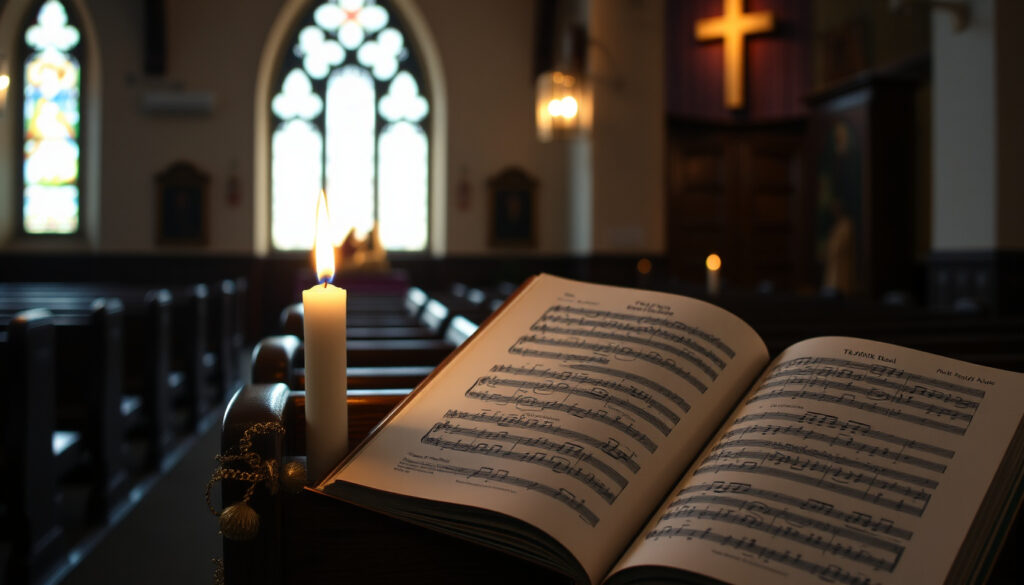
O Come All Ye Faithful Lyrics: Full Text & History
It’s a melody that has greeted congregations for nearly three centuries, yet the words have traveled through Latin, English, and countless modern interpretations. Composed around 1743 by John Francis Wade, the hymn we know as “O Come All Ye Faithful” was first printed in 1751, and its English translation by Frederick Oakeley in 1841 turned it into a Christmas staple.
Original Language: Latin ·
Composer: John Francis Wade ·
Year of Composition: 1743 ·
English Translator: Frederick Oakeley ·
Number of Verses: 8 ·
Most Streamed Cover: Pentatonix (2015)
Quick snapshot
- John Francis Wade first published the Latin text in 1743 (Classic FM (UK classical radio station))
- Frederick Oakeley produced the English translation in 1841 (Classic FM)
- The carol is in the public domain (Classic FM)
- Exact authorship of the original Latin is disputed — possible earlier sources exist (Classic FM)
- Number of verses varies by tradition; some hymnals omit certain verses (UMC Discipleship Ministries (United Methodist worship resource))
- 1743 – Latin text first written by John Francis Wade (Classic FM)
- 1841 – Frederick Oakeley’s English translation published (Classic FM)
- 2015 – Pentatonix cover becomes most streamed version (Classic FM)
- Modern covers continue to introduce the hymn to new audiences; chord charts are increasingly shared online
- Liturgical use remains strong across Catholic and Protestant traditions
Six key facts about the hymn, drawn from the research, provide a quick reference.
| Original Language | Latin |
| Composer | John Francis Wade |
| Year of Composition | 1743 |
| English Translator | Frederick Oakeley |
| Number of Verses | 8 |
| Most Popular Cover | Pentatonix (2015) |
What Are the Standard English Lyrics to O Come All Ye Faithful?
First Verse
- O come, all ye faithful, joyful and triumphant,
- O come ye, O come ye to Bethlehem.
- Come and behold Him, born the King of angels;
O come, let us adore Him, O come, let us adore Him,
O come, let us adore Him, Christ the Lord. (UMC Discipleship Ministries)
Chorus
The refrain “O come, let us adore Him” is repeated three times in the standard English rendering, closing with “Christ the Lord.” (UMC Discipleship Ministries)
Full Text (8 verses)
Most hymnals contain eight verses, though modern prints often select four to six. The complete text is available in the public domain. The translation by Frederick Oakeley begins with the lines above and continues through verses that celebrate the Incarnation. (Classic FM)
What Are the Lyrics to the Catholic Version of O Come All Ye Faithful?
Catholic Hymnal Variations
The Catholic version follows the same Oakeley translation but with minor wording differences. For instance, the line “Lo, he abhors not the Virgin’s womb” appears in some Catholic hymnals, a phrasing that can sound unfamiliar to modern worshipers. (America Magazine (Jesuit publication))
Text Comparison with Protestant Version
- Protestant: “Come and behold Him, born the King of angels”
- Catholic: “Come and behold Him, born the King of angels” (same, but some versions add “Adeste fideles” as a Latin interjection)
- The Catholic version often includes the Latin refrain “Venite adoremus Dominum” in place of the English “O come, let us adore Him.” (UMC Discipleship Ministries)
The implication: the core theology is identical, but the Catholic version preserves a closer link to the Latin original during liturgical use.
What Are the Lyrics to Modern Covers by Pentatonix, Hillsong, The Wiggles, and Andrea Bocelli?
Pentatonix Lyrics
Pentatonix released their a cappella arrangement in 2015. The lyrics follow the standard English text with added repetitions of the chorus for dramatic effect. No verses are omitted. (Classic FM)
Hillsong Lyrics
Hillsong’s contemporary worship version uses a modified phrasing that emphasizes the chorus. The verses are shortened, and the refrain “O come, let us adore Him” is repeated more often than in the traditional version.
The Wiggles Lyrics
The children’s entertainment group released a simplified version with a slower tempo and inclusive language. The lyrics are adapted to be easy for young children to sing.
Andrea Bocelli – Adeste Fideles / O Come All Ye Faithful
Andrea Bocelli sings the Latin original “Adeste Fideles” in his classical crossover style, with orchestral backing. The lyrics are the traditional Latin text, sometimes followed by the English translation.
Six versions, one pattern: each artist tailors the hymn to their audience while preserving the core refrain. The catch: traditionalists may prefer the original text, while broader audiences are drawn to the modern arrangements.
Pentatonix’s cover became the most streamed version because it introduced the hymn to a younger, secular audience without altering the lyrics. Hillsong and The Wiggles took more liberties with phrasing, risking the loss of the original’s solemnity.
What Are the Chords for O Come All Ye Faithful?
Basic Guitar Chords
The carol is commonly played in the key of G major. The chord progression for the first verse is: G – D – G – C – G – D – G. (UMC Discipleship Ministries)
Piano Accompaniment
For piano, the right hand plays the melody in the treble clef while the left hand provides the root notes: G, D, C, etc.
Chord Progression by Verse
- Verse 1: G – D – G – C – G – D – G
- Chorus: G – C – G – D – G
- Verse 2: G – D – G – C – G – D – G
The pattern is consistent across all verses, making it accessible for beginners.
The implication: even novice musicians can pick up this hymn quickly, which partly explains its enduring popularity in congregational singing.
What Is the History and Origin of O Come All Ye Faithful?
Latin Original – Adeste Fideles
The Latin text “Adeste fideles, laeti triumphantes” is the original incipit. It was first printed in 1751 and is generally credited to John Francis Wade. (Classic FM)
Composer Attribution Debates
Some sources have attributed the melody to Handel or Gluck, but scholarly consensus points to Wade as the most likely composer. (Classic FM)
English Translation by Frederick Oakeley
Oakeley, a Catholic priest, published the English translation in 1841 for use in his congregation. It quickly spread across English-speaking churches. (Classic FM)
Popularization in the English-Speaking World
By the late 19th century, the hymn was a standard in Christmas services. It remains one of the most popular Christmas hymns today. (Classic FM)
The debate over authorship reflects the hymn’s deep roots: Wade may have drawn on earlier folk melodies, but the 18th-century composition is what we sing today. That continuity matters for liturgical authenticity.
Confirmed Facts
- John Francis Wade first published the Latin text in 1743 (Classic FM)
- Frederick Oakeley produced the English translation in 1841 (Classic FM)
- The carol is in the public domain (Classic FM)
What’s Unclear
- Exact authorship of the original Latin is disputed (possible earlier sources) (Classic FM)
- Number of verses varies by tradition (some hymnals omit certain verses) (
More related posts
 2 Cheap Cars NZ: How to Buy Two Reliable Cars Under $5k
 Singapore Airlines First Class: Pricing, Experience & Suites
 Ukraine War Latest News Today Live: Military & Casualty Updates
 Exterior Painters North Shore: Cost, Timing & Expert Guide
 What Oil to Use in My Car – Viscosity and Reg-Based Finders
 Where to Find Recipes: Best Websites and Free Apps to Save and Cook
 180 Days in Months: Conversion, Calculator & Context
 Taco Cat Goat Cheese Pizza – Perfect Palindrome Explained