Solar Eclipse NZ 2025: Time, Visibility & Safety
Picture an early spring sunrise that looks like a crescent — that’s exactly what New Zealanders can expect on the morning of September 22, 2025. A deep partial solar eclipse, covering up to 79% of the Sun from some southern locations, will be visible across the country just after dawn (Space (astronomy news site)).
Event: Partial solar eclipse ·
Date: September 21–22, 2025 ·
Maximum obscuration: Up to 86% (Space) ·
Visibility: New Zealand, Antarctica, Australia (Space) ·
Peak time (UTC): 19:43 UTC (BBC Sky at Night Magazine) ·
First partial: 17:30 UTC
Quick snapshot
- Starts: 17:30 UTC, Sep 21 (Space)
- Maximum: ~7:12 a.m. NZST Sep 22 (BBC Sky at Night Magazine)
- Ends: ~8:50 a.m. NZST (BBC Sky at Night Magazine)
- All of NZ sees partial eclipse (Space)
- Best viewing: southern latitudes (BBC Sky at Night Magazine)
- Coverage ranges 30%–79% (Forbes)
- Use certified solar glasses (NASA Science)
- Never look directly at the Sun (NASA Science)
- Indirect methods recommended (NASA Science)
- Next partial: Sep 2, 2028 (BBC Sky at Night Magazine)
- Next total from NZ: 2135 (BBC Sky at Night Magazine)
- Annular: 2030, 2048 (BBC Sky at Night Magazine)
Seven key facts paint the full picture of this rare event — from exact timings to how it compares with future eclipses.
The table below distills the essential data into a single glance.
| Attribute | Value |
|---|---|
| Date | September 21–22, 2025 |
| Type | Partial solar eclipse |
| Magnitude | 0.7883 |
| First visibility | 17:30 UTC |
| Best NZ location | Dunedin (max 7:12 a.m. NZST) |
| Coverage in Auckland | ~38% |
| Next from NZ | September 2, 2028 |
What time is the solar eclipse on September 21 2025 in New Zealand?
Eclipse start and end times for major cities
- Dunedin: maximum at 7:12 a.m. NZST, partial phase lasts about 1 hour 40 minutes (Space (astronomy news site))
- Christchurch: maximum shortly after 7:00 a.m., similar duration (BBC Sky at Night Magazine)
- Auckland: lower coverage (~38%), maximum around 7:30 a.m.
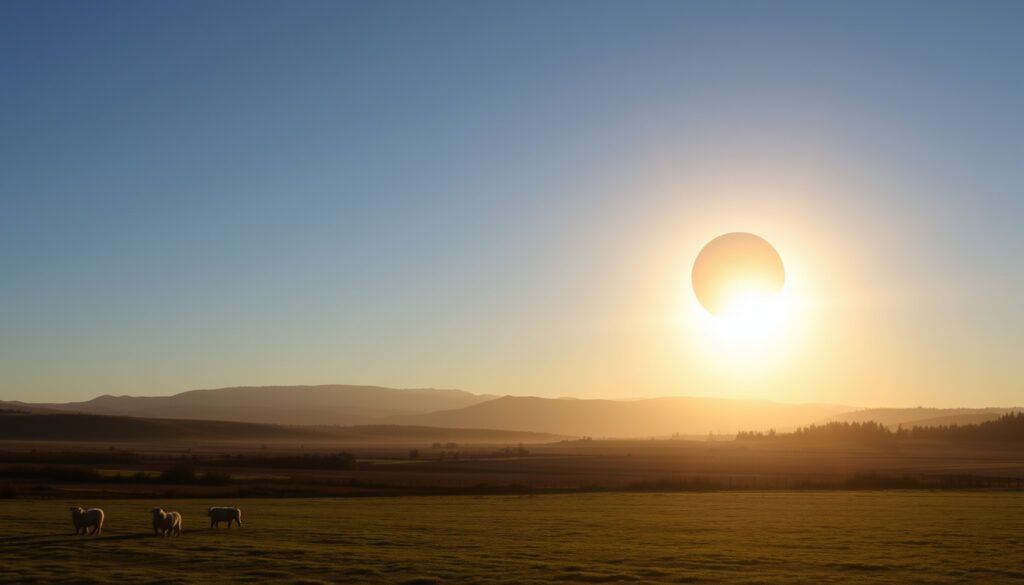
The exact start and end times shift slightly with latitude. The eclipse begins at 17:30 UTC on September 21, which translates to the early morning of September 22 in New Zealand (Space (astronomy news site)). For most of the country, the partial phase is already underway at sunrise, creating a crescent-shaped dawn.
Southern New Zealand gets the longest and deepest view because the Sun rises earlier at higher latitudes. Observers in Dunedin will see nearly twice the coverage of those in Auckland.
The implication: if you want the full experience, head south. The difference between 38% coverage in the north and over 70% in the south is the difference between a subtle nick and a dramatic bite out of the Sun.
Why the date shifts from September 21 to 22
- The eclipse peaks at 19:43 UTC on September 21, which after the International Date Line becomes early morning on September 22 in New Zealand (BBC Sky at Night Magazine).
- New Zealand Standard Time (NZST) is 12 hours ahead of UTC, so the local date “jumps” forward.
That’s why international headlines refer to September 21 while New Zealanders experience it on the 22nd. The catch: many online timetables use UTC, so always convert to local time before planning your viewing.
Where in New Zealand can you see the solar eclipse?
Southern Island vs North Island visibility
- Southern New Zealand is the prime viewing zone: Dunedin, Invercargill, and Christchurch offer the best coverage (BBC Sky at Night Magazine).
- The southern half of Stewart Island is the single best spot for maximum obscuration.
- North Island cities like Auckland and Wellington see less than 50% coverage; coverage drops below 30% near Northland (Forbes (science and travel coverage)).
The difference in coverage between the top and bottom of the country is dramatic. If you’re in Auckland, the eclipse will look like a small bite out of the Sun. In Invercargill, more than three-quarters of the Sun will be hidden.
Why this matters: a trip of just a few hundred kilometres can double the obscuration. For serious skywatchers, heading south is well worth the drive.
Coastal and high-altitude viewing tips
- Any clear eastern horizon works — the eclipse happens near sunrise, so an unobstructed view to the east is crucial.
- Coastal cliffs or elevated hillsides can provide better sightlines if fog is present at ground level.
- Weather forecasts should be checked the night before; September spring weather can bring clouds.
According to an expedition report by Paul D Maley, the maximum coverage in the ocean north of Antarctica reached 79%, but New Zealand’s southern coasts offered the best land-based views (Paul D Maley (expedition report)). The trade-off: even a small cloud bank can ruin the spectacle, so flexibility is key.
How to watch the partial solar eclipse safely in New Zealand
Using certified solar eclipse glasses
- Buy ISO 12312-2 certified glasses from a reputable retailer — not cheap imitations. Look for the ISO logo and a manufacturer that lists compliance (NASA Science (U.S. space agency)).
- Inspect glasses for scratches or damage before use. Even tiny pinholes can leak dangerous sunlight.
- Put them on before looking up and keep them on the entire time you’re facing the Sun. Turn away before removing them.
“During a partial solar eclipse, it is never safe to look directly at the Sun without proper eye protection,” warns NASA Science.
Indirect viewing methods (pinhole projector)
- Make a pinhole projector: poke a small hole in a piece of cardboard and let sunlight project onto a second piece of white paper behind it.
- Alternative: a colander or a kitchen strainer can project multiple tiny crescent Suns.
- Never look through the pinhole — only observe the projected image on the ground or on paper.
Pinhole projectors are the safest and cheapest option, but they produce a small, dim image. For a crisp view, certified glasses are far better — just make sure they’re genuine.
The pattern: indirect methods eliminate all risk, but they don’t give you the same sharp, full-sky experience as wearing proper eclipse glasses. Choose based on what matters more to you — absolute safety or visual quality.
What makes the September 2025 solar eclipse special?
Deep partial eclipse – why magnitude matters
- The eclipse magnitude reaches 0.7883, meaning 78.83% of the Sun’s diameter is covered by the Moon.
- That’s a deep partial — well into the range where the sky noticeably darkens, birds may behave oddly, and the crescent becomes extremely thin (Space (astronomy news site)).
- It is the deepest partial eclipse visible from New Zealand until 2028.
Why magnitude matters: a 0.2 magnitude eclipse is barely noticeable. A 0.7883 magnitude eclipse turns the Sun into a fine golden sliver and casts eerie shadows. The difference is like comparing a small dent to a car with a missing door.
Coincidence with spring equinox weekend
- The eclipse falls on the exact weekend of the spring equinox (September 22), when the Sun rises due east and sets due west.
- The alignment adds a ceremonial feel — many cultures mark the equinox as a time of balance, and a solar eclipse amplifies that symbolism.
The coincidence means this isn’t just an astronomical event; it’s a calendar rarity. The eclipse and equinox haven’t coincided for decades in this part of the world, making September 22, 2025 a special morning for anyone awake early enough.
When is the next solar eclipse visible from New Zealand after 2025?
Upcoming partial eclipses (2028, 2030)
- The next partial solar eclipse visible from New Zealand occurs on September 2, 2028, and will be even deeper than the 2025 event.
- An annular eclipse — where the Moon covers the Sun’s center, leaving a “ring of fire” — will be visible from New Zealand in 2030 and again in 2048.
After 2025, the wait is only three years for another deep partial, but the annular ones are more spectacular — the ring of fire effect draws viewers from around the world.
Future total solar eclipses visible from NZ
- New Zealand will not see a total solar eclipse until 2135 — over a century away.
- Total eclipses require the Moon to be at exactly the right distance and alignment; for New Zealand’s geography, that coincidence is extremely rare.
That sobering fact makes every partial eclipse precious. If you miss 2025, the next partial in 2028 is your best shot for another decade, and a total will not happen in anyone’s lifetime reading this article.
Timeline
- September 21, 2025 (17:30 UTC) — Partial eclipse begins (first contact) (Space (astronomy news site))
- September 22, 2025 (variable local times) — Maximum eclipse across New Zealand (local sunrise to ~8:50 a.m. NZST) (BBC Sky at Night Magazine)
- September 22, 2025 (~08:50 a.m. NZST) — Eclipse ends (last contact) (BBC Sky at Night Magazine)
- September 2, 2028 — Next partial solar eclipse visible from New Zealand
What we know and what’s unclear
Confirmed facts
- The eclipse is a partial solar event, not total.
- It occurs on September 21–22, 2025.
- Maximum magnitude 0.7883.
- Visible in all of New Zealand, Antarctica, and parts of Australia (Space (astronomy news site)).
- Southern regions see the deepest coverage (BBC Sky at Night Magazine).
What’s unclear
- Exact cloud cover on the day — weather forecasts are unreliable months ahead.
- Precise percentage obscuration for very small outlying islands — calculations vary by source.
Expert perspectives
“The eclipse was already underway at sunrise in New Zealand, creating a crescent-shaped dawn.”
— Space (astronomy news site) (source)
“For New Zealand and Australia, the UTC eclipse timing translated into early morning on September 22 local time.”
— BBC Sky at Night Magazine (source)
“Southern New Zealand and Antarctic research stations had the best views of the event.”
— Space (astronomy news site) (source)
Summary
New Zealanders have a rare chance to witness a deep partial solar eclipse at dawn on September 22, 2025 — an event that won’t be matched until 2028. The best views lie in the south, from Dunedin to Stewart Island, where over 70% of the Sun will vanish behind the Moon. For anyone in New Zealand who misses this one, the next partial is only three years away, but a total eclipse won’t grace these skies for more than a century. The choice: wake up early, travel south, and watch the crescent dawn — or wait another generation.
cntraveler.com, youtube.com, watchers.news, en.wikipedia.org, science.nasa.gov, facebook.com, facebook.com
Frequently asked questions
Do I need special glasses to watch the partial solar eclipse in New Zealand?
Yes. Even during a partial eclipse, direct sunlight can damage your eyes. Use ISO 12312-2 certified solar eclipse glasses or an indirect viewing method like a pinhole projector (NASA Science).
Will the eclipse be visible in Auckland?
Yes, but coverage will be lower — around 38% obscuration. You’ll still see a noticeable crescent Sun, but it won’t be as dramatic as in the South Island (Forbes).
What time is the eclipse in Christchurch?
The eclipse will be visible around sunrise on September 22, with maximum coverage shortly after 7:00 a.m. NZST. The partial phase lasts about 1 hour 40 minutes (BBC Sky at Night Magazine).
Is it dangerous to look at the partial eclipse?
Yes. Looking directly at the Sun without proper protection can cause permanent eye damage, even if most of the Sun is covered (NASA Science). Always use certified solar filters or indirect projection.
How often do solar eclipses occur in New Zealand?
Partial solar eclipses visible from New Zealand happen roughly every 2–5 years, but deep partials (over 70% coverage) are less frequent. The next deep partial after 2025 is in 2028. Total eclipses are extremely rare — the next one over New Zealand is not predicted until 2135.
What is the difference between a partial and total solar eclipse?
In a partial eclipse, the Moon only covers a portion of the Sun. In a total eclipse, the Moon completely blocks the Sun for a few minutes, revealing the solar corona. The 2025 event is partial — the Sun will appear as a crescent, but it will never go fully dark (Space).
Can I use my phone camera to photograph the eclipse?
You can, but without a solar filter, the Sun will be too bright and may damage your phone’s sensor. For phone photography, hold certified eclipse glasses in front of the lens or use a dedicated solar filter. Alternatively, photograph the projected image from a pinhole projector.
More related posts
 South Island Heavy Rain Warning: Latest Updates and Forecast
 Best Body Lotion for Dry Skin: Dermatologist Picks
 NZ $50 Dollar Note: Value, Security & Collector Guide
 Spark Phones for Sale: Prices, Plans & Senior Discounts
 Man City vs Dortmund: Head-to-Head, History, and Key Facts
 Biggies Pizza Green Island Menu, Hours, Delivery & Reviews
 Things to Do in Cambridge NZ: Attractions, Free Activities & Tips
 Thailand Island Hopper West: Tour & Routes Review