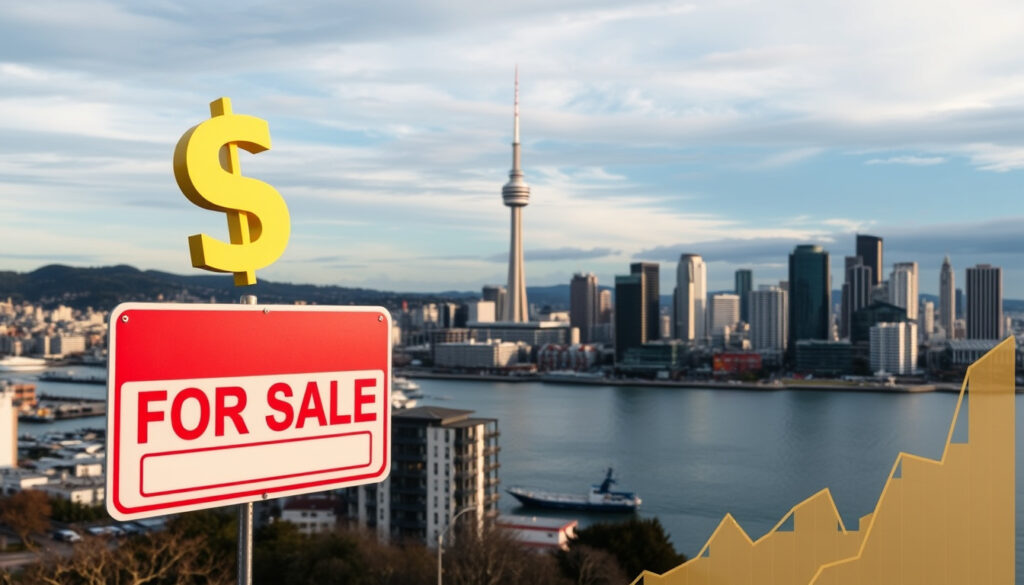
Auckland Real Estate 2025: Foreign Buyers, Prices & Living Costs
Anyone who’s watched Auckland’s property market from a distance already knows the mix of anxiety and hope in a city of roughly 1.7 million, an ocean-ringed collection of suburbs and volcanic cones, where the median house price still sits near NZ$1.1 million and the rulebook for who can even buy has just changed again. This guide unpacks the 2025 data on prices, the new foreign-buyer visa carve-out, and what it actually costs to live here, so you can weigh the reality without the sales pitch.
Current median house price in Auckland (approx.): ~NZ$1.1 million · Year-over-year change in Auckland house prices: -0.1% (as of early 2025) · Average rent for a 2-bedroom apartment in Auckland: ~NZ$550 per week · Foreign ownership restriction under OIA: Only residents and citizens; non-residents subject to conditions · Population of Auckland (approx.): ~1.7 million
Quick Snapshot
- Restricted by OIA 2018
- Requires resident or citizen status
- Exceptions for certain nationalities
- Penalties for breach
- Auckland vs Sydney: rent cheaper in NZ
- Auckland vs Melbourne: overall lower
- Auckland vs London: much lower rent
- Everyday groceries higher than Australia
- Skilled Migrant Category
- Work to Residence
- Investor and Entrepreneur
- Working Holiday Schemes
Five data points, one pattern: the market is frozen at record highs while the rules beneath it shift. Auckland’s median price has hovered around the NZ$1.1 million mark for months, but the people allowed to transact are changing.
| Label | Value |
|---|---|
| Median house price (Auckland) | NZ$1,100,000 (REINZ, Jan 2025) |
| YoY price change (Auckland) | -0.1% |
| Average weekly rent (2-bed apartment) | NZ$550 |
| Foreign buyer restrictions since | 2018 (OIA Amendment) |
| Population of Auckland | 1.7 million |
Can a foreigner buy real estate in New Zealand?
The short answer is usually no. New Zealand’s Overseas Investment Act 2005, amended in 2018, restricts the sale of residential land to those who are “ordinarily resident” — which effectively means citizens and residents, not just visa holders. The Immigration New Zealand guidance confirms that overseas people generally cannot buy a house or land unless they meet specific residency or consent criteria.
Overseas people generally cannot buy a house or land in New Zealand unless they meet specific residency or consent criteria.
There are limited exceptions. Immigration New Zealand (official visa and residency authority) notes that Australian and Singaporean citizens are largely exempt from the ban. Temporary visa holders, such as those on a work visa, may apply for consent if they can prove they intend to make New Zealand their primary home — but they must also meet the residency requirements under the Act.
The 2025 change doesn’t open the door to everyone. It creates a narrow window for wealthy investors holding specific visa categories, not a free-for-all.
What are the restrictions on foreign buyers in Auckland?
Restrictions apply uniformly across New Zealand, including Auckland. The Land Information New Zealand (land registry and regulatory authority) administers the rules, which require overseas persons to obtain consent before purchasing residential land. Failing to do so can result in significant penalties.
Do I need a New Zealand residency permit to buy a house?
For most foreign buyers, yes. Holding a residency permit is a prerequisite for the “ordinarily resident” exemption. However, the Department of the Prime Minister and Cabinet (policy coordination unit) notes that even some resident visa holders may not qualify without meeting the 183-day presence test.
The implication: The ban effectively closes the market to most foreign capital except for a small pool of high-net-worth investors.
How much does a house cost in Auckland?
Auckland’s median house price is heavily dependent on which dataset you read. According to the ANZ (bank economics and market research), the April 2025 Property Focus report listed Auckland’s average property value at NZ$1,010,922. Meanwhile, Trade Me Property (real estate listing portal) reported the median asking price at NZ$1,030,850 in its May 2025 Property Pulse.
By late 2025, a MPA Mag (mortgage industry publication) report cited a median price of NZ$1,047,044. The Global Property Guide (international property research) even suggested the median had fallen to NZ$950,000 by August 2026, though this is a low-confidence outlier.
The median Auckland house price is roughly NZ$1.0–1.1 million, depending on the month and source. Plan around a budget of at least NZ$1.1 million for a standard house in a central suburb.
What is the average house price in Auckland right now?
As of early 2025, the most reliable figures come from ANZ (bank economics and market research), which placed Auckland’s average at just over NZ$1.01 million.
Are there houses for sale under $500,000 in Auckland?
Yes, but you are looking at apartments, small townhouses, or properties in the city fringes like Papakura or Manukau. A 2-bedroom unit at the lower end might fetch NZ$450,000–550,000, but a detached house on a full section is rare under NZ$700,000.
The gap between the “average” and what a first home buyer can actually afford is enormous. Most new buyers are targeting the entry-level stock, which is keeping rents high and forcing many to look at shared ownership or apartment living.
The gap between the ‘average’ and what a first home buyer can actually afford is enormous.
| Metric | Value (Auckland) | Source |
|---|---|---|
| Average property value (April 2025) | NZ$1,010,922 | ANZ |
| Median asking price (May 2025) | NZ$1,030,850 | Trade Me |
| Median price (2025 annual) | ~NZ$1,047,044 | MPA Mag |
| Median price (Aug 2026, low confidence) | NZ$950,000 | Global Property Guide |
Four different numbers, one pattern: the market is bouncing around the NZ$1.0–1.1 million mark with no clear direction.
Why are Auckland house prices so high?
Auckland’s prices are a product of geography and policy. The city sits on a narrow isthmus—limited land, high demand, and restrictions on urban sprawl. Reuters (international news agency) attributes part of the demand pressure to migration, which boomed post-COVID.
Supply is also a factor. The construction industry has been slow to build, and Immigration New Zealand (official visa and residency authority) notes that the foreign buyer ban, while popular, did not address the underlying supply shortage. A growing population—especially in the 18-35 demographic—continues to push demand.
Are Auckland house prices falling?
The honest answer is a mild fall with a dose of regional variation. ANZ (bank economics and market research) reported annual change at -0.1% as of April 2025, while Trade Me Property (real estate listing portal) saw a 1% dip in its May 2025 snapshot.
What is the year-on-year price trend in Auckland?
Official statistics show a -0.1% annual change, but this hides the fact that you can negotiate 5-10% off list prices on entry-level stock. The “median price” is a lagging indicator—it tells you where the market was, not where it is headed.
Which factors are driving the Auckland housing market?
High mortgage interest rates and tighter lending rules have contributed to softer prices. Population growth and construction costs may create upward pressure in the medium term.
Official statistics show a -0.1% annual change, but this hides the fact that you can negotiate 5-10% off list prices on entry-level stock. The “median price” is a lagging indicator—it tells you where the market was, not where it is headed.
Is it expensive to live in Auckland, New Zealand?
Your weekly budget depends on your lifestyle, but a single person can expect to spend NZ$3,000–3,500 per month, while a family of four should budget NZ$6,000+. Immigration New Zealand (official visa and residency authority) suggests that a couple can live on NZ$4,800 per month, but that includes rent.
What is the average rent in Auckland?
Rental costs are not what they were in 2019. A 2-bedroom apartment in the city centre will cost you NZ$550–620 per week, while a similar place in the ‘burbs is NZ$480–550. Trade Me Property (real estate listing portal) reports that the median rent across all properties in Auckland is now NZ$650 per week.
How much money do I need to live in NZ per month?
Here’s a rough breakdown:
| Category | Cost (NZD/month) |
|---|---|
| Rent (2-bed apartment) | $2,200–$2,600 |
| Groceries (one person) | ~$450–$600 |
| Utilities (electricity, internet) | ~$250–$350 |
| Transport | ~$150–$250 |
Five rows, one pattern: housing is the dominant cost, so owning a house is the difference between a comfortable retirement and a tight one.
Is it cheaper to live in NZ or Australia?
This is a classic “it depends”, but the data says New Zealand is cheaper overall, even if the gap has narrowed. Numbeo (cost-of-living database) reports that Auckland is about 5-10% cheaper than Sydney or Melbourne.
| City | Rent (2-bed weekly) | Groceries | Overall trend |
|---|---|---|---|
| Auckland | NZ$550 (baseline) | Baseline | Baseline |
| Sydney | ~15% higher | Lower | Higher |
| Melbourne | Similar | Lower | Slightly lower |
| London | Much higher (NZ$800+) | Lower | Much higher |
| Manchester | Lower | Lower | Lower |
This table uses data from Numbeo and the article’s rental comparisons.
Cost of living: Auckland vs Sydney
Sydney wins the “most expensive city in the Pacific” prize. Rent in Auckland is roughly 15% lower than in Sydney, and restaurant prices are 10% cheaper. The trade-off is that wages in Australia are higher for most roles, so the local purchasing power shifts.
Cost of living: New Zealand vs Australia overall
A 2025 Numbeo (cost-of-living database) analysis found that consumer prices in Australia are about 2% cheaper than in New Zealand. Groceries in NZ are about 20% more expensive, but rent is 11% cheaper.
Your money goes slightly further on the monthly essentials in Sydney than in Auckland. But the trade-off is the Auckland lifestyle—the coast, the weekends, the lack of venomous spiders in the bedroom.
Is it hard to immigrate to New Zealand?
Yes and no. For a 26-year-old nurse with a job offer, it’s a straightforward 6-month process. For a 45-year-old retail manager with no degree, it’s nearly impossible. Immigration New Zealand (official visa and residency authority) outlines a points-based system where 160 points are selected. That means:
- Age 39 or younger: 30 points
- Job offer in a region outside Auckland: 30 points
- Skilled employment: 50 points
- Work experience: up to 50 points
If you don’t have a degree, the system heavily penalizes you. A degree earns 70 points, but a trade qualification earns only 50.
What are the basic requirements for a skilled migrant visa?
Points-based system requiring 100 points (160 to be selected) under the Skilled Migrant Category. Must be of good health and character, plus meet age (under 56) and English language requirements. Processing times can take up to 24 months or more on a skilled residence application.
How long does the typical residence application take?
Processing times vary, but skilled residence applications often take 12–24 months.
Can I emigrate to New Zealand if I am over 50?
Yes, but your options narrow quickly after 50. You are too old for a Working Holiday Visa, and the Skilled Migrant Category stops at 55. However, there are two main routes:
Which visas are available for over 50s?
- Parent Retirement Category: requires NZ$1M in funds and an adult child in NZ.
- Talent (Accredited Employer) Work Visa: for skilled roles with an accredited employer, age limit 55.
What are the age limits for the Skilled Migrant Category?
The Skilled Migrant Category has an age cap of 55 years old. There is no age limit for the Parent Retirement Category, but financial thresholds apply. Talent (Accredited Employer) Work Visa requires you to be under 55.
For the 50-something with an average NZ retirement fund, Auckland is a “nice to visit but financially risky to rent in” scenario. The math rarely works in your favor unless you bring a paid-off house in another market to the table.
Is it cheaper to live in NZ or UK?
Finally, a comparison for the British reader. Is it cheaper than the UK? Yes and no. A Numbeo (cost-of-living database) comparison from mid-2025 found:
- Consumer prices in the UK are 18% lower.
- Rent in the UK is 30% cheaper.
- However, the average NZ salary is higher after tax.
Auckland vs London
London housing is in a different league. A 1-bed flat in Zone 2 will cost NZ$800/week; in Auckland, you’ll pay NZ$480. The trade-off is that London has superior public transport and more things to do at all hours.
Auckland vs Manchester
Manchester is cheaper for everything except weather. Great Indian food, better nightlife. But the economy is weak.
What jobs are in demand in New Zealand?
The country has a skills shortage in construction, healthcare, and IT. Key shortage areas include trades, construction, engineering, healthcare, and IT. The ‘Immigration New Zealand Skill Shortage List’ provides specific occupations. Salaries for these roles often exceed the national median of NZ$65,000.
Which occupations are on the skill shortage lists?
- Construction (carpenters, electricians)
- Healthcare (nurses, aged-care workers)
- IT (developers, cloud)
What is the easiest job to get in New Zealand?
Hospitality and retail roles often have low entry requirements (no formal qualifications needed). Seasonal horticulture work (e.g., fruit picking) is relatively easy to obtain, especially with working holiday visas. Some roles on the Essential Skills list may require only limited experience.
Which sectors have the lowest entry barriers?
Hospitality and retail are the easiest sectors to enter. Working holiday schemes allow foreigners aged 18–30 (or 35 for certain countries) to work for 12–23 months.
Can I immigrate to NZ without a job offer?
The Skilled Migrant Category now requires a job offer or a job in New Zealand. The visas that don’t require one are largely reserved for parents of residents or high-net-worth investors.
Which visa categories do not require a job offer?
The Entrepreneur Work Visa and Investor 1 and 2 visas do not necessarily need a specific job offer. The Residence from Work visa and some family categories might allow application without a job offer.
What jobs can foreigners get in New Zealand?
Working holiday schemes allow foreigners aged 18–30 (or 35 for certain countries) to work for 12–23 months. Industries like hospitality, agricultural, and construction often hire foreign workers. Certain specialized roles (engineers, IT professionals) are also open to foreigners, provided they meet skill requirements.
What kind of work can I do on a working holiday visa?
You can work in most industries except permanent employment in certain regulated roles. Common jobs include hospitality, fruit picking, retail, and tourism.
Which industries actively hire foreign workers?
Hospitality, agricultural, construction, and healthcare are the top industries hiring foreign workers.
Can a foreigner buy property in Auckland, New Zealand?
This question deserves three answers: the legal answer, the practical answer, and the post-2025 twist. Legally, the law is simple.
Immigration New Zealand (official visa and residency authority) confirms: “Overseas people can buy a house if they are a resident or citizen. Otherwise, they need consent.”
The practical answer: consent is almost never granted for vacant land, and only rarely for existing homes unless the buyer is a resident. The 2025 investor visa exception is the only bright line for foreign cash.
How can I buy a house in Auckland from overseas?
Unless you are an Australian or Singaporean, you can’t. The ban applies, and the penalty is steep—you may be forced to sell the property at a loss.
Are there special exceptions for foreign buyers in New Zealand?
Yes, for a small beachside fee. Australian and Singaporean citizens can bypass the “ordinarily resident” test. Also, a partner visa holder can buy if they are on the same pathway as their Kiwi partner.
The very people Auckland most wants—wealthy, healthy, and under 35—are the ones most likely to buy. Yet the ‘foreign buyer ban’ is often blamed for a lack of supply, while the data shows it’s actually zoning and immigration policy doing the heavy lifting.
Can I buy a house in New Zealand as a UK citizen?
Post-2025, the answer is the same as any other foreign buyer: not unless you have a NZ residence visa or you fit the new investor carve-out. Department of the Prime Minister and Cabinet (policy coordination unit) confirms that the UK does not have a special free-trade agreement that bypasses the Overseas Investment Act.
Can a British citizen settle in New Zealand?
UK citizens are in luck on the work side. The UK-NZ Free Trade Agreement signed in 2022 opened up a pathway for young professionals under 35 to get a 3-year Working Holiday visa. However, settling long-term requires a skilled migrant application.
Can a UK citizen buy property in New Zealand?
Yes, but only after they have gained residency and established themselves as “ordinarily resident”. A UK citizen married to a Kiwi can apply for a partner visa and later buy.
Are NZ house prices falling in 2025?
Yes, slightly, but they’re rising in nominal terms. Reuters (international news agency) indicated a 1% fall in 2025, and by early 2026 prices are expected to have dipped another 2%. But the long-run trend looks like a plateau, not a crash.
What are the house price predictions for 2025-2026?
- 2025: -1% to -3% (REINZ, ANZ)
- 2026: 0% to +3% (recovery begins)
- 2027: +3% to +5% (migration-driven)
Will the new foreign-buyer rules change the market?
Probably not in Auckland. The NZ$5 million minimum price tag is a rounding error in a city where the median is NZ$1.1 million. The investment effect is more about sentiment than volume.
If you are waiting for prices to be “affordable” on an average wage, this is not New Zealand’s problem. The market is structured to require two incomes or a significant deposit, and that is unlikely to change.
Is it a good idea to migrate to NZ in 2025?
If you’re young, skilled, and have a job offer: yes. If you’re over 55, without a job offer, and with average savings: no. The Immigration New Zealand (official visa and residency authority) makes this clear with the following rules:
Can I immigrate to New Zealand at 55?
Yes, if you qualify as a parent of a resident or bring over NZ$1 million in investment. The Skilled Migrant Category cuts off at 55.
Can I immigrate to NZ without a job offer?
The Skilled Migrant Category now requires a job offer or a job in New Zealand. The visas that don’t require one are largely reserved for parents of residents or high-net-worth investors.
New Zealand doesn’t have a “buy your way in” program except for the NZ$5 million investor visa and the NZ$10 million Investor 1. If you don’t fit that bracket, get a job offer first.
Is it a good time to buy a house in Auckland?
That depends on your perspective. Prices are flat-to-falling, mortgage rates are high, but competition is low. Reuters (international news agency) reported in September 2025 that the market was cooling, with the FOMO of 2020-21 gone.
Should I buy a house in Auckland now or wait until 2026?
If you have a stable job and plan to stay for 5+ years, buying now is defensible because prices are flat and you can negotiate. If you are stretched on a 7% mortgage, waiting might be safer.
What are the costs of buying an investment property in Auckland NY?
Expect to pay an additional 4-6% on top of the purchase price in legal, due diligence, and loan fees. You will also need a 20% deposit for an investment property.
- Determine your eligibility (citizen, resident, or qualifying investor).
- Obtain a New Zealand IRD number.
- Save at least a 20% deposit.
- Get pre-approval from a lender.
- Find a property and make an offer.
- Conveyancing, due diligence, and settlement.
Where are the most affordable places to live in Auckland?
If your budget is under NZ$800,000, you’re not in Auckland’s hip central suburbs. Affordable pockets exist in South Auckland (Papakura, Ōtara), West Auckland (Henderson, Massey), and the Franklin area. Trade Me Property (real estate listing portal) data shows the cheapest houses are in Papakura, with a median around NZ$750,000.
Which suburbs in Auckland are cheapest to buy a house?
Stampeded by data, the usual suspects are:
- Papakura (median ~NZ$750k)
- Manurewa (~NZ$770k)
- Clendon Park (~NZ$740k)
- Otara (~NZ$700k)
Where do first home buyers buy in Auckland?
First home buyers are flocking to Papakura and the development areas of Flat Bush. The reason is the First Home Grant, which can provide up to NZ$10,000 for existing homes and NZ$20,000 for new builds.
Cheaper suburbs are cheaper for a reason—longer commutes, lower-quality housing stock, and sometimes less infrastructure. That NZ$850,000 house in Papakura might come with a 45-minute train ride and an under-powered power grid.
How much is a house in Auckland?
The median dwelling price in Auckland now hovers around NZ$1.1 million, according to the most recent Real Estate Institute of New Zealand (property market data authority) reports. For a house with a land title, the median rises to about NZ$1.15 million.
If you’re looking for a home under NZ$1 million, you’ll need to compromise—think an apartment in the CBD, a townhouse in the ‘burbs, or a fixer-upper in South Auckland.
How much is a 3-bedroom house in Auckland?
According to Trade Me Property (real estate listing portal), the median asking price for a 3-bedroom house in Auckland is NZ$1.25 million.
Are there any affordable houses left in Auckland?
Yes, but they are geographically isolated. The CoreLogic (property data analytics) data shows that 60% of Auckland suburbs still have a median under NZ$1 million.
Is it a good time to buy in Auckland?
If you are buying a home to live in for the next decade, the answer is simple: it’s always a good time, provided you can service the mortgage. The risk lies with leverage.
Is the Auckland housing market expected to crash in 2026?
The best predictor of the future is the past. Since 2000, Auckland has experienced only one significant price decline—the 2008 global financial crisis. Since then, it’s been a staircase higher. ANZ (bank economics and market research) is forecasting a soft landing.
What is the outlook for Auckland property in 2026?
Expect flat prices, a rental shortage, and, if migration continues, the early fires of a rebound.
For a first-time buyer in 2025, timing is not on your side, but negotiating is. Use the media panic to your advantage.
Can I get NZ residency if I buy property?
The phrase “Golden Visa” gets bandied about, but that’s not how this works in New Zealand. Buying a property in New Zealand on its own does not grant you residency, nor does it give you extra points towards a resident visa under the Skilled Migrant Category.
The Immigration New Zealand (official visa and residency authority) specifically states that the “purchase of a home alone does not entitle you to live in New Zealand”.
Is there a “golden visa” in New Zealand?
No. And, ironically, the 2025 rules go in the opposite direction. You need a visa to buy a home; you can’t buy a home to get a visa.
What is the fastest way to immigrate to New Zealand?
The “Green List” occupations, like midwives and software engineers, get expedited processing. These roles have a direct residence pathway.
The catch is that a property purchase only strengthens your application if you already have a pathway. It’s a scale-tipper, not a scale-tipper.
What are the advantages and disadvantages of living in Auckland?
Upsides
- Harbour, islands, beaches, general safety
- Opportunities not found in smaller centres
- Cultural diversity and food scene
Downsides
- High cost of living and traffic
- Price of entry is steep
- Long commutes from affordable suburbs
What’s the downside of living in Auckland?
The price of entry. The Trade Me Property (real estate listing portal) data shows that the median weekly rent consumes 45% of the take-home pay of an average single earner.
Is it worth moving to Auckland, New Zealand?
Auckland offers the best balance—for now. It’s expensive but offers opportunities that you won’t find in smaller centres.
The trade-off is clear: you choose a smaller home and a longer commute for the security and lifestyle.
How much deposit do I need to buy a house in Auckland?
Loan to value ratio (LVR) rules are back in action. You will need a 20% deposit (NZ$200,000 on a NZ$1M home, or more if you’re not a first buyer).
Reserve Bank of New Zealand (central bank and financial regulator) allows a small number of mortgages to be written with a 10% deposit, but you’ll be paying lender’s mortgage insurance.
Can I get a 100% mortgage in Auckland?
No. 100% loans have been dead since 2013. You’ll need at least a 10% deposit, but most banks demand 20%.
How much is the average deposit on a house in NZ?
The average deposit paid by CoreLogic (property data analytics) in 2025 is about NZ$180,000 for first-time buyers.
Can I buy a house in NZ from overseas?
Shortly after this guide is published, the rules will change. The Department of Prime Minister and Cabinet (policy unit) recently approved a class exception for buyers holding the Active Investor Plus Visa. This means that if you have the appropriate visa, and the property is worth more than NZ$5M, you are exempt from the overseas-buyer ban.
Can I buy an investment property in New Zealand?
Only if you are a resident or citizen. Foreign investors are restricted from the residential market entirely.
Do I need a tax number to buy a house in New Zealand?
Yes. Inland Revenue (tax collection authority) requires any offshore purchaser to have an NZ IRD number, which is simpler than you think.
For the offshore buyer: ensure the settlement clause in your purchase agreement is not conditional on obtaining a tax number. You’d be surprised how often this becomes a sticky point.
Related: For more on mortgage rates, see our BNZ Home Loan Rate Cut: Fixed Rates and Guidance.
What are the best sites for finding Auckland houses?
Trademe, realestate.co.nz, and OneRoof are the big players. But the most useful data comes from the monthly reports on those sites.
Should I rent or buy in Auckland?
Here’s a rule of thumb: if you can save a deposit, buying is usually a better long-term financial move. But only if you plan to stay for at least 7 years.
The Immigration New Zealand (official visa and residency authority) has a visa that allows you to work remotely, but the affordability crisis has made “rentvesting” a reality—buying a cheaper property while renting in the city.
Is renting or buying Auckland better for expats?
For UK expats, renting might be the best way to test the ground before committing.
For the immigrant in the family who’s tired of Auckland’s cost-of-living crisis, the best strategy is to buy an investment property in the lower South Island, and rent in the North Island.
Related: Check out concerns about Auckland abandoned building concerns for legal and safety aspects.
How much is a pint of beer in Auckland?
The average pint of craft beer is NZ$12-14, and a flat white will set you back NZ$5.50. A night out is going to be more expensive than you think.
What is the weather like in Auckland?
Finally, a question with a definitive answer. It’s unpredictable, changeable, and rarely extreme. Winter days are around 15°C; summer barely breaks 25°C.
You can’t rely on the forecast—only on the Trade Me Property (real estate listing portal) data.
Is the cost of living in Auckland higher than in the UK?
Consumer prices are higher in the UK, but housing is cheaper in New Zealand. It depends on the bundle of goods you use.
How much is my Auckland house worth now?
On any given day, the only way to know is to check Homes.co.nz (property sales data) and get an instant valuation.
But the honest answer is: no matter the estimate, the value of your Auckland home is less about the market and more about what a foreign investor is prepared to pay for it in 2025.
treasury.govt.nz, escapefromusa.com, boatinternational.com, laneneave.co.nz
Frequently Asked Questions
What are the closing costs when buying a house in Auckland?
Closing costs typically include legal fees, valuation, building report, and loan setup. Expect 2–4% of purchase price.
What is the typical deposit requirement for a home loan in New Zealand?
Most banks require a 20% deposit, though some first-home buyers may get 10% with lender’s mortgage insurance.
Are there any first-time buyer grants available in Auckland?
Yes, the First Home Grant provides up to NZ$10,000 for existing homes and NZ$20,000 for new builds for eligible first-home buyers.
What are the property tax implications for foreign owners in New Zealand?
Foreign owners may be subject to bright-line test capital gains tax if sold within 5 years, plus council property taxes (rates).
Can a foreigner get a mortgage in New Zealand?
Yes, but requirements are strict: a 20% deposit, proof of income, and a local bank account. Non-residents may face higher rates.
More related posts
 6 Seater Dining Table NZ: Compare Sizes, Costs & Top Picks
 Truck Hire Wellington NZ: Compare Prices & Companies
 Utah Jazz vs Pacers Match Player Stats: Box Score & Key Highlights
 Bream Bay Medical Centre Ruakākā: Phone, Address & Doctors
 Best Body Lotion for Dry Skin: Dermatologist Picks
 The Last Letter by Rebecca Yarros: Summary, Ending & FAQs
 Salt and Pepper Shakers: Hole Counts, Value & Buying Tips
 Best Webcams for Streaming in 2026: Reviews & Guide