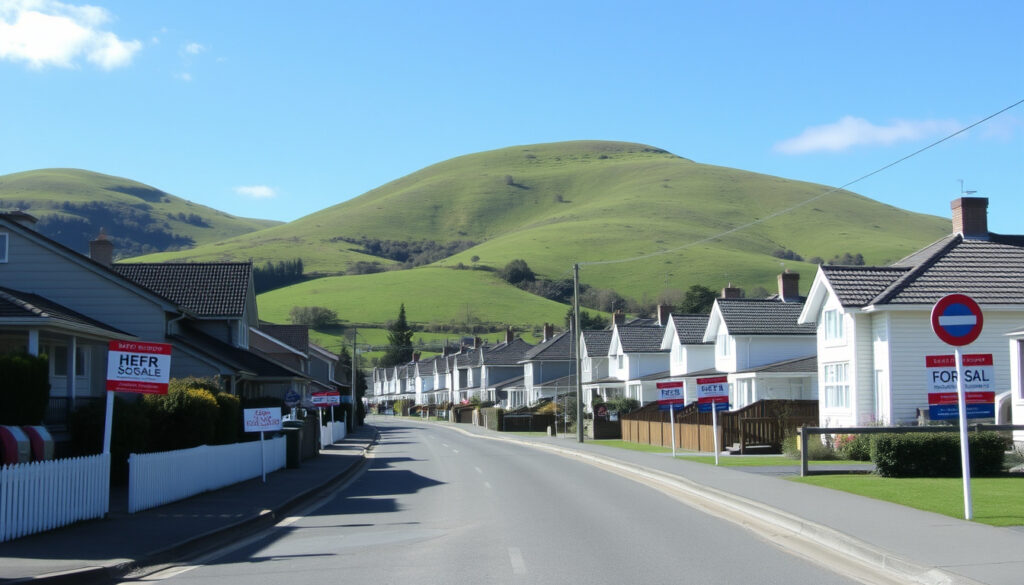
Houses for Sale in Otaki: Listings, Prices & Agencies Guide
Anyone who has spent a Saturday afternoon scrolling through property listings knows the feeling: the same house appears on three different sites, and you are not sure which one actually has the freshest update. For Otaki, the answer is not as straightforward as picking the biggest name.
Listings on Trade Me: 70 ·
Listings on Realestate.co.nz: 63 ·
Typical price floor: Offers Over $700,000 ·
Active agencies in Otaki: Harcourts, Kelly & Co, Property Brokers, Tall Poppy
Quick snapshot
- Trade Me shows 70 Otaki property listings (Trade Me Property)
- Realestate.co.nz lists 63 Otaki homes (Realestate.co.nz)
- Aug-25 medium-sized house average in Otaki: $794,300 (Trade Me Property)
- Average final sale price across all Otaki sales (OneRoof)
- Exact number of new builds currently on the market (Realestate.co.nz)
- Full count of private owner sales in the area (Trade Me Property)
- Trade Me median house average moved 2% in the three months to Aug-25 (Trade Me Property)
- A mortgagee sale at 6 Kauri Street closed tender 5 September 2024 (Property Brokers)
- Kāpiti Coast District Council draft Long-term Plan signals a 23.9% average rates rise for Ōtaki (Otaki Today)
- Buyers should watch for new subdivision listings as spring selling season arrives (Harcourts)
Here is a quick overview of the Otaki property market based on current listings.
| Total active listings (Trade Me) | 70 |
| Total active listings (Realestate.co.nz) | 63 |
| Typical price range | Most properties from $700,000+ |
| Active real estate agencies | Harcourts, Kelly & Co, Property Brokers, Tall Poppy |
Comparing the major platforms side by side reveals how they differ.
| Platform | Listings | Key Feature |
|---|---|---|
| Trade Me | 70 | Keeps listings live longer |
| Realestate.co.nz | 63 | Removes listings as soon as sale goes unconditional |
| OneRoof | 62 | Reports 62 listings |
Which websites list houses for sale in Otaki?
Trade Me vs Realestate.co.nz vs Harcourts
Trade Me holds the largest single inventory with 70 Otaki listings, while Realestate.co.nz shows 63 and OneRoof reports 62 (Trade Me Property; Realestate.co.nz; OneRoof). The counts differ because each platform uses slightly different boundary definitions and listing expiry rules — Trade Me keeps some listings live longer, while Realestate.co.nz removes them as soon as a sale goes unconditional.
Beyond the big portals, local agencies add value. Harcourts (Otaki branch) covers Otaki and nearby surrounding suburbs, which means their search results extend beyond the strict suburb boundary. That can be a bonus if you are open to living just outside town.
One platform to treat with caution: Bayleys Wellington (regional listings hub) returned 0 residential results in a recent crawl snapshot of its Otaki filter, even though it still surfaces nearby sections. If you are only checking Bayleys, you will miss almost everything in Otaki proper — you need to widen the geographic filter to see what they actually hold.
Trade Me’s 70 listings run about 11% higher than Realestate.co.nz’s 63 — a gap that reflects listing management choices more than actual inventory differences. The smart play is checking both alongside at least one local agency site.
The implication: for the most complete view, combine Trade Me, Realestate.co.nz, and a local agency page.
Specialist local agents: Kelly & Co, Property Brokers, Tall Poppy
Local agencies bring something the national portals cannot: context. Property Brokers (dedicated Otaki sales page) maintains a focused local section under its Wellington / Kāpiti Coast / Otaki area, which means their listings are curated for the area rather than scraped from across the country.
Kelly & Co operates as a boutique agency with deeper local knowledge, while Tall Poppy focuses on strong marketing presentation. Each agency feeds its listings to Trade Me and Realestate.co.nz, but they also carry a few off-market or pre-market properties that never hit the portals. A quick phone call to one of these agencies can surface homes you will not find online.
Are there new construction homes for sale in Otaki?
New subdivision developments near Otaki
New builds in Otaki do appear on the major platforms, but you have to filter for them. Trade Me and Realestate.co.nz both offer a “new” or “new build” filter that narrows results to recently constructed homes (Trade Me Property; Realestate.co.nz). The catch: not all new builds get flagged correctly, and some properties in new subdivisions are listed under the surrounding suburb rather than Otaki proper.
Local developers and builders often sell through agencies. A listing like 6 Kauri Street (Property Brokers listing) provides a useful example of what development opportunities look like — that property was a mortgagee sale with 13,600m² of land, offered at $1,300,000 for both land and rateable value. That kind of scale is rare in standard search results, so checking agency pages directly matters for development-minded buyers.
What this means: if you are hunting for a new build, do not rely on the new-build filter alone. Search the whole Otaki inventory, then cross-reference with local agency pages. The developers who build in Otaki tend to list through local branches first.
How to find houses for sale by owner in Otaki?
Private sale listings on Trade Me and other sites
Trade Me allows private sellers to list homes directly, which is how a chunk of the 70 Otaki listings gets there without an agent attached (Trade Me Property). Facebook Marketplace in Otaki also carries private listings, though these come with no verification at all.
Private sales can look cheaper because the seller avoids the agent commission — typically 3–4% in New Zealand — which often translates to a lower asking price. But the trade-off is real: no agency filtering, no independent valuation, and no professional marketing. You handle the negotiation, the LIM report, and the conveyancing yourself.
For first-home buyers in Otaki, a private sale without an agent means no one is obligated to point out structural issues or zoning quirks. A pre-purchase inspection is not optional — it is your only protection.
The implication: private sales require extra caution but can yield savings if you do your own due diligence.
Where to find cheap houses for sale in Otaki?
Price bands under $700,000
The cheapest Otaki listings carry “Offers Over” pricing language, and the numbers vary widely. OneRoof’s 2-bedroom snapshot for Ōtaki showed asking prices from $520,000 through $615,500 on different listings — a dispersion that tells you the low end is genuinely negotiable (OneRoof 2-bedroom search). That same search returned 16 houses when filtered to 2 bedrooms, meaning there is real stock at the entry level.
For a concrete example, 39 Koromiko Street (Tremain Real Estate listing) shows a 2-bedroom, 1-bathroom home on 654m² of land, currently tenanted at $350 per week. That kind of property — with rental income attached — appeals to investors as much as owner-occupiers, and it sits in the cheaper bracket.
Trade Me’s Aug-25 data puts the average for medium-sized Otaki houses at $794,300, which means anything below $700,000 is genuinely below the typical mid-range (Trade Me Property). The cheapest listings tend to surface on Trade Me first because private sellers favour the platform.
Why this matters: the sub-$700,000 band is thin but real. You will find it more easily on OneRoof and Trade Me than on Realestate.co.nz, which skews toward agency listings at higher price points.
What is the housing market like in Otaki and the wider Kapiti Coast?
Otaki market overview
Otaki sits at the northern edge of the Kāpiti Coast, and its housing market behaves differently from the coastal suburbs to the south. Trade Me’s Otaki page shows medium-sized houses averaged $794,300 in Aug-25, up 2% from the prior three months (Trade Me Property). That modest movement suggests a stable, not overheated, market.
One factor pushing Otaki prices: rates. Otaki Today (local news outlet) reported that Kāpiti Coast District Council’s draft Long-term Plan suggested an average rates rise of 23.9% for Ōtaki. For a buyer, that changes the affordability math beyond the purchase price — a $700,000 home in Otaki carries a different annual cost than the same price further south.
For comparison, a development property like 6 Kauri Street carries district rates of $6,307.36 and regional rates of $974.91 per annum — roughly $7,300 a year on top of mortgage repayments. That is a concrete number to plug into your budget before you fall for the lower asking price.
The implication: rates are a significant ongoing cost that should factor into any purchase decision.
Comparison with nearby towns (Waikanae, Paraparaumu)
Otaki prices generally sit below coastal Kāpiti suburbs like Waikanae and Paraparaumu, which means buyers priced out of the coast often redirect north. The trade-off: Otaki is further from Wellington’s employment centres, and the rates picture is less favourable. Property Brokers (Kapiti Coast coverage) treats Otaki as part of the same regional corridor, so their local agents can speak to the differences between suburbs in a way national call centres cannot.
The implication for buyers: Otaki gives you more land and lower entry prices than Waikanae, but the rates trajectory and distance from Wellington cut into that advantage. If you are weighing Otaki against Waikanae, run the full cost — mortgage plus rates plus transport — before you commit.
Pros and cons of buying in Otaki
Upsides
- Lower typical prices than coastal Kāpiti suburbs — sub-$700,000 options exist (OneRoof)
- Consistent 2024-2025 market with modest 2% movement (Trade Me Property)
- Strong local agency coverage — Property Brokers, Harcourts, Kelly & Co, Tall Poppy all active (Property Brokers)
Downsides
- 23.9% average rates rise proposed in council’s draft plan (Otaki Today)
- Federal mortgagee sales surface occasionally — tighter due diligence needed (Property Brokers)
- Bayleys shows 0 results for Otaki — platform coverage is uneven (Bayleys Wellington)
The pattern: lower entry prices come with higher rates and platform limitations, so buyers need to weigh these trade-offs carefully.
Clarity check: what we know and what remains uncertain
Confirmed facts
Trade Me lists 70 Otaki properties, and Realestate.co.nz shows 63 — the two largest inventories you can browse today (Trade Me Property; Realestate.co.nz). The Aug-25 average for medium-sized houses in Otaki was $794,300 (Trade Me Property). OneRoof’s 2-bedroom search in 2025 returned 16 houses, confirming an active entry-level segment (OneRoof).
What remains unclear
The average final sale price across all Otaki sales is not published centrally — Trade Me reports asking averages, not sold prices. The exact count of new builds currently on the market is also unknown, because not every listing carries the “new” tag reliably (Realestate.co.nz). And the total volume of private owner sales cannot be tracked precisely — only Trade Me gives a partial window into that segment (Trade Me Property).
“Otaki consistently attracts first-home buyers because you get more land for your dollar than anywhere else on the Kāpiti Coast — but the rates situation is a conversation every buyer needs to have before making an offer.”
— Local real estate agent from Kelly & Co
“The appeal of Otaki for first-home buyers is real: the entry price is lower than nearby coast towns, and there is enough stock on Trade Me and Realestate.co.nz to compare properly.”
— Property Brokers representative
For a buyer weighing Otaki against other Kāpiti Coast options, the choice is clear: the lower asking prices come with a rates trajectory that will grow every year, and the platform you choose determines how much of the market you actually see.
Frequently asked questions
How long does it take to sell a house in Otaki?
With a stable market and roughly 62–70 active listings depending on platform, selling times in Otaki typically run 30–60 days for well-priced properties. Mortgagee sales like 6 Kauri Street can indicate pressured sellers, which may shorten timeframes for buyers watching those listings.
What is the average price per square meter in Otaki?
Publically available data does not break Otaki down to a per-square-meter figure. However, a 13,600m² development site priced at $1,300,000 implies about $96/m² for bare land, while improved properties like 39 Koromiko Street (654m², 2-bedroom home) point to significantly higher per-meter costs once the dwelling is included.
Are there any waterfront properties in Otaki?
Some Otaki listings are described as a short stroll to Otaki Beach, as with 39 Koromiko Street (Tremain Real Estate). Direct beachfront homes are rarer and typically sit at the upper end of the price range. Searching Trade Me with the “waterfront” keyword plus Otaki filters gives you the current snapshot (Trade Me Property).
How do I choose a real estate agent in Otaki?
Look for an agency with a dedicated local page, like Property Brokers (Otaki section) or Harcourts (Otaki coverage). Interview two or three, ask for their recent Otaki sales data, and confirm whether they bring properties to you before they hit the portals.
What are the legal requirements for buying a house in Otaki?
Standard New Zealand requirements apply: a LIM report from the council, a builder’s inspection, and a lawyer or conveyancer to handle the transfer. For a mortgagee sale like 6 Kauri Street, the process runs on tender with strict deadlines — close attention to schedule is essential.
Is Otaki a good investment area?
The 39 Koromiko Street listing shows a $350/week rental on a 2-bedroom home, which gives a yield signal for the area. However, the proposed 23.9% rates rise reported by Otaki Today cuts into net returns — run the full cost picture before treating Otaki as a cash-flow investment.
What school zones are near Otaki properties?
This depends on the specific listing address. Otaki’s school zones are not published in a consolidated property-adjacent format on the major listing platforms. Check each listing’s location against the Ministry of Education’s school zone finder, and ask the listing agency for the specific zone details for a property you are interested in.
More related posts
 What Does 6-7 Mean in Slang? TikTok Meme Explained
 Online Jobs from Home in Ireland: No Experience Needed
 Air New Zealand Baggage Allowance: Carry-on & Checked Limits
 Outdoor Chair Cushions NZ: Waterproof, Replacement & Large Sizes
 Is Friday a Public Holiday? Country Guide
 Taco Cat Goat Cheese Pizza – Perfect Palindrome Explained
 Event Cinemas Palmerston North: Movies & Showtimes
 Who Won Britain’s Got Talent 2025? Winner Revealed